Kuwait seeking to diversify economy away from oil
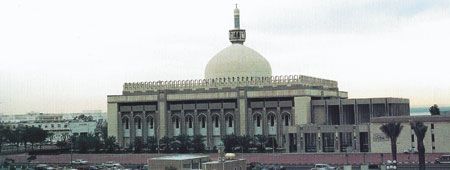
The Grand Mosque is the largest in Kuwait. The dome of the mosque is 25 meters in diameter and 43 meters high,and is decorated with the “Asma al-hosna,” or 99 names of God. Courtesy of Kuwaiti Embassy
Kuwait has a wealthy, relatively open economy as its gross domestic product (GDP) stood at $165.9 billion in 2012 with a real growth rate by 6.3 percent, while the GDP per capita has reached $43,800 in 2012.
Crude oil reserves of about 102 billion barrels, about 14.8 percent of the world’s oil reserves of crude oil and is among the world’s largest oil producers. So that oil and oil-related products naturally would dominate the economy of Kuwait which accounts for over half of gross domestic output.
Kuwait produces 3.1 million barrels of oil per day, but the Kuwaiti government is ambitious to increase oil production to 4 million barrels per day by 2020. The rise in global oil prices throughout 2011 and 2012 is reviving government consumption and economic growth.
In 2010, Kuwait passed an economic development plan that pledges to spend up to $130 billion over five years to diversify the economy away from oil, attract more investment, and boost private sector participation in the economy especially in areas like technology, education, and health care and alongside the older and better established sectors.
Kuwait is vying to become a regional financial and trade center and its government has embarked on an ambitious five-year plan to reach this goal. And while some of the required infrastructure has been built, much remains to be done as the government strives to accelerate the execution of large projects alongside GCC-wide schemes such as the 25 billion dollar GCC (Gulf Cooperation Council) railway network.
for Kuwait were South Korea (17.7 percent), India (15.3 percent), Japan (13.7 percent), China (9.6 percent) and the United States (8.4 percent).
On the other hand, imports reached $24.1 billion and most of imported items are food, construction materials, vehicles and parts and clothing. Top imports partners were the U.S. (12.4 percent), China (9.7 percent), Saudi Arabia (8.4 percent), South Korea (6.5 percent), India (6.4 percent), Japan (6.2 percent), Germany (5 percent) and UAE (4.3 percent).