Iran requests use of frozen money 'to purchase $1 billion worth of medical equipment'
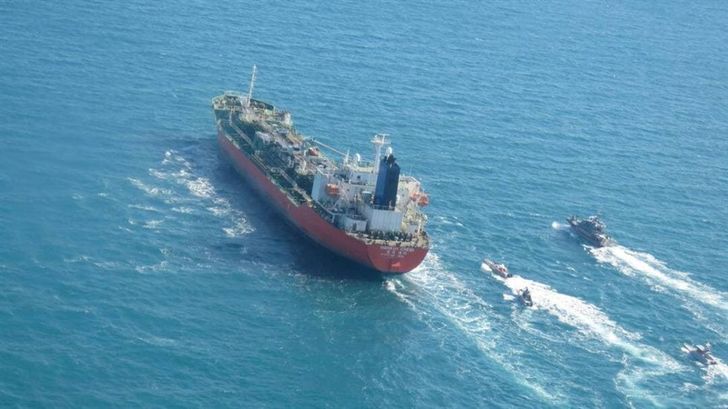
A Korean-flagged tanker which was seized by Iran. is seen in the Gulf, Iran, Jan. 4, 2021. Reuters
Iran made a request to South Korea for the use of its money frozen under U.S. sanctions to purchase $1 billion worth of medical equipment, a diplomatic source has said, stressing Tehran's wish to unlock its massive assets here.
The source mentioned the request amid tensions between Seoul and Tehran over the frozen assets, known to be $7 billion in total, and over this week's seizure of a South Korean-flagged oil tanker on allegations of environmental pollution.
"Iran has made a request to South Korea to purchase $1 billion worth of medical equipment from $7 billion (frozen) in Korea," the source told Yonhap News Agency on condition of anonymity on Wednesday.
Besides the call for the medical equipment, Iran has requested the use of $10 million or more from the frozen assets to purchase COVID-19 vaccines from the COVAX facility, a global vaccine procurement mechanism.
But Iran remains concerned that its money in the Korean currency won could be frozen again in the process of wiring it to the facility after the dollar conversion at a U.S. bank under the supervision of American regulators.
"Under U.S. law, if Iranian money goes through a U.S. bank, it is to be frozen. We cannot agree to that remittance," he said, noting Korea has yet to assure Iran that it would guarantee the safe transfer of the money.
Iran's assets at two Korean bank accounts have been frozen as the Donald Trump administration withdrew from a landmark nuclear deal with Iran in 2018 and tightened sanctions against the Islamic Republic.
South Korea and Iran had used the accounts based on the Korean currency to continue Korea's imports of oil and its exports of goods to Iran despite U.S. sanctions banning dollar-based transactions with Iran.
The source hinted that Iran hopes that Vice Foreign Minister Choi Jong-kun will bring a practical solution to the issue of the frozen money when he visits Tehran next week.
"Candidly speaking, I think South Korea has wasted time over the last two years without taking good measures," the source said. "Iran is hoping that Vice Foreign Minister Choi will come with a program that will allow Iran to use the money."
Iran has recently been stepping up calls for Seoul to find a way to unlock the assets, as it has been facing shortages of medicine and medical equipment under crippling U.S. sanctions and the COVID-19 pandemic.
The source rejected the notion that this week's seizure of the Korean oil tanker might be linked to the issue of the frozen assets.
"It would be an excessive interpretation to link this matter to Iran's efforts to regain the frozen funds," he said, stressing that the seizure is a "technological" response to water pollution by the vessel.
"There is a process of releasing oil or injecting water to keep the balance of a ship. There might not be a problem in a big ocean, but the Persian Gulf is a special region where an environmental issue is a serious matter," the source said.
The South Korean delegation, led by Koh Kyung-sok, director-general of the foreign ministry's Africa and Middle Eastern affairs, is set to arrive in Tehran later in the day to seek an early release of the seized ship and its 20 crew members, including five Koreans.
The source also pointed out that the Iranian president has sent a letter to President Moon Jae-in twice and that there have been replies but "no practical action" taken by South Korea. (Yonhap)