KOSPI sinks below 2,000, despite state intervention
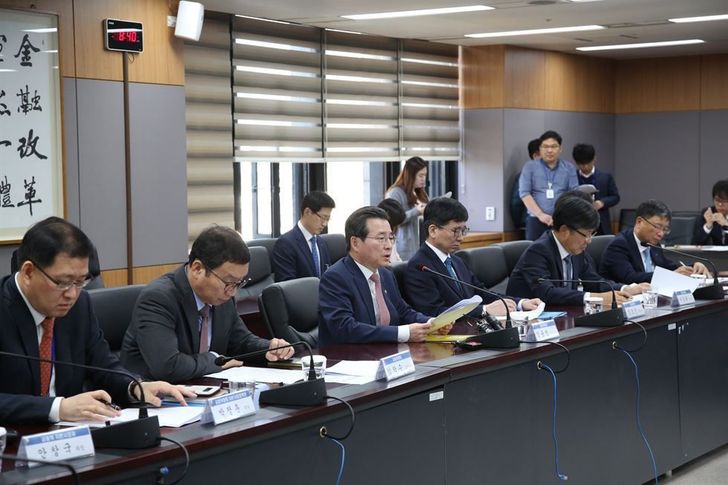
Financial Services Commission (FSC) Vice Chairman Kim Yong-beom, third from left, holds a meeting to check the stock market at the FSC headquarters in Seoul, Monday. Courtesy of FSC
Foreigners to shun stocks amid weak outlook, analysts say
By Park Hyong-ki
Foreign investors continued to dump Korean stocks Monday, despite the financial regulator's pledge to allocate funds to further invest in small-cap tech companies.
Stocks tumbled below 2,000 for the first time in 22 months.
The benchmark KOSPI closed at 1,996.05, down 1.53 percent or 31.10 points as foreign investors continued to shun and dump Korean stocks worth 160 billion won ($140 million) Monday. The tech-heavy Kosdaq shed 5.03 percent, or 33.37 points, closing at 629.70, according to the Korea Exchange (KRX).
In an emergency meeting with executives from brokerage houses in Seoul, Oct. 29, Financial Services Commission (FSC) Vice Chairman Kim Yong-beom said the government will allocate 500 billion won ($440 million) to stabilize the stock market.
The regulator will do so with the securities companies and invest in undervalued small tech companies listed on the tech-heavy Kosdaq.
“Our initial plan was to deploy 200 billion won for the Kosdaq. The government will increase it to 300 billion won. Also, an additional 200 billion won will be allocated to invest in KOSPI- and Kosdaq-listed companies as we monitor the market,” Kim said.
He added the FSC will work closely with the Financial Supervisory Service (FSS) and the KRX to clamp down on irregular trading and disclosure practices such as naked short-selling in an effort to further stabilize the market.
The state measures take after that of China, which stated Oct. 18 that its central bank and securities regulators would support investors and funds when investing in small-cap companies that are facing difficulties in raising money.
China's stock market has been spiraling downward amid growing concerns over its prolonged trade dispute with the United States and gloomy prospects of the world's second-largest economy.
As in China, whose stock market continues to suffer despite the measure, Korean stocks are expected to get slammed going forward for similar reasons.
“The measure here follows China. Foreign capital could further shun or exit the market as the country's economic outlook remains bleak,” said Kim Doo-un, an economist at KB Securities.
“On top of that, the interest rate gap between here and the U.S. is not going to narrow. This could cause more foreign funds to exit over the next year.”
The analyst added that the question is how much can Korea withstand the rate gap amid the economic slowdown?
Historical data showed the economy will be able to bear a gap as wide as 100 to 150 basis points, Kim noted.
The rate gap stood at 100 basis points from May 2006 to July 2006 when the Bank of Korea's (BOK) rate was 4 percent and the Federal Reserve's was 5 percent. Both raised their rates by 25 basis points in June 2006.
“The market here will have to inevitably accept the fact that the gap will increase given the country's economic condition,” he said, noting the BOK will not be able to hike its rate as fast as the Fed.
Foreign investors unloaded KOSPI and Kosdaq-listed shares worth more than 4 trillion won from Oct. 1 to 26, coming close to the record of 4.3 trillion won in August 2015, according to the KRX.