Why Starbucks conquered South Korea — but not Vietnam
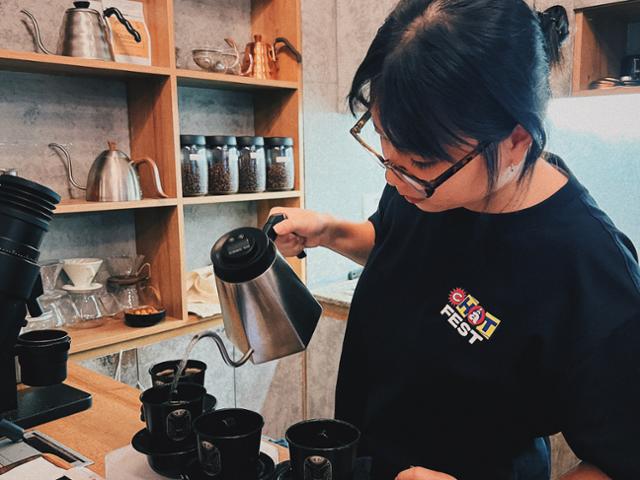
A cafe worker prepares coffee using a phin filter at a cafe in Hanoi, Vietnam. Hankookilbo
HANOI, Vietnam — On nearly every street, there is a cafe. People sit on low plastic stools, sipping coffee and passing the time. Motorcycle riders pull over at the side of the road for a quick coffee break.
Here, even the world’s largest coffee company, Nestle, and Starbucks — the emblem of American coffee culture — struggle to assert their presence.
This is Vietnam.
The country is the world’s second-largest coffee producer. According to data from the U.S. Department of Agriculture, Brazil accounts for about 39 percent of global output, followed by Vietnam at 17 percent.
As of 2023, Vietnam’s coffee-growing area totaled roughly 715,800 hectares (2,764 square miles), larger than South Korea’s entire rice-growing area. The country produces about 1.8 million tons of coffee annually.
Of those 1.8 million tons, robusta beans account for around 95 percent. Alongside Brazil’s arabica, it is one of the most widely produced coffee beans globally and is commonly used in instant coffee due to its strong bitterness.
People sit on low outdoor stools, drinking coffee and chatting, in Hanoi, Vietnam. Hankook Ilbo
The roots of Vietnamese coffee trace back to the French colonial era. First introduced by French missionaries in the nineteenth century, coffee cultivation spread rapidly across the Central Highlands region, where the climate and soil proved well suited to growing robusta beans.
Today, the coffee industry has become an important pillar of Vietnam’s economy. The sector accounts for about 3 percent of gross domestic product and generates between $7 billion and $8 billion in annual export revenue.
Coffee production alone employs around 550,000 people. Meanwhile, the number of cafes nationwide is estimated at roughly 500,000, generating about $1.46 billion in sales.
Coffee from Vietnamese local brand Trung Nguyen. A phin filter sits atop the cup for brewing, while condensed milk, right, is served separately to allow customers to adjust sweetness. Hankook Ilbo
Vietnamese coffee is often described as both intense and sweet. The most popular drink, “ca phe sua da,” is made by brewing strong coffee through a metal drip filter known as a “phin,” then mixing it with sweetened condensed milk and ice. The name literally translates to “coffee with milk and ice,” and it is commonly known as Vietnamese iced coffee.
The phin is a traditional tool used in Vietnamese coffee making. It is a small metal brewer perforated with tiny holes that sits directly atop a cup, allowing for a slow extraction that deepens flavor and accentuates bitterness.
Sweetened condensed milk is widely believed to have been introduced to soften robusta’s sharp edge. Another explanation traces its use to earlier decades, when refrigeration was limited and fresh milk was difficult to store, making condensed milk a practical alternative that ultimately became a signature ingredient.
Other ingredients are used to soften the bitterness of Vietnamese coffee. Among the most common are coconut and egg yolk, which give rise to popular variations such as coconut coffee and egg coffee.
By contrast, the American-style Americano — so commonly consumed in South Korea — remains a niche order in Vietnam.
“The most common and best-selling drink among Vietnamese customers is still ca phe sua da,” said Tu Hang, 24, who works at a hand-drip coffee shop in Hanoi. “Foreign customers tend to choose milder options, such as lattes or egg coffee.”
Vietnamese egg coffee, made with egg yolk / Hankook Ilbo
Local chains dominate the market
Coffee consumption in Vietnam largely takes place in two settings: roadside stalls and full-service cafes. Simple takeaway counters, similar to pushcart coffee vendors in South Korea, are also common. People rarely walk while drinking coffee; commuters usually stop their motorbikes briefly, pick up a cup and continue on.
Since the 1990s, Vietnam has seen the rapid expansion of branded coffee shops. Franchises such as Highlands Coffee, the country’s largest coffee chain; Trung Nguyen, a high-end coffee brand; Phuc Long, which specializes in coffee and tea; and Cong Caphe, known for its Vietnam War-era aesthetic, now dominate the domestic market.
According to local research firm Q&Me, Vietnam had 4,658 coffee franchise outlets last year — an increase of about 10 percent from the year before.
ShopeeFood delivery riders wait to pick up drinks at a Phuc Long coffee and tea shop. Hankook Ilbo
In this environment, global brands struggle to gain traction. Starbucks, which entered Vietnam in 2013, opened only its 100th store in 2023.
Given Vietnam’s population of roughly 100 million, that amounts to about one store per 1 million people — a stark contrast with South Korea, where Starbucks operates about 36 stores per 1 million people.
Market research firm Euromonitor International estimates that Starbucks holds just 2 percent of Vietnam’s coffee market, valued at roughly $1.2 billion.
Analysts say the company has failed to fully align with local tastes. Vietnamese consumers accustomed to bold, bitter robusta beans have shown limited interest in Starbucks’ all-arabica offerings. Euromonitor says Starbucks’ presence in Vietnam “remains constrained by consumer preferences for local coffee flavors.”
Price differences also matter. A cup of ca phe sua da from a street stall typically costs between 15,000 and 20,000 dong (about $0.60), while coffee at local cafes rarely exceeds 40,000 dong. By contrast, a Starbucks Americano costs around 60,000 dong, and a latte about 70,000 dong — more than double local prices. Demand among young consumers is rising, but foreign customers still make up much of Starbucks’ core clientele.
Commuters stop to buy coffee on their motorbikes during the morning commute in Ho Chi Minh City, Vietnam. Hankook Ilbo
Climate change threatens the harvest
Vietnam’s coffee industry, however, now faces a different set of challenges. The biggest threat is climate change. Last year, El Nino conditions brought alternating droughts and heavy rains. Dry spells hit during the growing season, while intense downpours arrived during harvest, reducing yields. Bean production fell by about 10 percent from the previous year.
In November, record rainfall inundated coffee farms across central provinces such as Dak Lak, causing the worst flooding in three decades. A local trader told Reuters that farmers harvested only 10 to 15 percent of their crop and struggled to dry beans amid persistent rain.
Conservation International, an American nonprofit organization, projects that by 2050, land suitable for robusta cultivation in Vietnam could shrink to about half of today’s area.
“Vietnam’s robusta production has reached a turning point,” said Peter Laderach, principal scientist at the International Center for Tropical Agriculture, warning that “droughts and floods are increasingly undermining annual harvests.”
A worker inspects a durian at a farm in Tan Phu, Dong Nai province, Vietnam. Hankook Ilbo
Another factor in diminishing coffee production is farmers turning to different crops. As Chinese demand for durian surged in recent years, many growers uprooted coffee trees to plant the fruit, which offers higher returns. Vietnamese media outlet Dan Viet reports that coffee generates about 100 million dong per hectare annually, while durian can earn 500 million to 700 million dong. A common saying now holds that one durian fruit can match the value of an entire coffee tree.
Lower supply has pushed prices higher. Robusta futures traded in London stood at $3,964 per metric ton as of Jan. 1. Prices peaked at $5,694 a year earlier and remain well above levels seen two or three years ago.
A new cafe formula for younger consumers
Coffee prices are unlikely to stabilize quickly. Coffee trees require three to five years to produce harvestable beans, and yields — highly sensitive to weather — will continue to be threatened by climate change.
At the same time, changes are also unfolding on the demand side. In the past, cafes were centered on coffee itself. Since the 2000s, however, new cafes built around a variety of themes — such as book cafes — have emerged. More recently, health-conscious trends have boosted demand for tea, yogurt smoothies and other non-coffee drinks.
Younger consumers, in particular, are placing growing emphasis on atmosphere and visual appeal. Social media-driven cafe hopping has fueled demand for colorful fruit lattes and tea-based drinks designed for online sharing.
A representative at the Hanoi office of the Korea Trade-Investment Promotion Agency says Vietnam’s cafe market is rapidly reorganizing around experience-driven consumption, led by millennials and Generation Z. “While strong robusta-based coffee remains central, consumers are increasingly embracing matcha, low-sugar options and vegan offerings,” the official said.
A coffee shop in Hanoi, Vietnam / Hankook Ilbo
This article from the Hankook Ilbo, the sister publication of The Korea Times, is translated by a generative AI system and edited by The Korea Times.