Japanese in Hong Kong defend Japan's decision to discharge Fukushima radioactive water
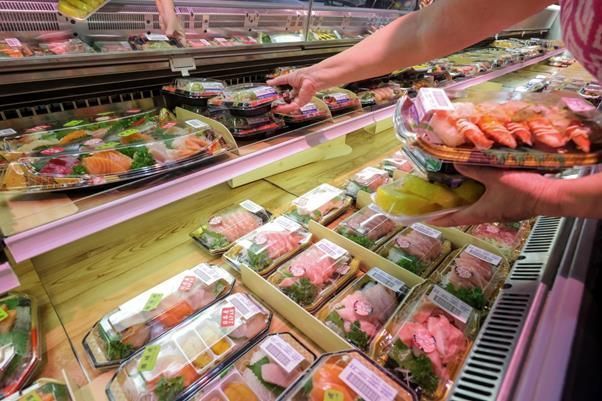
A Hong Kong ban on aquatic produce such as seafood from the Fukushima area and 10 other Japanese prefectures kicked in at midnight on Wednesday. Courtesy of Jelly Tse
Japanese people living in Hong Kong have brushed aside concerns over seafood safety as the release of treated radioactive water from the disabled Fukushima nuclear plant started and some insisted the controversy had become "very political".
Fujimoto, a banker who has worked in the city for 13 years, said fears over the discharge's long-term effects on the ocean food chain were groundless.
He said he was confident that Japanese seafood would still be safe to eat after Tokyo started to release the treated waste water, which contains radioactive tritium, into the Pacific Ocean on Thursday.
"The International Atomic Energy Agency (IAEA) has approved [Japan's plan]. According to some scientific studies, China has released more radioactive [material] than what Japan will release," he told the Post.
The Japanese Ministry of Economy, Trade and Industry, earlier said one of China's nuclear plants, Qinshan, had discharged 143 terabecquerels ― a unit of radioactivity ― of tritium in liquid form in 2020, compared to the less than 22 terabecquerels of tritium that would be released from the Fukushima plant every year.
Fujimoto said he felt that the ban by some parts of the region was a "political" gesture.
"Other countries have accepted the proof and evidence provided by the IAEA, but only China does not accept it," he said.
He was speaking after the release of the treated water from the tsunami-crippled Fukushima nuclear plant started and sparked mixed reactions in Asia.
Local fishes are displayed in a tank at a wholesale market that used to sell Japanese seafood affected by the city's import ban, in Hong Kong, Thursday. AP-Yonhap
Beijing, Hong Kong and Macau imposed bans on seafood imports from 10 prefectures, but South Korea and Taiwan took no action.
But Fujimoto said: "If the Chinese and Hong Kong governments consider the seafood is not safe at all, they will ban those from all the prefectures."
He admitted, however, that the Japanese government could have done a better job of explaining why it decided to discharge the water into the sea instead of keeping it in storage.
The Hong Kong ban, which came into force at midnight on Wednesday, covers the import and supply of aquatic products "live, chilled, frozen, dried or otherwise preserved", as well as sea salt and raw or processed seaweeds, from the blacklisted prefectures.
Chief Executive John Lee Ka-chiu earlier slammed Japan for "imposing its problems on others irresponsibly", after the country said it would release 1.32 million metric tonnes, equivalent to 500 Olympic swimming pools, of treated radioactive water over three decades.
Tokyo earlier said most radioactive elements would be filtered out of the effluent, except tritium, an isotope of hydrogen difficult to separate from water.
But the Japanese authorities insisted the treated water would be diluted to well below internationally approved levels of tritium before it was pumped into the sea.
Antony Blinken, the US Secretary of State, said last week that Washington considered Tokyo's plan to be in line with international standards.
The South Korean government has also said it accepted the IAEA's approval and that its study had established that the water to be discharged met international standards.
Seafood prepared by sushi chef Jasy Choi is seen in a kitchen he runs for takeaway Japanese food in Hong Kong, Thursday. AFP-Yonhap
Mari, who has lived in Hong Kong for 30 years, said she was not concerned about the release of the water because of the IAEA's green light.
"The discharge is scientifically proven to be safe. If people feel that they are not comfortable with eating Japanese seafood, it should be their own choice to decide whether to eat it or not," she said.
Mari said that Japanese friends who operated restaurants in Hong Kong had said they were worried the controversy might damage their businesses.
"They are worried that it may take longer for the imports to pass through customs as the seafood has to be tested. The freshness of the food may decline," she said.
Mainland China is Japan's largest market for fisheries exports, with Hong Kong in second place.
Hong Kong government figures show the city imported about 75.5 billion yen ($536 million) of Japanese marine produce in 2022, more than 20 per cent of the country's exports in the sector that year.
Toyama, who has worked in Hong Kong for 12 years, said he also noticed that the number of reservations had dropped significantly at the Japanese restaurant where he is a regular customer, making it much easier to get a table.
But he suggested the effluent from Fukushima might not affect waters distant from the site because of Japan's geography and length of coastline. (SCMP)