Trump suspends arms treaty, citing Chinese, Russian threats
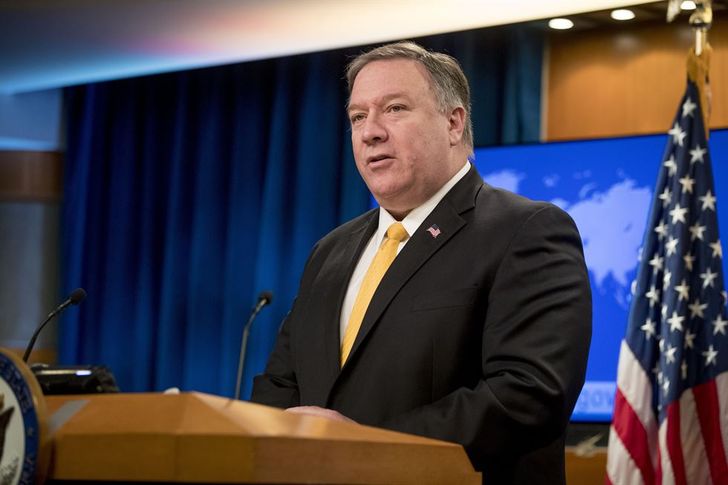
Secretary of State Mike Pompeo speaks at a news conference at the State Department in Washington, Friday. AP-Yonhap
The Trump administration is pulling the plug on a decades-old nuclear arms treaty with Russia, lifting what it sees as unreasonable constraints on competing with a resurgent Russia and a more assertive China.
The move announced Friday sets the stage for delicate talks with U.S. allies over potential new American missile deployments.
In explaining his decision, which he foreshadowed months ago, U.S. President Donald Trump accused Moscow of violating the 1987 Intermediate-Range Nuclear Forces treaty with “impunity” by deploying banned missiles. Moscow denies it is in violation and has accused Washington of resisting its efforts to resolve the dispute.
Democrats in Congress and some arms control advocates criticized Trump's decision as opening the door to an arms race.
“The U.S. threat to terminate the treaty will not bring Russia back into compliance and could unleash a dangerous and costly new missile competition between the United States and Russia in Europe and beyond,” the private Arms Control Association said. It argued that Washington had not exhausted options for drawing Russia back into compliance.
Trump said in a statement that the U.S. would “move forward” with developing its own military response options to Russia's banned deployment of cruise missiles that could target Western Europe.
“We cannot be the only country in the world unilaterally bound by this treaty, or any other,” Trump said. Other officials said the treaty could still be saved if Russia reversed course and returned to compliance, but that window of opportunity will close in six months when the American withdrawal is due to take effect.
The Trump decision reflects his administration's view that the arms treaty was an unacceptable obstacle to more forcefully confronting not only Russia but also China. China's military has grown mightily since the treaty was signed, and the pact has prevented the U.S. from deploying weapons to counter some of those being developed in Beijing.
Leaving the INF pact, however, risks aggravating relations with European allies, who share the administration's view that Russia is violating the treaty, but who have not endorsed a U.S. withdrawal.
Secretary of State Mike Pompeo, speaking to reporters after Trump's statement, said Russia would be formally notified on Saturday that the U.S. was withdrawing from the treaty, effective in six months. In the meantime, starting Saturday, the U.S. suspended its obligations under the treaty.
Pompeo said that if, in the coming six months, Russia accepted U.S. demands that it verifiably destroy the cruise missiles that Washington claims are a violation, then the treaty could be saved. If it did not, “the treaty terminates,” he said.
Administration officials have dismissed concerns that the treaty's demise could trigger a race to develop and deploy more intermediate-range missiles. U.S. officials have emphasized their fear that China, which is not party to the treaty, was gaining a significant military advantage in Asia by deploying large numbers of missiles with ranges beyond the treaty's limit.
Whether the U.S. will now respond by deploying INF non-compliant missiles in Asia is unclear. In any case, it seems unlikely Beijing would agree to any negotiated limits on its weaponry.
Russia accused the U.S. of unilaterally seeking to neuter the treaty.
“I 'congratulate' the whole world; the United States has taken another step toward its destruction today,” said Konstantin Kosachev, head of the foreign affairs committee in Russia's upper house of parliament.
INF was the first arms control measure to ban an entire class of weapons: ground-launched cruise missiles with a range between 500 kilometers and 5,500 kilometers. At the time, in the late stages of the Cold War, the U.S. and its allies were mainly concerned by the perceived threat of Russian medium-range nuclear missiles that were aimed at Europe. The U.S. deployed similar missiles in response, in the 1980s, leading to negotiations that produced the INF treaty.
Rep. Adam Smith, a Washington state Democrat and new chairman of the House Armed Services Committee, blasted Trump for raising the risk of nuclear war.
“The administration's ideological aversion to arms control as a tool for advancing national security is endangering our safety, as well as that of our allies and partners,” Smith said. “The risk of miscalculation or misunderstanding is already higher than at any point since the end of the Cold War, and this decision only makes it worse.”
U.S. officials say they have little reason to think Moscow will change its stance in the next six months.
“We have raised Russia's noncompliance with Russian officials ― including at the highest levels of government ― more than 30 times,'' Pompeo said. “We have provided Russia an ample window of time to mend its way. Tomorrow that time runs out.”
Jens Stoltenberg, the NATO secretary-general, said on Friday that Russia could still save the treaty by returning to compliance before the U.S. withdrawal took effect.
“But at the same time, we have started to assess the consequences, look into options,” Stoltenberg said. “We need to make sure that we respond as an alliance, all 29 allies, because all allies are involved and all allies are affected.”
Trump said his administration would move forward with developing military response options. But senior Trump administration officials said they did not expect any immediate testing or deployment of weapons that were banned under the treaty.
The current Pentagon budget includes $48 million for research on potential military responses to the alleged Russian violations, but U.S. officials said the options did not include a nuclear missile.
The officials, speaking after Trump's announcement, said the U.S. was not in position to flight test, let alone deploy, INF noncompliant missiles as a counter to Russia any time soon. The officials spoke on condition of anonymity under ground rules set by the White House.
One official said allies would be consulted before any decisions were made on responding to any Russian missiles.
Leaving the treaty would allow the Trump administration to counter the Chinese, but it' is unclear how it would do that. U.S. security concerns are complicated by what U.S. intelligence officials earlier this week called efforts by China and Russia to expand their global influence, particularly in Asia and the Middle East.
“China and Russia are more aligned than at any point since the mid-1950s, and the relationship is likely to strengthen in the coming years as some of their interests and threat perceptions converge,” Director of National Intelligence Dan Coats told Congress on Tuesday. (AP)