Japanese microbiologist Yoshinori Ohsumi wins Nobel prize in medicine
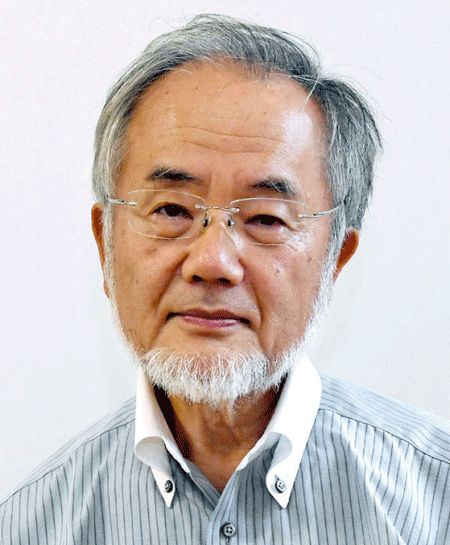
Yoshinori Ohsumi / Yonhap
By Park Si-soo
Japanese microbiologist Yoshinori Ohsumi has won the 2016 Nobel Prize in medicine for his work on cell autophagy, a process that helps the body remove unwanted proteins but can also lead to conditions such as Alzheimer’s disease.
Ohsumi, 71, of the Tokyo Institute of Technology, is credited with discovering the mechanisms that allow cells to break down and recycle unwanted components. They enclose the item in a sack and then transport it to a recycling unit known as a lysosome for destruction.
“Difficulties in studying the phenomenon meant that little was known until, in a series of brilliant experiments in the early 1990s, Yoshinori Ohsumi used baker’s yeast to identify genes essential for autophagy,” the Nobel committee said in its citation on Monday. “He then went on to elucidate the underlying mechanisms for autophagy in yeast and showed that similar sophisticated machinery is used in our cells.”
It said his work led to understanding of the “fundamental importance” of autophagy in many physiological processes, such as in the adaptation to starvation or response to infection.
Ohsumi told NHK by phone he felt “very honored” when he heard the news.
He is the 25th Japanese to win a Nobel prize, including individuals who later obtained citizenship of other countries, and he is the fourth to win the medicine prize.
Ohsumi is expected to attend the Nobel awards ceremony Dec. 10 in Stockholm, where he will also receive a prize of 8 million kroner ($930,000).