President’s panda request revives debate over animal diplomacy
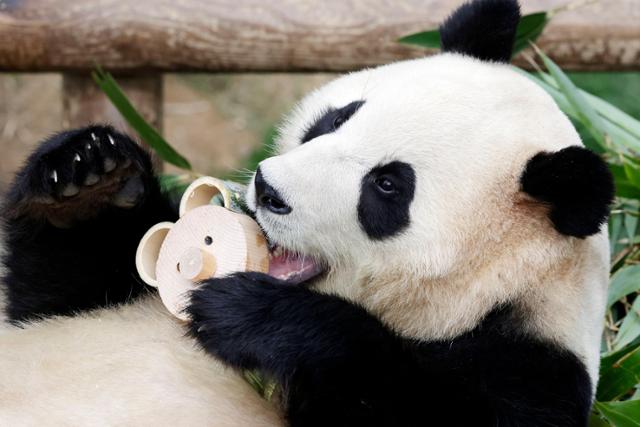
Giant panda Fu Bao lies down holding a bamboo toy at Everland's Panda World in Yongin, Gyeonggi Province, Mar. 3, 2024. Joint Press Corps
On Jan. 7, the final day of his state visit to China, President Lee Jae Myung explained the reasoning behind his surprise request for an "additional panda loan" during the Korea-China summit.
Speaking at a press conference, Lee revealed that after South Korea returned a pair of Qing Dynasty stone lion statues to China, he asked for the return of the giant panda Fu Bao, who was sent back to China two years ago.
While Seoul and Beijing are currently in working-level talks regarding the lease, the practice of "animal diplomacy" — treating living creatures as diplomatic gifts — has once again come under fire. Animal rights groups are condemning the tradition as anachronistic and calling for the withdrawal of the loan request.
It remains unclear whether the pandas will be loaned. During the summit with Chinese President Xi Jinping on Jan. 5, Lee requested a pair of pandas to promote bilateral ties, suggesting Uchi Park Zoo in Gwangju as a candidate site. After a positive response from China, the Ministry of Climate, Energy and Environment and the Ministry of Foreign Affairs began working-level consultations. The government, however, says nothing has been finalized.
Speculation is mounting over whether the leased panda will be Fu Bao. Born in 2020 to Ai Bao and Le Bao — a pair loaned by China in 2016 — Fu Bao spent three years at Everland before moving to China in April 2024. Under the lease contract of pandas, offspring of leased pandas born abroad are considered Chinese property and must be returned before they turn four.
Fu Bao fans are eagerly awaiting a possible return. The "Bulssi" (Spark) Campaign and the Fu Bao Protection Alliance, which have held rallies demanding better living conditions for the panda in China, plan to hold a candlelight rally near the Chinese Embassy on Jan. 16 to urge her return.
From ancient giraffes to modern pandas
Former President Moon Jae-in pets Gomi, a Pungsan dog, at the presidential residence in Seoul in this November 2018 photo. Yonhap
The history of animal diplomacy dates back to ancient times. Records show that Queen Cleopatra of Egypt may have sent a giraffe to Julius Caesar, and Empress Wu Zetian of the Tang Dynasty sent pandas to the Japanese royal family.
The practice involves sending a nation's rare animals to other countries to boost diplomatic "soft power." China is famous for its "panda diplomacy," while Australia uses "koala diplomacy."
South Korea has a long history of receiving or gifting animals. A notable starting point for animal diplomacy was 1994, when the Kim Young-sam administration leased a pair of pandas (Lili and Ming Ming) from China.
Former President Kim Dae-jung exchanged two Pungsan dogs from North Korea (Uri and Duri) for the South's Jindo dogs during the 2000 inter-Korean summit. The Lee Myung-bak administration received crested ibises from China in 2008, and the Park Geun-hye administration leased pandas Ai Bao and Le Bao in 2016.
Former President Moon Jae-in received Pungsan dogs Gomi and Songgang from the North in 2018. Former President Yoon Suk Yeol, known for living with 11 pets, brought two Alabai (Central Asian Shepherd) dogs (Happy and Joy) — the national dog of Turkmenistan — to his residence.
Destined for display: Grim reality of animal diplomacy
Former President Yoon Suk Yeol and first lady Kim Keon Hee hold Alabai puppies, the national dog of Turkmenistan, during a state dinner at a hotel in Ashgabat, Turkmenistan, Jun. 10, 2024. Courtesy of the Presidential Office
What happens to these animals once the diplomatic fanfare fades? Most are transferred to zoos after receiving fleeting public attention.
The Pungsan dogs Uri and Duri were sent to Seoul Grand Park just six months after arriving in 2000 and died there in 2014. Gomi and Songgang, raised by Moon after his retirement, were eventually sent to Uchi Park Zoo. Their puppies were scattered to local governments nationwide, with two sent to the Goseong Unification Observatory. The Alabai dogs, Happy and Joy, were also moved to Seoul Grand Park. They were effectively reduced to mere exhibition animals.
Some animals become burdens due to high upkeep costs. Pandas Lili and Ming Ming arrived in 1994 on a 10-year loan but were returned after just four years due to the economic strain of the 1997 Asian financial crisis. China charges an annual lease fee of approximately 1 billion won ($680,000) per pair, calling it a "Panda Protection Fund."
Animal rights groups point out that animals and diplomacy are fundamentally incompatible.
"Animals have agency over their own lives, so they should not be used as diplomatic tools that can change at any moment," said Kim Young-hwan, a director at Korea Animal Rights Advocates.
Recently, as diplomatic friction deepened between Tokyo and Beijing, Japan returned two pandas to China a month ahead of schedule, highlighting the precarious nature of these arrangements.
Animal diplomacy at odds with welfare pledge
Fu Bao stays in her indoor enclosure for quarantine and health checks ahead of her return to China in this March 2024 photo. Courtesy of Everland
Activists argue that diplomacy should be conducted strictly between people. They point out that cross-border transport and adaptation cause immense stress to animals, and that the scientific justification of "biodiversity research" often disguises the real purpose of commercial gain.
"No matter how much better public zoos may be than private ones, captive environments cannot be better than natural habitats," said Lee Hyung-ju, head of the Animal Welfare Advocacy, Research and Education (AWARE). "Joint research, often cited to justify panda diplomacy, has produced almost no tangible results. Simply breeding more animals in captivity has nothing to do with conservation."
Critics also note a contradiction in the Lee administration's policies. They argue it is ironic for a government that included "animal welfare" as a national agenda item to use animals as diplomatic tools.
"There are still 119 farmed bears in Korea," said Lee Won-bok, head of the Korea Association for Animal Protection, referring to the ban on bear farming that took effect this year. "The government should be focusing its budget and resources on relocating these bears, yet it is only interested in leasing pandas."
Experts are also calling for the government to set clear principles on animal ethics.
"If we have a philosophy, we can refuse such offers by stating they violate our principles," said Lee, the head of AWARE. "There are plenty of ways to achieve diplomatic goals without trading live animals."
A precedent exists. Former President Moon, during his visit to Austria in 2021, was honored with a sponsorship of a Siberian tiger at Schonbrunn Zoo, rather than gifted the animal itself.
This article from the Hankook Ilbo, the sister publication of The Korea Times, is translated by a generative AI system and edited by The Korea Times.