Don't say 'My mom's not like that': How to avoid family conflict during Korea’s Chuseok holiday
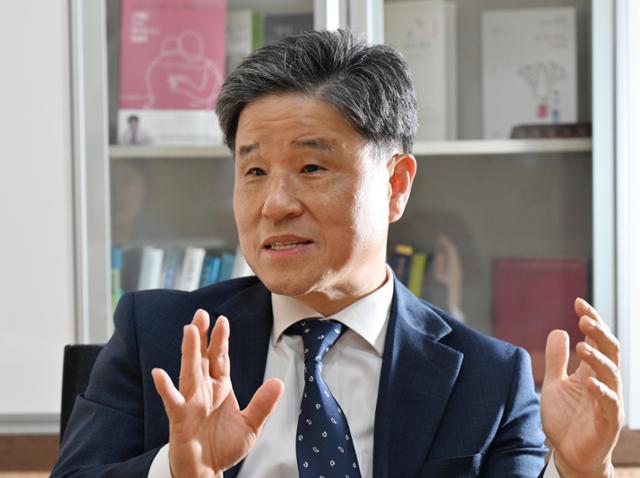
Park Sung-deok, head of the ParkSungDeok Family & Couple Institute, speaks during an interview with the Hankook Ilbo at his office in Seoul’s Gangnam District, Sept. 29. A graduate of Korea University College of Medicine and a former psychiatrist, Park turned to couples therapy after questioning, “My wife is kind and I am diligent — so why do we keep fighting?” Since 2003, he has counseled about 3,500 couples, making him one of Korea’s leading experts in the field. Hankook Ilbo
As families gather for Chuseok, many couples find themselves fighting in the car on the way home. One wife vents about her frustrations: “It was stressful every time your mother interfered. She praised my sister-in-law for bringing expensive gifts, but ignored me even though I came early and worked hard.” Her husband’s face darkens. “Here we go again. Why are you always so dissatisfied after visiting my family? Is my mom such a terrible person? Can’t you at least be grateful for what she packs for us?” (From the book whose Korean title literally translates as "Still, we can’t break up.")
For Park Sung-deok, 62, head of the ParkSungDeok Family & Couple Institute, the counseling room gets much busier around the holidays. The terms “holiday syndrome” and “holiday divorce” exist for a reason: conflict is almost inevitable when people gather. And this year’s Chuseok break is unusually long. If family tension takes over, the holiday can end up doing more harm than good. In a recent interview, Park, a psychiatrist and the only internationally certified Emotionally Focused Therapy (EFT) trainer in Korea, offered tips for spending the holiday more peacefully.
Beneath in-law conflict lies marital conflict
Park points to the gap between reality and perception as the main reason family conflict occurs during holidays. “Most people now live in nuclear families, but their thinking is still stuck in the extended-family era,” he said. “Even after marriage, many men still identify more as sons than as husbands. They emphasize their wives’ duties as daughters-in-law, which inevitably leads to clashes.”
He explained that being surrounded by a spouse’s family during the holidays can make anyone feel psychologically vulnerable. “At times like this, the desire for understanding and emotional support from one’s partner increases. That’s why paying attention to your spouse’s feelings and experiences should take priority over showing filial piety to your parents.” In other words, the center of the family dynamic should be the couple, not the parents.
For the same reason, Park said, almost all family conflicts have a marital component. Whether the problem is in-law tension, childcare issues, or financial stress, it’s not just about the surface-level cause. “Couples think they’re fighting over specific situations, but that’s rarely the case,” he said. “It’s not the father-in-law or mother-in-law causing the fight. It’s the way your spouse reacts to the situation that can either escalate the conflict or deepen your bond.” That’s a conclusion Park has drawn from counseling some 3,500 couples over more than 20 years.
Words that worsen fights: ‘My mom’s not like that’
Couples therapy has become so common that even engaged couples now seek counseling before marriage. Among those Park Sung-deok has counseled was an 88-year-old and a 90-year-old couple, brought in by their children who hoped to see them reconcile before they passed away. Hankook Ilbo
Certain phrases tend to ignite arguments, and one of the most common is, “My mom’s not like that” (or “She didn’t mean it like that”). Park said it’s crucial to recognize that your own experience of your parents as their child is different from your spouse’s experience as their in-laws. “You should try to understand your partner’s emotions through their experience, rather than dismissing them based solely on your own,” he said.
Responses like “just ignore it” or “don’t take it personally” also add fuel to the fire. A more constructive approach is to validate your partner’s feelings with words like, “That must have upset you.”
Even when feelings are hurt, the way they’re expressed matters. Instead of judgmental or accusatory remarks such as “You’re too sensitive” or “You’re so mean,” it’s more effective to focus on one’s own emotions: “I felt upset and hurt.”
Park also warned against commonly repeated sayings like “People never change,” “You can’t fix someone,” or “No one cheats just once.” These fatalistic beliefs crush hope and discourage people from working on their relationships. “Such words drag people trying to repair their relationships into despair,” he said. “People can change, and relationships can evolve.”
If you’ve suffered from family conflict every holiday, keep this in mind: this Chuseok can be different. With just a few thoughtful words, you can turn someone’s experience from hell to paradise — even in a traffic jam.
This article from the Hankook Ilbo, the sister publication of The Korea Times, is translated by a generative AI system and edited by The Korea Times.