‘Only 1% recover from addiction — but I did, and so can you’
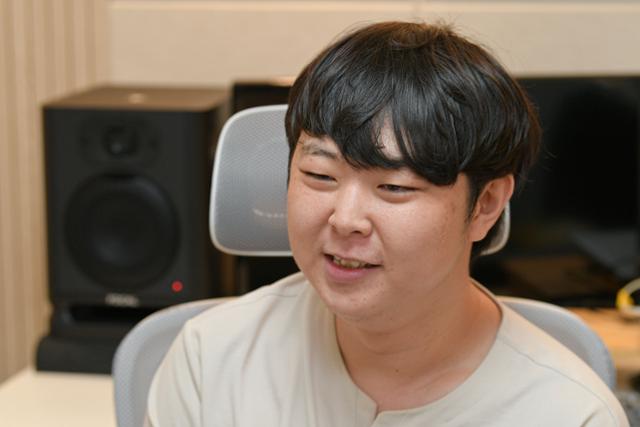
Han Dong-hwi, now working as a composer after overcoming drug addiction, explains his recovery process at his studio in Eunpyeong District, Seoul, June 29. Hankook Ilbo
Composer Han Dong-hwi opens up about overcoming zolpidem addiction and rebuilding his life through music and treatment
"Addicts are told they only have three roads: prison, a psychiatric hospital or death. Watching people around me disappear one by one, I realized I had nowhere left to go. It had to be now."
Composer Han Dong-hwi, 29, who is recovering from an addiction to the psychotropic sleep aid zolpidem, made the comments during an interview in his music studio in Eunpyeong District, Seoul. Not long ago, he was driving under the influence of pills, nearly setting his kitchen on fire while cooking late at night and blacking out without warning.
In 2020, he was prescribed zolpidem after reporting insomnia to a hospital. He never imagined he would end up as what he now calls a "drug addict."
"The doctor simply said, ‘Take one pill before bed.’ I wasn’t told about any risks or side effects," he said. Neither he nor his family initially recognized the signs, like raiding the refrigerator in the middle of the night or eating uncontrollably in a daze.
"When I came to, I couldn’t remember anything. My first instinct was always to find my phone and car keys to check if I’d done anything dangerous."
Easy access, hard recovery
Once the seriousness of his condition became clear, Han and his family began seeking treatment. He entered rehab and a residential recovery program, but quitting the drug was far from easy. He admits to "hospital shopping," or visiting multiple clinics a day to obtain zolpidem without any checks on prior prescriptions. "It wasn’t difficult to get. Internal medicine, ENT clinics, even dermatologists gave it to me without asking," he said bitterly.
Repeated relapses took an emotional toll. When the drug wore off, he was often left consumed by guilt and rage. Sometimes it turned violent. "Nothing you say or do reaches someone in that state. You just wait for the storm to pass," said his mother, Kim Ji-yeon, 57.
Still, it was his family — and his passion for music — that motivated Han to try again. "If I gave up, I’d lose my career and my family’s trust forever."
No cure, only vigilance
Han Dong-hwi, a composer who has overcome drug addiction, speaks during an interview at his studio in Eunpyeong District, Seoul, June 29. Hankook Ilbo
Quitting required immense mental and physical endurance. His weight ballooned from 73 to 100 kilograms due to uncontrollable cravings during withdrawal. What helped, he said, was connecting with others in recovery at the Jeju Soon-Oreum Treatment Center. "My brain kept telling me to take the drug, but I fought it by talking to others about our worst moments. It reminded me why I had to stop."
Han has now been off zolpidem for nearly a year. But he emphasizes: There is no such thing as a cure for addiction. "Only about one in 100 people manage to quit for good," he said. He continues weekly outpatient therapy and participates in counseling programs run by the Korea Association Against Drug Abuse.
The first step, Han said, is admitting you're addicted. "Most addicts only realize it when they’re facing criminal charges or suicidal thoughts. And even then, it’s hard to find proper treatment."
South Korea has only two major public institutions equipped for drug rehabilitation: Cham Sarang Hospital in Incheon and Bugok National Hospital in South Gyeongsang Province. Community-based centers have long waitlists and often require expensive out-of-pocket payments.
A message of hope
Composer Han Dong-hwi, who overcame drug addiction, is interviewed at his studio in Eunpyeong District, Seoul, June 29. Hankook Ilbo
Han now hopes his recovery story offers hope to others. "I used to think I’d never recover. I wanted to give up so many times. But if you don’t let go of your will to change, you can get back up."
He recently resumed composing music and contributed the ending song to a drug awareness musical at an anti-drug event hosted by the Seoul city government on June 23. The song, titled "Let it reach you," captures the sense of isolation and despair often felt by those in addiction.
"Most addicts think they’re alone, but they’re not. Help is available. I just want to be that small spark of courage for someone’s first step toward recovery."
This article from the Hankook Ilbo, the sister publication of The Korea Times, is translated by a generative AI system and edited by The Korea Times.