Jobseekers frustrated by one-size-fits-all recruitment
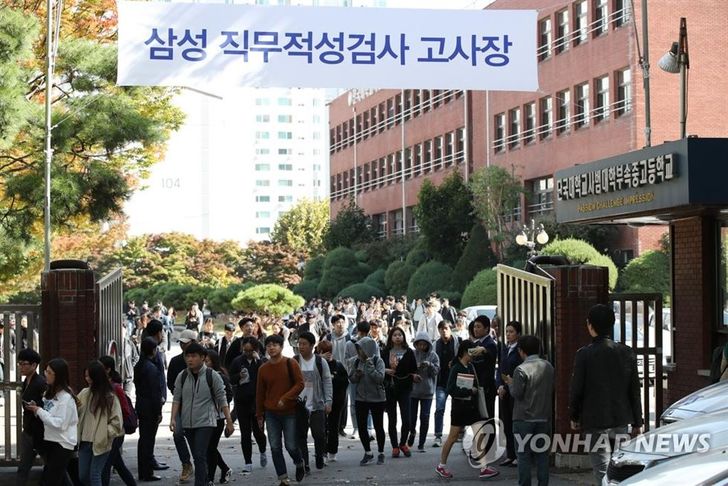
Job candidates leave Dan-kook High School in southern Seoul after taking the Global Samsung Aptitude Test (GSAT) Oct 22, 2017. / Yonhap
By Lee Suh-yoon
Twenty-two-year-old university student Moon Soo-young and 300 other jobseekers arrived at an HR institute in Gyeonggi Province last November to undergo a full-day assessment with one of the nation’s biggest commercial banks.
Candidates were herded from room to room. For 10 hours, Moon took various aptitude tests and participated in group debates.
“It felt like the company was trying everything they could,” Moon said. “There were too many eligible applicants to choose from.”
To prepare for this strenuous assessment, she joined a small study group two months ago through her university’s student community website. “We studied for everything from blockchain to the gender neutral toilet controversy,” she said.
“The recruitment process was so unnecessarily arduous, with no attempt to customize the process to the individual applicant. I felt like a product,” she said.
A few weeks later, Moon was asked to come for an interview, but chose not to go because the bank did not accommodate her schedule. She is currently exploring career options while working as an intern at an investment firm.
Moon is one of many young Koreans who are having a hard time finding work. The competition will likely become fiercer in the coming years as more university graduates join the burgeoning ranks of jobseekers, while businesses are reluctant to increase payrolls amid rising wages and uncertain economic outlooks.
President Moon Jae-in referred to the youth unemployment problem as “a national crisis” during a youth employment conference on Jan. 25. The Moon administration has set youth employment as its top priority since taking office last May, pledging to create 810,000 public sector jobs, including 174,000 more government jobs by 2022.
Despite the government’s ongoing campaign to generate jobs for young people, few expect the job market to improve much.
A 24-year-old graduate student surnamed Kim was unable to find a job last fall. “My friends told me afterwards that they knew I couldn’t get it because I only submitted six applications,” she said. “Most people submit over 20.”
Kim also did not enjoy the application process. “I felt disillusioned with each stage in the process. What’s the point of my university education if the only way I can prove myself is by solving aptitude tests more quickly?” she said.
Another student from Sungkyunkwan University said she plans to complete four internships before graduation, not an uncommon practice among her peers. She is now studying for company aptitude tests to prepare for her first application season.
The aptitude tests are about how much one can cram rather than if one has real talent for the job.
“Some of the questions are ridiculous, like which music theory fits the sound of cooking instant noodles,” she said. “HR teams should try to learn about the special traits of each applicant rather than conducting low-cost mass exams to weed out candidates.”
According to Statistics Korea, the number of potential economic participants between the ages of 15 and 29 – including those who did not actively seek out employment in the past four weeks – is 581,000.
This figure includes people who are training to increase their job market competitiveness or studying for various state-administered exams to land high-level public positions.
Factoring in jobseekers in these preparation stages brings the youth unemployment rate up to 20 percent, well above last year’s officially recognized figure of 9.9 percent.