Gov't gets bolder in actions against air pollution
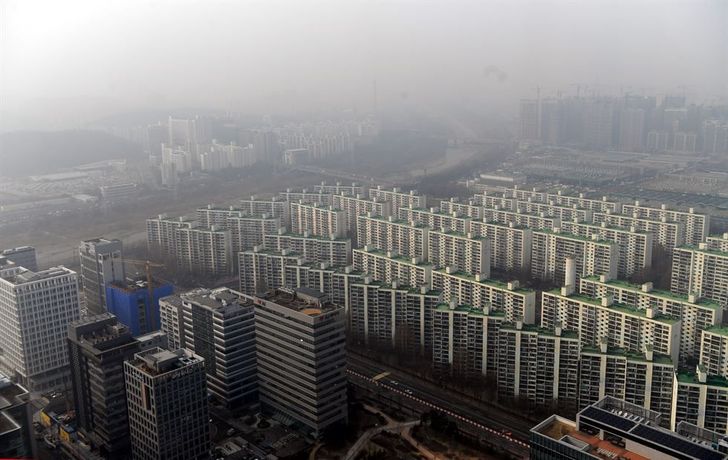
Seoul’s sky is thick with dust, Wednesday./Korea Times photo by Koh Young-kwon
By Kim Se-jeong
The Ministry of Environment is pushing to make an odd-even vehicle ban mandatory for all drivers and expanding it across the country in response to exceptionally bad air pollution this week.
Under the ban, vehicles with odd-number plates should not be driven on even-numbered dates and vice-versa.
Currently, the vehicle ban is issued only to Seoul, Incheon and Gyeonggi Province, subjecting only public organization vehicles and civil servant drivers ― the ban is issued when a daily average concentration for Particulate Matter(PM) 2.5 is 50 micrograms or more and lasts for two days.
“We are working with National Assembly members to make the vehicle ban mandatory for all drivers,” an anonymous environment ministry official said. “We are also discussing fines for violators; many are settling on 100,000 won.”
If implemented, this will mark the boldest government act against air pollution in decades.
Another anonymous ministry said there is a discussion on expanding the ban to cover the entire country.
The ministry had the expansion and mandatory ban for all drivers in its mid-term plan but this week’s dust attack made it move faster. Last year, the ministry announced it would start to discuss expanding the ban in 2019.
Experts also recommended the mandatory expansion, saying the current ban is incomplete.
Korea’s air pollution problem has been widely reported.
In January, it has become so bad that the ministry issued the odd-even vehicle ban four times in one week. The Seoul city government also made all public transportation free three this week to encourage drivers to leave their cars at home ― but the participation was low. It
The biggest proportion of pollutants comes from Chinese factories, power plants and households that burn coal and wood for power and heating.
Yet, a lot is also generated domestically. Korea’s west coast is thick with power plants and manufacturing facilities that emit PM 10 and PM 2.5 and other chemical compounds that transform into particulate matter after chemical reactions. Stagnant airflow was another contributing factor this week.
Particulate matter has a devastating impact on human health. Many studies have shown it causes hundreds of thousands of premature deaths. The World Health Organization said PM 2.5, in particular, causes cancer.
Internationally, restricting vehicles in response to air pollution is a growing trend. Paris, for example, is one of the cities to impose a vehicle ban on foggy days.
Yet in Korea, some complain that the ban will hurt the local economy and make life miserable for many self-employed drivers ― Korea has a large number of self-employed people who need their vehicles to make a living.