Scientist extracts phosphate from sewage
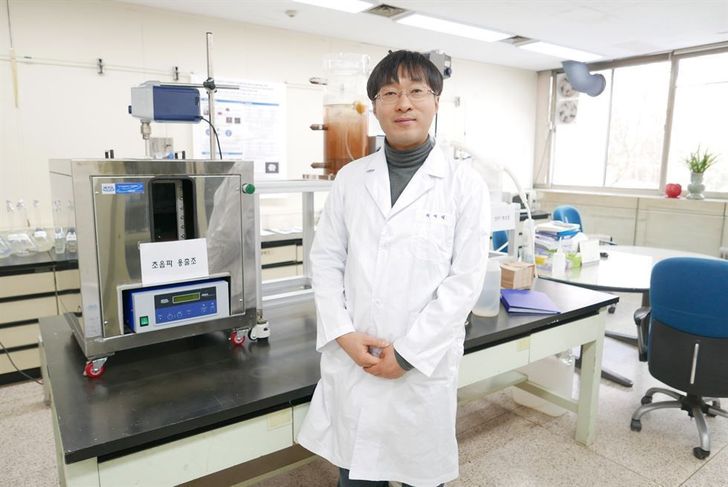
Choi Ye-duk
By Kim Se-jeong
Choi Ye-duk, a wastewater researcher at the Seoul Institute of Health and Environment, has invented a way to extract phosphate from sewage.
Phosphate is a critical ingredient in making fertilizer. Fertilizer makers in Korea rely solely on foreign imports for their production.
Phosphate deposits are found in China and Morocco but supplies have dwindled during the past century due to the rapid increase in fertilizer production globally.
“I’ve been researching wastewater for years and I’ve always wanted to do something useful with the sludge,” Choi said.
This is how he did it.
Wastewater from home toilets, kitchen sinks, construction sites and streets as well as rainwater is collected at the city’s four sewage treatment plants through underground pipes.
At each facility, the water is chemically purified and then released into the Han River. The sludge accumulated by this process undergoes a separate treatment and is dried for burial or power generation, or incinerated into ash for paving.
Choi extracts the phosphate from incinerated ash.
He separates phosphate from the ash using a chemical treatment and shaking the ash. Magnesium, calcium chloride or ammonia nitrate is added to solidify it.
These two steps are known and other scientists have tried it before. But what made Choi’s work stand out was that he used ultrasonic waves to shorten the time needed to separate the phosphate from the ash.
“By emitting ultrasonic waves, you can separate phosphate in 30 minutes, instead of two hours which is usually required,” Choi said. He extracted 80 kilograms of phosphate from a ton of ash.
His invention is a huge breakthrough for the city government, which is mainly responsible for wastewater management. Every day, Seoul deals with 1,832 tons of sewage sludge.
In October, the patent office endorsed his innovation and now he is working full-time at one of the four wastewater treatment facilities to see if he can commercialize his invention.
Choi is an experienced water researcher. He spent almost seven years at the Seoul Water Institute before joining the Institute of Health and Environment in 2013. He also spent four years in Incheon at the Regional Research Center for Coastal Environments of Yellow Sea.