My Seoul Story Big city surrounds ancient market
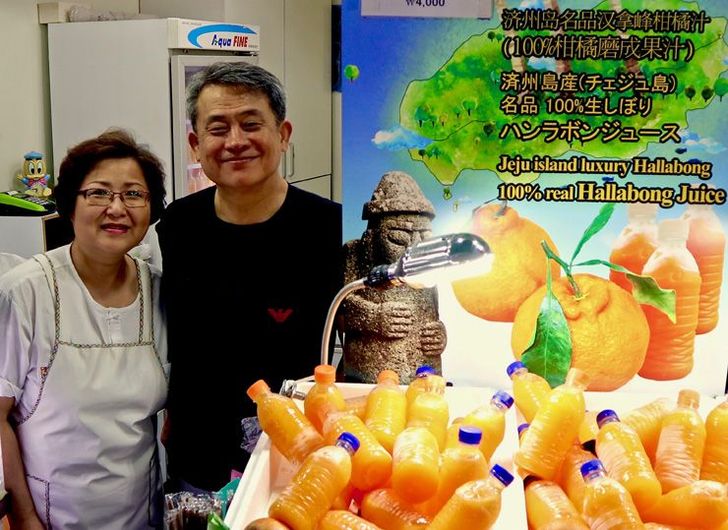
Tak Jai-jin, right, and his wife Song Sung-mi are the owners of the Jeju Hallabong juice shop in Namdaemun Market. / Korea Times photo by Lyman McLallen
This is the ninth in the series of contributions about Seoul's charms as seen from foreigners' points of view. ― ED.
By Lyman McLallen
Lyman McLallen
People have been going to Namdaemun Market next to the South Gate at the ancient boundary of Seoul since 1414 ― 40 years before King Sejong and his scholars developed Hangeul, the Korean alphabet, at Deoksu Palace, which is a 15-minute walk from the market.
Over the centuries fires have swept through the market’s small shops and buildings on occasion, often gutting the flimsy structures, destroying a lot of the merchandise the vendors brought to the market to sell. Fire, though, never stopped the trading. Slowed it down, yes, but not for long.
Every inch of the market has fallen into neglect and ruin at one time or another, only to be rebuilt, revamped and built again. What is constant about Namdaemun Market is the generations of Koreans who have been going there since its beginning to sell, buy and trade all manner of things.
Every day, thousands of vendors come to the market selling anything you can imagine and many items you’ve never dreamed of. It would take a month to walk through the maze of streets at Namdaemun Market, but even in a month, you still wouldn’t see everything. The market is always changing with new items for sale and new vendors selling them alongside those who have been there for years.
There are shops at Namdaemun Market run by old women and men selling antique watches, rings, necklaces and other pieces of jewelry. You can shop for baseball caps and Superman T-shirts, luggage of all shapes, sizes and purposes and thousands of toys, many of good quality. As with anything you buy, though, you have to know what to look for.
If you see something you want at Namdaemun Market, buy it on the spot, because if you don’t, someone else will and there’s no guarantee an item like the one that caught your eye will appear again.
There is a section in the market’s narrow alleys where you can buy fresh fish, chicken, beef and pork all kept on ice. Also for sale are oranges, bananas, pineapples and domestically grown melons, peaches, apples, and pears in season. You can also buy leafy vegetables, tomatoes, cucumbers, russet and red potatoes, sweet potatoes, peppers of many kinds and sizes, four or five types of onions, varieties of squash, a dozen types of mushrooms and garlic straight from the field.
Many customers sort through new clothing displayed at hundreds of stalls, others shop for porcelain ranging from inexpensive and plain to exquisite and rare, still others walk through buildings where thousands of men and women make and sell shoes, men’s suits, traditional dresses, silks and linens.
Hundreds of camera shops dot the market where you can choose from thousands of old Leica 35mm film cameras made in Germany during the 1950s along with other film cameras such as Hasselblads and Rolleiflexes. All are antiques today, though you can still take good pictures with them. Many of these shops also sell the latest digital cameras from Nikon, Canon and other manufacturers.
All this may seem like a lot of stuff for sale at one place but it is a mere fraction of what you can find at Namdaemun Market.
Not far from there is Myeong-dong, which is no longer a traditional market in the way Namdaemun Market is. With its movieplex and upscale restaurants, Myeong-dong is now an outdoor shopping mall of mostly high fashion and trendy-chic retail stores straight from Rodeo Drive in L.A., Paris and other imagined glamor spots, nothing at all like Namdaemun Market.
A welcome sight at the market, especially during the summer, are the carts selling chilled slices of melon and pineapple on wooden sticks. Among the small coffee shops and food stands on the main street of the market is a stall run by a couple selling fresh ice-cold juice squeezed from tangerines grown on Jeju Island. The juice is delicious and on a hot day nothing is better.
Thousands of vendors come to Namdaemun Market every day to greet customers. Since its beginning the vendors have mostly been small independent operators. Though none of them has much, what they have is everything to them and this hasn’t changed in the 703 years Namdaemun Market has been there in the heart of Seoul. To shop, after all, is why people have always gone to Namdaemun Market.
McLallen is a copy editor at The Korea Times.