Duel-exam CSAT confuses students
By Na Jeong-ju
The government’s plan to implement two versions of the College Scholastic Ability Test (CSAT) with different levels of difficulty from this year is drawing a strong backlash from many schools and students.
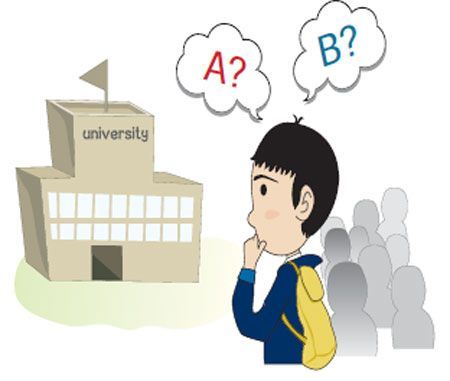
Under the new system, CSAT takers should choose between type A and B for each of the Korean-language, English and math sections ― Type A will be easier than Type B.
The Ministry of Education, Science and Technology adopted the dual-exam system to “normalize” public education, but there are concerns that students taking Type-A tests will be disadvantaged from gaining admission to colleges.
The real problem is that many high schools have yet to fix their curricula for this year because they don’t know how difficult the Type-A and Type-B exams will be.
“I’m confused about the new system. My students also don’t know how to prepare for the CSAT,” said Choi Ki-suk, a high school teacher in Seoul. “I just don’t understand why the CSAT should be changed in this way. Students are not mice in a lab.”
The ministry is facing growing calls to give up the plan. Some opponents have also vowed to campaign against the new format once President-elect Park Geun-hye takes office.
Last week, a group of top admission officials from nine private universities, including Korea University and Yonsei University, issued a statement urging the ministry to reconsider introducing the dual-exam system.
“We need time to evaluate the pros and cons of the proposed system. It is causing a lot of confusion among teachers, students as well as parents,” the statement said.
Lee Uck-yeon, an official from Sogang University, said the statement reflected concerns among universities that the state-run college entrance test is poorly prepared.
“It’s better to give up the plan before it creates greater confusion,” Lee said. “Many teachers and students still don’t understand why the new system is necessary. I’m not sure whether the new system is better than the current one in evaluating applicants.”
According to Etoos, a private institute in Seoul, its survey of 177 high schools in the capital showed that 62 percent are not providing lessons for the Type-B English exam. That’s because teachers there don’t exactly know how to teach students.
“Many people expect that the Type-B English test will be very difficult compared to the Type A. But the point is that no one knows how difficult it will be,” said Oh Jong-woon, an Etoos official. “Students will have to gain more vocabulary and knowledge and have better writing and reading skills to take Type B. But they don’t know how to study.”
Teachers worry that the new system could prompt greater household spending on private tutoring because more students could enroll at cram schools, or hagwon, to get related information.
Some cram schools in southern Seoul have already set up courses on Type-B exams.
“It is quite embarrassing to see that cram schools are providing such lessons even when there are no ministry guidelines on the exams,” said Ko Jeong-sook, an English teacher in Suwon.
The ministry said the concept of the duel-exam system is to give students opportunities to choose exams based on their academic levels.
“We are now working on the details of the system so that these can be successfully implemented,” a ministry official said. “We have instructed schools to set up lessons for both Type-A and Type-B exams. We will also provide education programs for teachers.”
An association of teachers in Seoul, called Seojinhyeop, cautioned that the unpopular system will be a burden for the next administration.
“Whether to reform the CSAT or not will be a key challenge for the new education minister to be chosen by Park Geun-hye,” said an official from the association. “We forecast that there will be heated debates on whether to implement the duel-exam system once she is inaugurated.”