Main opposition party moving to right
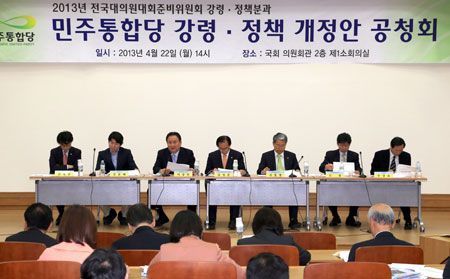
Members of the national convention preparatory committee of the main opposition Democratic United Party (DUP) hold a public hearing to discuss how to revise the party platform at the National Assembly on April 22. They announced proposals along a conservative party line, including a solid national security posture against North Korea. / Yonhap
DUP plans to revise platform to attract conservative voters
By Jun Ji-hye
Political pundits often make the joke: “It is as difficult to predict the future of the main opposition Democratic United Party (DUP) as it is the behavior of North Korean leader Kim Jong-un.”
Since its defeat in the Dec. 19 presidential election, the DUP has lost political clout and lacks direction. Independent Ahn Cheol-soo’s overwhelming victory in a by-election in Nowon district in Seoul on Wednesday dealt another setback to the party.
The rapidly changing political landscape could pose a threat to the party’s survival unless it overcomes two main obstacles.
The first is factional conflict over who should take responsibility for the election defeat. The second is ideological struggles between liberal and conservative members.
In particular, ideological debates have deepened further since the party recently signaled a willingness to move toward a more conservative line.
This would be to attract middle-of-the road voters disgruntled with the party’s political leanings to the left.
However, left-leaning DUP members are fiercely opposed to such a shift, claiming that the party has to maintain a progressive stance. Opinions from analysts are divided over the issue too.
Moving to right
Last Monday, the DUP’s national convention preparatory committee announced proposals to revise the party platform which is to be approved at the convention slated for May 4.
Most notably, they are keen to revise the party’s approach to issues of national security.
“We will ensure a solid national security posture against North Korea’s provocative acts including its nuclear threats,” the committee stated in a report circulated before holding the public hearing.
Members of the labor relations board of the Democratic United Party (DUP) speak at a press conference at the National Assembly on April 24 to oppose the party’s move toward a conservative line. They called on the DUP to maintain a progressive stance. / Courtesy Rep. Woo Won-shik’s office
They added that they will pay more attention to human rights in the Stalinist state.
Regarding economics, the committee agreed to refrain from using strong language such as a “complete reexamination” when referring to the Korea-U.S. Free Trade Agreement (KORUS FTA).
Instead, they plan to adopt trade policies to “maximize the national interests and minimize any damage.”
The committee relaxed its hostile stance toward conglomerates by saying they are now in favor of “supporting enterprises’ management activities.”
Regarding labor conditions, they deleted content on “abolishing discrimination against non-regular workers and raising the minimum wage,” and added that the party would be “pushing ahead with creating a society where laborers are respected and establishing fair and autonomous labor-management relations,” abstract notions that can be regularly reinterpreted.
“We also agreed to replace ‘providing universal welfare’ with “welfare aiming at growth,” the report said.
On diplomatic matters, the committee inserted the phrase saying “pressing
ahead with future-oriented development in Seoul and Washington relations.”
Resistance
The said proposals have become a subject of debate within the party due to opposition toward it from left-leaning members.
Resistance regarding it was first seen at the party’s labor relations board.
“When the then Democratic Party combined with members of the Federation of Korea Trade Unions (FKTU) in 2011, the strongest ground shared by the two was aiming to protect workers,” said members of the board including Lee Yong-deuk, former FKTU chairman.
Speaking at a press conference in the Assembly last Wednesday, they said, “Realizing equal pay for equal work and raising the minimum wage were core laborer-related policies. But these have disappeared in the new proposal.”
They say the party’s new direction is unacceptable and that it will only damage the party’s identity.
“Embracing middle-of-the-road voters is completely different from damaging the party’s progressive identity. It is a very dangerous and vulgar idea,” they said.
Lee Seok-haeng, the board chairman, said, “I joined hands with the DUP because it promised to consider ways of protecting laborers who are also part of the party.”
Lee stressed that the board will take appropriate steps if the committee pushes forward with revising the party platform as proposed.
Reps. An Min-suk and Park Wan-ju joined the protest by issuing a joint statement.
“The cause of the DUP’s presidential election defeat was not because it adopted a progressive line. It was because it frequently changed its ideology, resulting in a loss of public trust”.
The two lawmakers additionally say that maintaining a middle course is results in a lack of identifiable political ideology, so a party cannot present a platform or an identity.
“Politicians can choose to steer a middle course just as politicians such as Tony Blair or Gerhard Schroder, former prime minister for Britain and Germany, did. But this resulted in them not pursuing their ideology,” said An and Park.
They also pointed out that it’s wrong to weaken worker’s rights.
“Protecting such rights gave the DUP the chance be a political party for ordinary people and the working classes.
Two lawmakers called on the committee to reflect the opinions of the FKTU in the amendments of the party’s platform.
Following vigorous opposition, the committee took a step backward to some extent Friday by saying it would maintain most content related to the labor sector and the expression of universal welfare.
Poles apart evaluation
When asked to evaluate the DUP’s recent moves, analysts also gave conflicting views, making it even less clear whether the committee is going to the right direction.
Some describe the platform proposal as a “very reasonable step” for a dying party to revive, while others say it has made a terrible mistake.
“I am aware of growing controversy about attempts by the DUP to move toward the right. But in my opinion, this is the only way for the DUP to survive amid crisis,” said Chung Goon-gi, a professor at the Journalism and Media Department of Kyonggi University.
Chung argued that the DUP lost the presidential election because they were too progressive, for example, by combining forces with Lee Jung-hee, chairwoman of the Unified Progressive Party.
“These days, regardless of which parties candidates come from, nobody can win an election without attracting voters from the center ground. You can witness these examples when looking at the victories of Tony Blair who was initially viewed as a left-leaning politician who then embraced conservative values and George W. Bush who followed ‘compassionate conservatism,’” he said.
On the contrary, political analyst Lee Kang-yun said the DUP has made a major mistake.
“What the party needs to do now is prevent their traditional supporters from leaving them, which means they have to maintain their original political colors,” he said.
Ultimately, Lee expects that the platform proposal will not be approved because of an angry backlash from the labor sector and significant numbers of people within it.
“Their attempt to create a strong stance on national security in their party platform was so predictable because the North has ratcheted up its military threats more intensively than ever before. I will just comment it is too late and ineffective,” he said.
He added the party will have to put out more substantial and creative measures, other than changing political tack and colors.