As scam sites empty in Cambodia, Korean activist says this week is ‘last golden hour’ for rescues
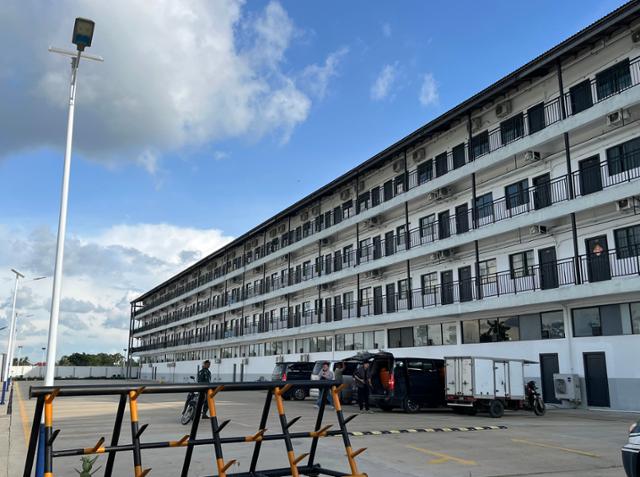
The Taizi compound in Takeo Province, Cambodia, on Thursday. Once one of the country’s largest scam complexes, it now stands deserted. Hankook Ilbo
PHNOM PENH, Cambodia — When the door opened, the smell of stale cigarettes filled the air. Each small room, no more than a few square meters, contained two or three bunk beds. Clothes and blankets lay scattered across the dusty floors — signs of people who had fled in haste.
On Oct. 16, when this reporter visited the Taizi compound in southern Cambodia’s Takeo Province with a joint government response team, the site was eerily silent. Located about 40 kilometers south of Phnom Penh, the complex was run by the Prince Group, which was sanctioned by the United States and the United Kingdom the previous day for large-scale fraud and human trafficking. Once known as one of Cambodia’s largest “yuanqu,” or scam compound, it now stood deserted.
Inside the Taizi compound in Takeo Province, Cambodia, on Thursday. Rows of bunk beds and abandoned rooms show traces of a hurried escape. Hankook Ilbo
The site consisted of 11 four-story buildings with approximately 120 rooms, each estimated to house four to six people. By rough calculation, the compound could have accommodated more than 5,000 workers, including Koreans and other foreign nationals who had been held captive and forced into online fraud schemes. Now, only dust and trash remained; no equipment or computers were left behind.
“By the time police arrived after receiving reports, the criminals had already fled,” said Pang Naren, deputy secretary-general of Cambodia’s Online Scam Response Committee. “We had been cautiously investigating intelligence on the site, but unfortunately, the suspects escaped.”
However, a Korean resident who accompanied the team added, “It would have been impossible for them to flee so quickly without some inside information from local police.”
A room inside the Taizi compound in Takeo Province, Cambodia, on Thursday. Half-finished drinks and scattered belongings remain after the occupants fled. Hankook Ilbo
Suspects may have escaped to neighboring countries
Similar scenes were observed at two other scam complexes near the capital — the Wongu compound and the Mango compound, once notorious centers of voice phishing operations. At Wongu, there were no guards at the gate, and behind high walls, buildings with dense iron bars hinted at their former use as detention sites. A torn banner reading “For rent” fluttered in the wind. A local street vendor nearby said, “There have been almost no people coming or going for the past three or four months.”
At the Mango compound, known for its brutal torture and voice-phishing operations, a guard hurriedly shut the gate when approached by reporters. Asked how many people were still inside, he replied, “No one is here.” Only a few motorbike riders were seen coming and going, and a glimpse through the narrow opening revealed a deserted courtyard.
A banner reading “For rent” hangs at the entrance of the Wongu compound near Phnom Penh, Cambodia, on Thursday. Hankook Ilbo
Signs of a large-scale exodus are also appearing in Sihanoukville, about 200 kilometers southwest of Phnom Penh. Videos obtained by Hankook Ilbo from Korean residents show Chinese and Korean workers carrying out monitors and luggage, apparently preparing to relocate.
But experts warn that this does not signal the end of criminal activity, only a shift in location. With growing reports of abductions and confinement of foreigners, syndicates are believed to be moving to border areas such as Poipet or other countries, including Myanmar.
The concern now is that Koreans previously held captive may have been moved along with them. “The longer the government delays, the deeper these groups go underground, and the harder it becomes to rescue victims,” one activist said.
Ok Hae-sil, vice president of the Korean Association in Cambodia, who has worked on rescue operations for the past three years, said, “There are rumors that some groups have moved to Myanmar, Thailand or Vietnam. In those cases, they could take the Korean hostages with them.”
“The deeper they hide, the harder it becomes to track them down,” Ok said. “In reality, this week is the government’s last golden hour to use law enforcement power and rescue the Koreans being held captive.”
The Korean-Cambodian joint task force announced that the two governments have agreed to establish a rapid response system to protect Korean victims. They also reached a consensus on the early repatriation of Korean suspects detained in connection with the crimes.
The exterior of the Mango compound in Kampong Speu Province, on the outskirts of Phnom Penh, Cambodia, on Thursday. The site, once notorious for torture and voice phishing crime operations, now appears abandoned. Hankook Ilbo
This article from Hankook Ilbo, the sister publication of The Korea Times, is translated by a generative AI system and edited by The Korea Times.