Opposition lawmakers to visit China over THAAD
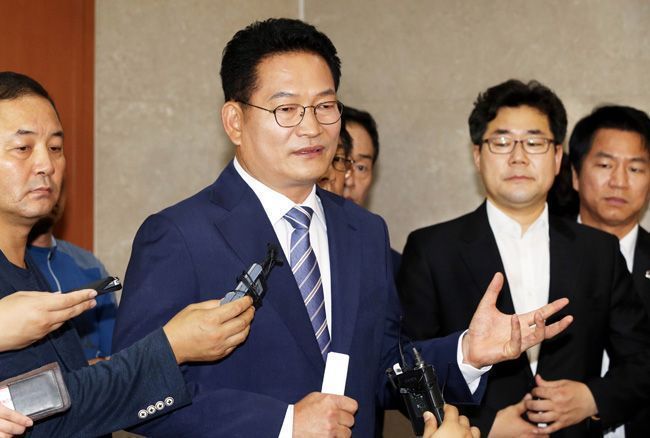
Song Young-gil
Wang Yi
By Jun Ji-hye
Eight lawmakers from the main opposition Democratic Party of Korea (DPK) will visit China later this week for talks with Chinese government officials and scholars over the planned deployment of an U.S. anti-missile system to South Korea, a major thorn in relations between Seoul and Beijing.
While staying in China for three days beginning Wednesday, they plan to deliver “messages” from DPK presidential hopefuls, including Moon Jae-in, on the deployment of the Terminal High Altitude Area Defense (THAAD) system.
Their itinerary includes a meeting with Chinese Foreign Minister Wang Yi, according to Rep. Song Young-gil, Sunday.
Other lawmakers who will visit China along with Song include Reps. Youn Kwan-suk, Park Chan-dae, Shin Dong-kuen, Yoo Dong-soo, Yoo Eun-hae, Park Jeung and Jung Jae-ho.
Moon, the odds-on favorite in this year’s presidential election, and other presidential hopefuls of the party have called for reconsideration of the THAAD deployment and letting the next government decide whether to scrap the decision or not. The demand has been made after President Park Geun-hye, who strongly pushed for the deployment despite huge controversy, was impeached by the National Assembly, Dec. 9, for a corruption and influence-peddling scandal.
Song said China has virtually taken retaliatory moves against South Korea, though the country officially said it was not retaliation against the THAAD decision.
“Indeed, events in China with K-pop and K-drama stars have been canceled,” he said. “Entrepreneurs whose main trading partners are in China have also been citing their difficulties.”
The four-term lawmaker said visiting lawmakers will make efforts to ease China’s apparent ban on Korean stars as well as on bilateral exchanges and cooperation.
“We will tell Beijing that our presidential candidates including Moon are calling on the THAAD issue to be reconsidered in the next government,” he said. “Plus, we will also discuss China’s role in resolving icy relations between South and North Korea.”
In July, Seoul and Washington announced their plan to install the THAAD system here by 2017 with the aim of improving South Korea’s defense capabilities against Pyongyang. But Beijing has ramped up its criticism of it, repeating that THAAD will undermine regional stability and China’s security interests.
After Park’s impeachment, Prime Minister Hwang Kyo-ahn, now the acting head of state, said the Park government’s decision on THAAD will remain unchanged, stressing that the system should be deployed as soon as possible to enhance national security.
But DPK lawmakers disagreed, citing allegations that Park’s arrested close friend Choi Soon-sil, with no government position or security clearance, abused her decades-long ties to the President and meddled in state affairs including security and diplomatic policies.
In August, six first-term DPK lawmakers also visited China to discuss THAAD, but at the time they faced strong criticism from the government and also from the ruling Saenuri Party. The government then said their visit to China will only bolster Beijing’s stance over THAAD and exacerbate the growing division among South Koreans.