Declining hand-made shoemaking in Seoul finds new lifeline
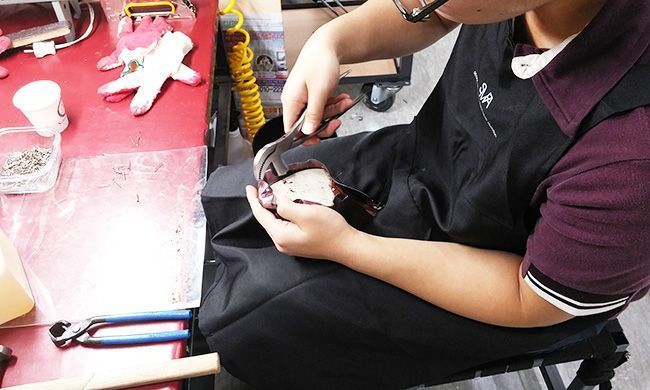
A student practices shoemaking at the Seoul Municipal Footwear Academy, Thursday, in Seongsu-dong, famous for handmade shoemakers. Six students are currently enrolled at the shoemaking class that will run until next June. / Korea Times photo by Kim Se-jeong
By Kim Se-jeong
For a long time, straw was the main component of shoes for ordinary Koreans. Leather or rubber shoes existed but they were only for those with money.
Modern-day shoes began appearing after the Japan-Korea Treaty in 1876. Seoul had its first shoemaker in 1880 who learned his skills from Japan, according to historical documents.
Among Korean intellectuals and young students who came back from Japan, a pair of modern-day shoes was common.
Over the decades to follow amid Korea’s industrialization, shoes were eventually manufactured by machines.
Yeomcheon Bridge near the Seoul Station was an early Mecca for shoemakers. Around the 1980s, Seongsu-dong in eastern Seoul became a new center for shoemaking as the area had cheaper rents for businesses, attracting many shoe-related businesses.
Lim Jae-young, 57, was one of those craftsmen who settled there. Originally from Samcheok, Gangwon Province, he first settled in Myeong-dong to learn shoemaking. In 1978, he moved to Seongsu-dong. “It was a trend then. Everyone was moving to Seongsu. How could you not?” Lim said.
Dwindling business
A shop owner now, Lim is working with his son.
“Three years ago, he told me that he will take over my business,” he said. That was when his son was in the military, and it’s been six months since the two have been working together.
He has mixed feelings about his son. “I am relieved that he is taking over, but sometimes I ask myself if it is really a good idea because this is hard work that does not make so much money.
The shoemaking business is declining now. It used to make a lot of money in the early 1990s. The decline is mainly because of cheap imports from China, which caused prices to plummet . The change in consumers’ taste was another factor. Sports outfits have gained popularity and more people purchase tennis and jogging shoes. Also imports of good European shoes, saw people snatching them up.
Very few craftsmen made a living out of selling their own shoes. The majority were employees of shoe companies, working on hand-made brand lines. Many hopped from one position to another. Right now, around 310 craftsmen are left.
Lim is one of the lucky ones.
Because of the tough working environment and low profits, shoemaking is not a popular career choice for young job seekers. According to city statistics, the average age among the 310 shoemakers is 58.
The City’s effort
The city government has jumped in to help.
“This is because of a strong belief by Mayor Park Won-soon that shoemaking is vital to the city,” Roh Dong-young from the city government said. “Without manufacturing, Seoul has no future ― this is what the mayor believes in. What we are trying to do is to make shoemaking a value-added business so that it can attract young entrepreneurs.
The city has done some groundwork over the last three years. It decorated the subway station at Seongsu with shoe-themed art; and opened a small museum at the station where passersby can have a glimpse of shoemaking. Outside the station, the city also created space for rent for the craftsmen.
Starting from July, the city began putting more efforts into people.
It established the Seoul Municipal Footwear Academy which trains six young people in shoemaking. They have no background in the subject and are on an intense one-year program. Two teachers are veteran craftsmen from the neighborhood.
“This is interesting, I enjoy the course a lot,” one student who didn’t disclose his name said.
A new training program starts Monday. A four-month program is aimed at teaching students design and the business side of shoemaking. Sixteen have signed up for it, and the city will recruit more for the second session. Trainers are professional shoe designers and marketing experts ― some flying in from Italy.
“This will be a great opportunity for students and the city” Kim Jeong-hoon, the director of the academy, said.