Prisoners' children need social assistance
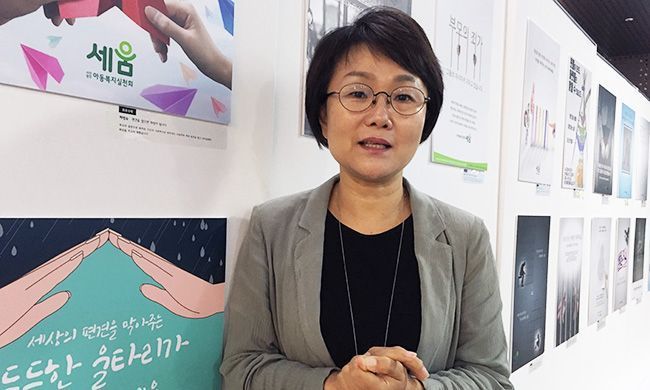
Seum Executive Director Lee Kyung-rim / Korea Times photo by Kim Bo-eun
By Kim Bo-eun
Children of prisoners suffer prejudice and discrimination and need greater social attention, an activist said.
“These children are not offenders, but they are in the poorest of circumstances and they need help from society,” said Lee Kyung-rim, executive director of Seum, a welfare organization for prisoners’ children.
In Korea, there is no official data on the children of the incarcerated ― there are estimated to be around 60,000 of them ― and this is related to a low awareness of children’s rights.
The Constitution states that family members should not be subject to disadvantages due to the faults of other family members.
However, they suffer financial difficulties due to the absence of a parent, and are also in constant fear of the stigma they will face when others find out about their incarcerated parent, Lee said.
“The children we meet tell us it is relieving to be able to talk to somebody about their secret without being judged,” she said.
The prejudice is derived partly from findings that children of offenders are themselves more likely to be driven to commit crimes.
A study from the Korea Institute of Criminology shows children of offenders are five times more likely to become offenders themselves than their counterparts.
“This is due to their poor upbringing environment, in which a parent is absent, and not other factors,” Lee said.
According to the United Nations Convention on the Rights of the Child, children have the right to maintain personal relations and direct contact with parents on a daily basis.
A bill of rights drafted by the San Francisco Children of Incarcerated Parents Partnership says that children have the right to speak with, see and touch their parents, to be heard when decisions are made about them and not to be judged, blamed or labeled.
This is why Seum is advocating enhancing the rights of children to visit their parents in prison.
A survey by Seum shows that only 40 percent of children with incarcerated parents have visited their parents in prison.
“It is important to let them know that their parent is in prison,” she said. “They should be told that their parent is being punished for breaking the rules of society, but this doesn’t mean the parent does not love the child.”
Inmates are only allowed five visits a month, which are not specifically reserved for their children. The visits are limited to 15 minutes behind a glass window, which prevents the children from being able to be in direct contact with their parents. These are areas Seum is seeking to improve.
Lee said the offender parents also benefit from seeing their children regularly.
A study from the Korea Criminological Association shows the sturdier the relationship among family members, the better inmates are able to adapt to life after serving their sentences.
Seum is involved in a number of efforts which include providing monetary aid for students as well as counseling.
By establishing ties with the National Medical Center, the children are able to get health checkups, including psychiatric assessments.
The organization is also engaged in campaigns to raise awareness of the plight of children of the incarcerated and mitigate the stigma against them.
“The government needs to support the children of offenders, just as they support the children of victims,” Lee said.