History-rich Seongbuk aims to attract more tourists
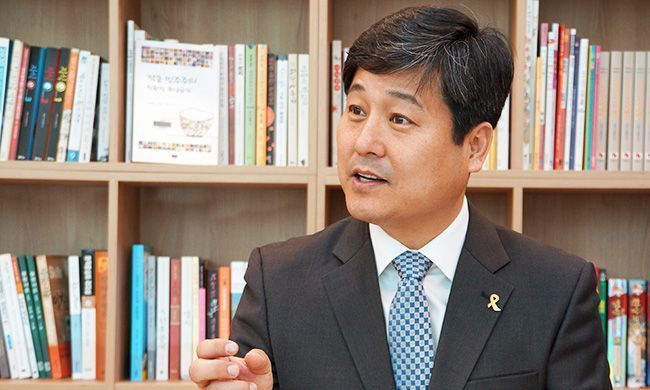
Kim Young-bae, head of Seongbuk District Office, speaks in an interview with The Korea Times at his office, Seoul. / Courtesy of Seongbuk District Office
By Jhoo Dong-chan
Seongbuk head Kim Young-bae is forging ahead with a project to make his northern Seoul district into a tourist attraction.
The district has a number of renowned historical and cultural sites including Hanyang Fortress Wall, which is expected to be designated as a UNESCO World Heritage Site soon, Gansong Art Museum, Gilsang Temple and Seongnagwon Royal Gardens.
“Seongbuk is now being transformed into a historical and cultural area under the project,” Kim said during a recent interview with The Korea Times.
“We are creating a special zone to show traditional streets of the Joseon Kingdom era, and building a museum cluster there. The project will be completed by 2018.”
The 48-year-old also showed his special affection toward Gansong Art Museum.
“It is the most important site here, and more people should visit it,” Kim said. “The museum keeps the Haerye Edition of Hunminjeongeum. Its value is in the tens of trillions of won range.”
The Haerye is a commentary on the Hunminjeongeum, the original form of the Korean alphabet, Hangeul, which was promulgated in the 15th century by King Sejong.
Recognizing Kim’s efforts to boost the district’s historic and cultural value, the Seoul Metropolitan Government designated Seongbuk as the city’s Special History and Cultural District in November 2013.
“Seongbuk itself is being transformed into a big museum,” Kim said. “Walking around the streets here makes you feel like you are living a part of Korea’s history.”
Elected by popular vote in July 2010 and now on his second term, Kim has changed not only the district’s streets but also the citizens’ lives with his special interest in children’s human rights.
Under Kim’s leadership, the district won the UNICEF Child Friendly City certificate in November 2013, the first time in Korea.
The certificate, created in Italy in 1996, aims to guide cities and other systems of local governments to include children’s rights in their policy making.
“I believe that we should listen directly to children’s voices in order to make a Child Friendly City,” said Kim. “They are not just objects to be protected but deserve the same respect as adults in making their own decisions.”
The district office enacted an ordinance about children’s human rights to be a Child Friendly City in 2011, providing adolescents a direct opportunity to participate in the district’s youth policy. It has also initiated nine public daycare centers in the district and established four that it has operated directly since 2011.
Following the certification, the nation’s 27 municipalities, which also aim to become Child Friendly Cities, selected Kim as chairman of their group.
Kim also focuses on communication with residents.
“Under the nation’s local autonomy system, local governments and municipalities are at the forefront to face residents’ needs and requests,” said Kim. “Without communication with the people, not only local government but also central government fails.”
One of the nation’s youngest municipality heads, Kim introduced “Town Democracy” where residents can directly become involved in the district’s decision-making processes and budget audits.
“The country is under a representative democracy system. But it sometimes fails to collect minority opinions. Elected representatives sometimes do not represent voters’ opinion,” said Kim.
“If people actively express their opinions through not only the election but also various civic events such as town hall meetings, the elected officials will be more careful about representing the people’s will.”
Born in Busan in 1967, Kim majored in political science at Korea University and earned a master’s degree in administration at Syracuse University.
He was engaged in politics after joining former President Roh Moo-hyun’s presidential election camp and later served as a presidential secretary.