Media fueling international conflict
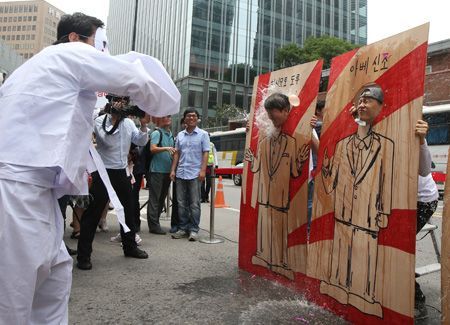
A member of a civic group throws a water balloon at figures representing Japanese Prime Minister Shinzo Abe and Osaka Mayor Toru Hashimoto in front of the Japanese Embassy in Seoul on June 19 as part of a protest against their defamatory remarks against South Koreans who were forced to serve as sex slaves for Japanese soldiers during World War II. / Yonhap
By Chung Min-uck
Late North Korean leader Kim Jong-il described South Korean reporters as “authors” fabricating stories to lead public opinion in their taste while meeting with then President Roh Moo-hyun, according to the minutes of the 2007 inter-Korean summit disclosed last week.
Ironically, he said North Korean news reports are based on “facts” and objectivity
Without taking into account the evaluation of Kim’s self-owned North Korean media outlets, which are notoriously famous for their flattery of the regime there, the former North Korean leader, like many other experts, seemed to know more about the problem of the media here, particularly, when delivering international news.
“When South Korean media outlets report international news, they tend to prioritize two things: one, whether the context is sellable at the market, two, whether it serves the goal of domestic politics,” said professor Kim Sung-hae of Daegu University’s Department of Journalism and Mass Communication.
“In turn, such tendencies result in reporting and analyzing only the comments and incidents that are violent and able to stimulate anti-foreign sentiment. Those practices only fuel international conflict,” Kim said.
Statistics show almost half the articles on international news in South Korea are of “negative” views, with Japan and China also standing high, according to a research paper released by the Korea Press Foundation (KPF) in 2010.
“Today, media outlets here seem to collaborate in Japan-bashing, quoting defamatory remarks on colonial victims made by prominent Japanese political figures. Previously, at one period of time, it was the U.S. and China which the domestic media put focus on,” said the professor. “But journalists should understand that those remarks made by some right-wing politicians don’t represent the perspective of the general public in Japan.”
The problem is further compounded by the limited number of reporters in domestic media outlets dedicated to covering wider international news.
According to the KPF research, South Korean media mainly translate international news articles and cite foreign news agencies and newspapers. Only one out of five articles of global events were covered by overseas correspondents.
This contrasts to media institutions in the U.S., U.K. and Japan who had more than half of their international news covered by their correspondents on the ground.
Reporters in Korea, China and Japan are also notorious for overly relying on government officials for information regarding foreign events, a situation which experts say can easily lead to one-sided coverage of international events.
“South Korean reporters at the international department don’t have in-depth knowledge of global territorial and historical conflicts compared to other countries,” said Kim. “Media outlets here are not internationalized enough.”
Officials of the Foreign Ministry here also feel uneasy about what they consider to be biased reporting by reporters here.
A Foreign Ministry official lamented that “Media do not only report positive stories but also those that are negatively skewed. Sometimes some of them have bad influences when negotiating with the counterpart government since they think what’s written in those articles are actually our official position.”
The official added that “Ordinary people react emotionally to international problems staging rallies frequently, especially when it comes to historical issues. Those issues should be dealt with extremely carefully by the media.”
Experts further said journalists should focus more on covering reconciliation efforts being made by governments and individuals.
“Talking about the historical conflict in East Asia, Japan is fully responsible for the ones who suffered under its imperialism,” said Park Sang-byoung, a political commentator. “However, one of the most important roles of the media is to promote reconciliation and peace-building efforts made by nations and individuals. This is conspicuously missing in journalism nowadays.”
Japan’s failure to properly apologize and compensate for its past atrocities including the issue of comfort women coupled with the ongoing tension over territorial claims in the region, has resulted in what experts say is the “Northeast Asian paradox.”
This paradox refers to the phenomenon where East Asian countries are becoming increasingly distrustful of each other despite their obvious economic interdependence. The trouble with it is how this atmosphere distrust is hampering bilateral corporations between them.
Experts say, these conflicts have influenced news reportage in the region, especially within Korea, along the binary categories of good and evil.
A consequence of this is the over simplification and conflict-oriented coverage of international issues. The data shows news reportage from South Korea, China and Japan tend to portray overseas incidents more negatively than in other western nations.
“The media must not represent the interest of a certain nation, but instead, promote peace looking at issues objectively from a bystander’s standpoint,” said Park.
Measures to be taken
Experts say decreasing sales and net profits of the overall media industry, following the surge of electronic media, is not an excuse for reporters to focus on overseas incidents that are provocative and violent.
“Journalists can increase the number of people reading their articles by delivering information in a positive way with rich content without having to stir up anti-foreign sentiment,” said Prof. Kim.
“So educating reporters in a way that they can have expertise in international events is important in promoting peace between nations. More interaction with foreign journalists would be a good way in enhancing the understanding of international issues,” Kim added.
In this sense, the foreign ministry is planning on increasing the number of international exchange programs of journalists so that they can get more insight into what’s going on in the outside the world.
Experts also say reporters here often narrow their sources of information to the point of overlooking those at the grassroots level. A diversified pool of sources helps in bringing different perspectives to news coverage.
They claim these multiple perspectives can improve the objectivity of news coverage as well as reducing the problem of the current conflict-oriented news reporting here.