Park to hold 1st Cabinet meeting Monday
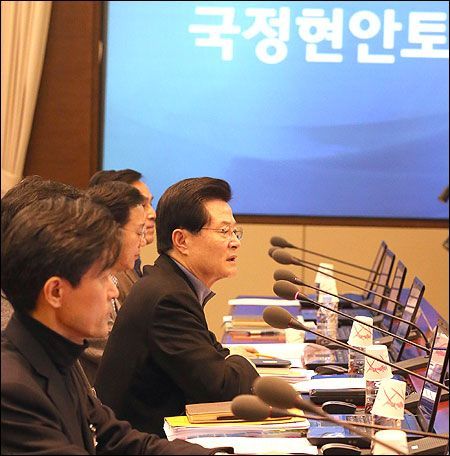
Meeting on state affairs : Presidential Chief of Staff Huh Tae-yeol, center, speaks at a meeting at Cheong Wa Dae, Sunday. Huh and other senior presidential advisors discussed how to create jobs and other economic issues. Yonhap
By Jun Ji-hye
President Park Geun-hye will appoint 13 ministers and hold her first Cabinet meeting today after a two-week impasse of the government restructuring bill at the National Assembly.
As well as the 13, two vice ministers of the previous administration still in place will participate to meet the weekly gathering’s requirements of at least 15 Cabinet members, the president and prime minister.
The Assembly agreed to provide confirmation results on agriculture minister nominee Lee Dong-phil this morning so that President Park could appoint him before the Cabinet meeting, Park’s spokeswoman Kim Haing said.
“President Park concluded that she cannot postpone the Cabinet meeting any more as the stability of state affairs is of the utmost importance. That’s why she decided to convene the meeting as soon as the requirements are met,” Kim said.
At first, Park planned to just appoint seven ministers who are not connected with the restructuring bill, but the heads five ministries subject to renaming in accordance with the bill were added following the consent of the opposition Democratic United Party (DUP).
Among those are Yoon Sang-jick of the Ministry of Trade, Industry and Energy; Suh Seoung-hwan of the Ministry of Land, Infrastructure and Transportation; and Yun Byung-se of the Ministry of Foreign Affairs.
With the addition of Lee Dong-phil of the farm ministry, the overall number rose to 13 out of a total 17 Cabinet posts. Defense Minister nominee Kim Byung-kwan, whose eligibility is disputed, will not be appointed today.
The DUP has decided not to oppose President Park’s appointments despite a tug-of-war over the restructuring bill.
The decision raised hopes the ruling and opposition parties might reach a compromise on the overdue passage of the bill this week.
Mindful of mounting concern over the stalemate in parliament, the ruling Saenuri Party and the DUP are committed to finding a common ground on the government restructuring bill.
Representatives from both parties plan to meet early this week after coming up with suggestions to solve the problems during the weekend.
Rep. Hwang Woo-yea, chairman of the ruling party, and Rep. Moon Hee-sang, interim chairman of the DUP, are expected to join the negotiations, sparking interest in whether their presence could give momentum to the speedy passage of the bill.
“The heads of the ruling and opposition parties plan to meet early this week,” a Saenuri official said Sunday.
So far, the negotiations have mainly been conducted by floor leaders and vice floor leaders.
The main opposition party has been under pressure from President Park to fill her Cabinet amid escalating tension between South and North Korea over joint military drills between South Korea and the U.S.
However, the two parties are still going head to head on the issue of moving jurisdiction over broadcasting policies from the independent Korea Communications Commission (KCC) to the tentatively named Ministry of Future Planning and Science.
It is especially the KCC’s oversight function of system operators (SOs) that is causing dissent. SOs operate cable television facilities, organize channels and broadcast to local areas.
The ruling party claims such functions should be transferred to the science ministry to develop the nation’s information and communications technology, while the DUP has raised concern over possible government intervention in broadcasting.
As SOs have the authority to grant channel rights, one of the most high-powered functions of broadcasting, the DUP is claiming, “It is feared that the government may politically abuse such authority by assigning ‘good’ numbers for channels in favor of them.”
The opposition suggested a new proposal Wednesday that SO functions can move to the ministry if the ruling party agrees to change the methods by which directors of public broadcasters are recommended. The Saenuri Party rejected the proposal, saying, “It would be government intervention in terrestrial broadcasting.”
Despite the rejection, the proposal was seen as a sign of possible compromise as it was the first time the DUP has hinted it could make a concession regarding moving the functions to the ministry, once measures to guarantee broadcasting fairness are presented.