Concern grows over arms buildup in NE Asia
By Kim Young-jin
The debate over whether Northeast Asia is in the throes of an arms race has picked up after successful rocket launches by both North and South Korea.
The South, which placed a satellite in orbit last week, complied with non-proliferation guidelines and the feat was not outwardly taken as a threat. Pyongyang on the other hand was condemned for its Dec. 12 launch that defied U.N. resolutions.
Both say their space programs are for peaceful purposes, though the North’s argument is undermined by a history of pursuing a “nuclear deterrent” directed at the United States. The technology used in the rockets can be used for missiles.
The competition comes as Pyongyang threatens to conduct a nuclear test it hopes will convince observers that it is a nuclear power.
This adds tension to the region, home to a thorny territorial spat between China and Japan and competition between Beijing and Washington for influence, which has prompted players to build up their militaries. If the trend persists, analysts worry a full-scale arms race could be on.
“If North Korea becomes a de-facto nuclear weapons state, ultra-conservative forces in Japan and South Korea, American pressures notwithstanding, are more inclined to push for their own independent nuclear deterrent forces,” Moon Chung-in, professor of political science at Yonsei University said.
“And as long as a negative spiral of assertive nationalism amplifies over territorial issues, China, Japan, and North and South Korea are likely to engage in a conventional arms race,” he added, noting that fiscal restraints in the South and Japan might be the only factor slowing the trend.
Big power relations
Experts point to uncertain China-U.S. relations as the lynchpin of the edgy atmosphere.
The Barack Obama administration hopes to shape China’s economic and military rise by shifting military resources to the Asia-Pacific region. Beijing, wanting greater control over sea lanes off its coast amid growing energy needs, has embarked on dramatic efforts to build up its Navy.
Analysts suggest the naval push may also stem from fears the Washington is attempting to “encircle” Chinese influence. China reportedly boosted its military budget by over 11 percent last year.
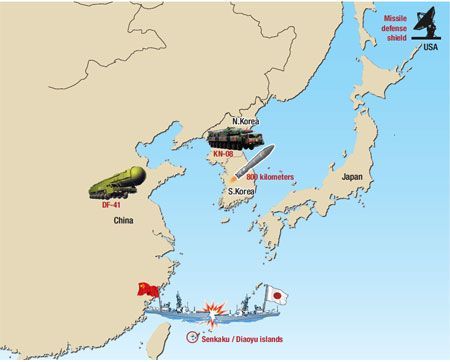
Washington is moving to expand ballistic missile defense in the region, which it says is aimed at North Korea but would also cover China.
The effort, which includes the deployment of an early-warning radar system known as X-Band is being conducted with cooperation from Japan. This would add to radar installed in northern Japan in 2006.
China and Russia oppose the move as it threatens to neutralize their nuclear strategies.
In response, Beijing is said to be building sophisticated missiles to overcome the shield. According to the U.S. Defense Department’s 2011 report, the buildup includes the acquisition of a new class of nuclear powered ballistic missile submarines and increasingly sophisticated radar systems.
Beijing is said to have test-fired a new intercontinental ballistic missile, the DF-41, which can be launched at short notice and can hit multiple targets.
Claiming the shield “fosters an arms race,” the Chinese newspaper the Global Times said last March that in response, China can “copy it and upgrade its nuclear weapon capability due to possible threats posed by the U.S. system.”
Cheong Woo-sik, director of the Peace Network in Seoul, said China’s increased military spending in part stems from “strategic mistrust,” especially in regards to Washington.
“There is a fundamental perception gap between China and its neighboring countries. Most of the surrounding countries are not having good relations with China. That’s the driving force for Beijing wanting to build its military power. Neighboring countries regard that as a threat,” he said.
Seoul, Tokyo to follow?
Seoul’s rocket launch, which was long planned, came after the country reached a landmark agreement with the United States to more than double the range of its ballistic missiles to 800 kilometers. This is meant as a deterrent to North Korea but also puts Chinese cities in range.
Kim Jang-soo, a member of President-elect Park Geun-hye’s transition team, said last month that the incoming administration will work toward “quickly putting in force ballistic missiles with a range of 800 kilometers” in response to the growing North Korean threat.
According to Cheong, Beijing may be concerned about South Korea’s satellite capabilities.
“China may regard the program not as the South’s independent program, but that it is allied with the U.S. and could be part of a containment strategy,” he said.
Park’s team has also sent signals that it will continue the nation’s push to develop, expand and export nuclear power plant technology. While this would ostensibly be for economic growth, some say could it could be taken as a sign of wanting to convert the technology for military purposes.
Meanwhile, Japan’s Cabinet has approved a budget that includes its first defense spending increase in 11 years, partly aimed at bolstering coastal and marine surveillance around what it calls the Senkaku Islands, a disputed area with China. Beijing has increased the number of ships and planes it sends to the area.
The new spending plan would reportedly seek to strengthen air and sea defenses around the disputed islands and increase the number of troops deployed there and to purchase early-warning aircraft.
Japan’s moves to revise its current defense program outline comes amid concerns over a sharp nationalist turn there, which has seen a return to power of hawkish conservative Prime Minister Shinzo Abe.
“Japan may be trying to compensate for their economic decline relative to China and even Korea by beefing up military capabilities,” an expert here said, asking not to be named.
NK’s nuclear variable
The most urgent saber-rattling is coming from North Korea, which is threatening to conduct a “higher-level” nuclear test aimed at the United States.
While it remains unclear what type of test Pyongyang would opt for, some believe it is aiming to refine the ability to mount nuclear warheads atop ballistic missiles. They say this involves miniaturizing the technology and making sure it can withstand the heat of long-range flight.
Such a development is of great concern to Washington following the Kim Jong-un regime’s successful launch which brought it closer to being able to targeting the mainland U.S. with a missile.
Reports citing U.S. officials suggest the regime is quickly advancing the development of its mobile KN-08 missile, an intermediate weapon that can be easily hidden and pose a threat the South, Japan and others.
Mitigating factors
According to a report on defense spending in Asia by the Center for Strategic and International Studies, South Korea's total defense spending increased in constant 2011 dollars from $17.1 billion in 2000 to $28.6 billion in 2011.
Some say the spending uptick can partly be equated to economic growth, as others say talk of an arms race is premature.
Bong Young-shik, a senior research fellow at the Asan Institute for Policy Studies, said that while the public welcomed last week’s launch success, many noted that because it involved technological assistance from Russia, the country still has a ways to go to achieve the feat alone.
“Even by its own internal understanding, South Korea is nowhere near the point of threatening regional countries in what can be termed as an arms race or a satellite technology competition,” he said.
The expert added that incoming Chinese President Xi Jinping has sent envoys to signal that Beijing wants to strengthen ties with Seoul, falling in line with Park’s vision of regional “trust building.”
The CSIS report said further increases in defense spending hinges on both political and economic factors.
“Overall, continued or increasing tensions in the Asia-Pacific region could drive further increases in defense spending. Should the economic climate of the Asia-Pacific region concurrently show positive growth, many countries will also have increased means to respond to security concerns,” it said.
Analysts say the North’s recalcitrance ― and the concern that it could trigger more military spending ― is stepping up the need to find a way to cap the growth of its program.
Moon, a former Seoul advisor on unification affairs and supporter of engagement, said the parties could look to the stalled six-party talks on Pyongyang’s denuclearization, which last met in 2008.
“There must be new arrangements for multilateral regional security cooperation that can enhance trust-building, transparence and strategic stability,” he said.