Who would best manage China, US ties?
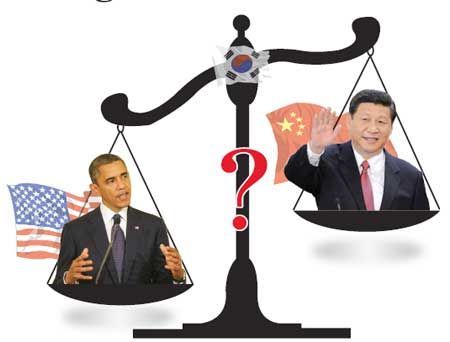
With delicate task, Park has experience, but Moon, Ahn have their own ideas
By Kim Young-jin
With Korea’s growing stature on the world stage, it is becoming harder to characterize it as a “shrimp among whales” ㅡ helpless to the whims of giant powers around it.
Yet its struggles to simultaneously manage its relations with the region’s biggest players, the United States and China, have prompted questions over its capacity in international affairs.
The three leading presidential candidates ㅡ Park Geun-hye, Ahn Cheol-soo and Moon Jae-in ㅡ propose to change that, pledging to strike the right mix of diplomacy with each of the giants after the Lee Myung-bak administration’s Washingtonfocused policy.
Experts say the task requires a careful reading of the competition between the superpowers during a period of flux and a proper understanding of the scope of Seoul’s own strength.
Success would represent a step toward emerging as a true “middle power” to be reckoned with.
“South Korea clearly needs a better relationship than it has right now with China,” said John Delury, assistant professor of international relations at Yonsei University. “But there’s no reason to antagonize the U.S.
“I would imagine that the next government’s approach will be to do it delicately.” The new administration will take office at a tricky time because it remains unclear as to the extent to which Washington and China, ushering in new leadership under Xi Jinping, will either cooperate or compete.
Tweaking the calibration of ties between Washington, the country’s closest ally, and Beijing, its top trade partner, is nothing new.
Under President Roh Taewoo’s “Northern Policy,” the country pushed for diplomatic relations with communist countries including China in the early 1990s when the first wave of regime change swept through Eastern Europe.
The late Roh Moo-hyun sought to fashion Korea as a “balancer” between the two when he was president. But the vision was doomed from the start due to a strained relationship presided over by the liberal head of state and his conservative U.S. counterpart, George W. Bush.
“Other neighboring powers did not accept Roh’s approach seriously,” said Kim Han-kwon, a China expert at the Asan Institute for Policy Studies (AIPS).
“The problem Roh had was his image as a progressive leader, so when he talked about a balancing role, that was interpreted as a negative movement away from Washington.” President Lee turned his attention to shoring up the alliance.
Two deadly attacks by North Korea in 2010 pushed the allies to step up security coordination and trilateral cooperation with Japan, while Beijing stepped up its role as Pyongyang’s protector.
Despite having consolidated economic relations, the political relationship lags behind, with issues such as China’s poor treatment of South Korean detainees, its repatriation of North Korean defectors and claims to Ieodo continually threatening to flare into diplomatic spats.
The candidates
It comes as good news for the Democratic United Party’s Moon Jae-in and liberal independent Ahn that the election has been short on foreign policy debate. A poll conducted by The Korea Times and Hankook Research last month found that Park, the former chairwoman of the ruling Saenuri Party, earns significantly more trust from likely voters.
Some 42 percent of those surveyed said she was the best choice to handle U.S. relations, and 40.6 percent felt the same way about China ties. The numbers compared to 27.1 percent (U.S.) and 18.7 percent (China) for Ahn and 21 percent and 26.9 percent, respectively, for Moon.
Analysts attribute Park’s edge on international affairs to her experience as a lawmaker and say she learned about diplomacy from her father, the late President Park Chung-hee.
Of the three, Park seems to be taking a more cautious approach, stressing that the alliance with Washington and the strategic partnership with Beijing, are different relationships and should thus be approached differently.
Watchers say this implies that she will not seek to rebalance relations but simply deepen ties with Beijing, which her camp believes have not reached their potential.
She also proposes to establish a “Northeast Asia Peace and Cooperation Initiative,” a process to help overcome imbalances in economic and security cooperation.
Ahn posits Seoul in a “mediator role” between the powers, stressing the need for Korea to emerge as a middle power capable of taking an active role to forge peace in the region.
Moon, whose numbers suggest a hangover on foreign policy from the Roh administration, has been stressing the importance of the U.S. alliance.
By far the most proactive candidate on economic cooperation with North Korea, he wants to position the country as “an active peace facilitator so that the Korean Peninsula does not remain a place for South-North, U.S.- North and U.S.-China conflicts but becomes a place for peace and prosperity.”
Leadership flux
Officials in the current administration hint that the new generation of Chinese leaders led by Xi will have a stronger understanding of South Korean affairs than their predecessors, leading to cautious hope for improved diplomacy that would allow them to handle issues before they escalate.
With China rising as a military and economic power and the United States increasingly focusing its security strategy on Asia ㅡ in a bid to shape that rise ㅡ the international community is watching to see what combination of competition and cooperation the giants will take.
Delury said a more competitive dynamic between the two could be troublesome if Seoul moves to significantly engage Pyongyang.
U.S. President Barack Obama, in coordination with Lee, has put the onus on the North to change in what critics call a passive approach.
“South Korea could be in a bind if they want to make a move more toward the Chinese approach” of engagement, he said. “That could be perceived as breaking with its ally...a move toward Beijing” if Washington sticks with a tough approach.
Analysts often cite China’s fear of “encirclement” by Washington’s regional influence as a reason behind its growing assertiveness in surrounding waters that have put Asian countries on edge.
Troy Stangarone, a Council on Foreign Relations-AIPS fellow, pointed out that rising states tend to “become more belligerent,” citing past precedent from Germany and Japan.
“The question is if China will see this pattern and avoid it. If you don’t that’s why you’ll start looking to states to try to rebalance power by coercing countries to be its allies, not those of the United States,” he said.
Middle power
The ability to strike the right chord between the powers and play a steady role in regional affairs would go a long way to bolstering Seoul’s international voice, the analysts said.
With its advanced military, top 15 economy and increasing role on global issues, Korea is regarded as an emerging “middle power” with capabilities and interest in international affairs but lacking the influence of great powers.
Outside analysts often credit the Lee administration for a systematic push in this regard, citing his hosting of international events such as the G20 Seoul Summit and Nuclear Security Summit, securing the rights to host the U.N. Green Climate Fund and cooperation in antipiracy operations in the Gulf of Aden. He has also continued efforts started by Roh in overseas assistance.
“You’re starting to see more of these things come together and playing a larger, more prominent role in international issues,” Stangarone said.
He added that while being a “balancer” was impossible due to the size of China and the United States, becoming a “close confidante” would enhance Korea’s diplomacy. “It could take a role of explaining the intent of the United States to China and vice versa.” Taking a lead role on North Korea would also be a boon for the nation’s foreign policy credentials, according to Delury.
“That is something both Beijing and Washington would appreciate,” he said.