Martin McMahon: The luck of the Irish in 1900s Korea
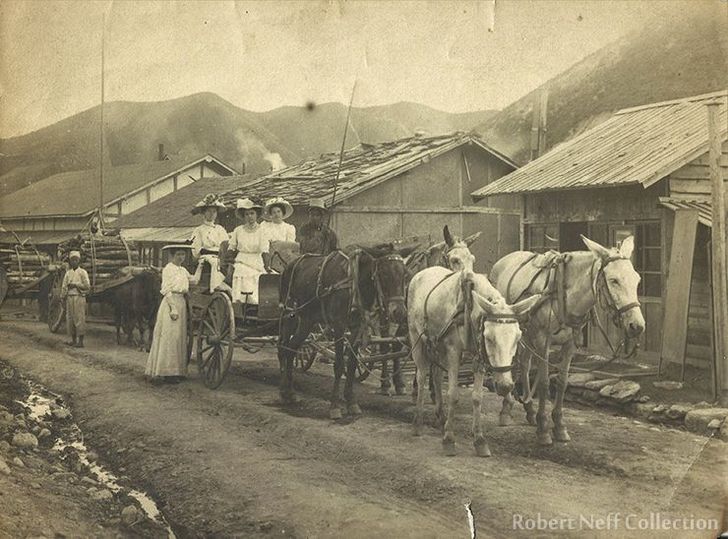
An excursion by the wives of Western miners in Korea in the early 1900s / Robert Neff Collection
By Robert Neff
Some of the most successful and famous silver and gold miners in the United States in the late 19th century were Irish or Irish Americans. Thus, it is not surprising that there were a large number of them in Korea in the early 20th century working for the American-owned gold mining companies. One of these early Irish-American miners was Martin McMahon.
McMahon was born in Limerick, Ireland, on Feb. 20, 1870, and his family immigrated to the United States in 1881 and settled in Colorado ― a state associated with mining. Naturally, at some point, McMahon became a miner and then fell in love with an Irish Canadian girl (five years his junior) named Mary Bel ― who apparently liked to be called Molly.
They started their family in Leadville, Colorado, and soon had three sons: Thomas (1895) Martin (1902) and Edward Alexander in 1906. McMahon seems to have been fairly successful with his finances and owned a couple of houses and lots in their city but could not resist the call of adventure and wealth in a far-off land.
In 1907, McMahon accepted a position in northern Korea with the American-owned Oriental Consolidated Mining Company (OCMC). The OCMC was the largest and wealthiest of the foreign mining concessions on the Korean Peninsula and had a rapidly growing settlement of Westerners ― complete with luxuries unheard of in other parts of the country and even in many parts of the United States.
One of the mills at the Oriental Consolidated Mining Company (OCMC) in northern Korea circa 1905 / Robert Neff Collection
In August, he and a group of men left Denver and traveled to San Francisco by train and then steamship to Korea via Hawaii and Yokohama, Japan. A hometown newspaper declared:
“The boys are all guaranteed a $4.50 a day job and board, with all transportation paid both ways, but they must stay three years with the company, and are assured of better pay after showing that they understand mining thoroughly and can take hold of the work for the company.”
Unfortunately, we don't know much about McMahon's trip to Korea or even his impressions of Korea as, unlike many young American miners, his letters were not copied in his local paper. We do know, however, that he seems to have found the conditions good enough to send for his wife and children ― they probably arrived in the summer of 1908 (may August).
For many Western women, life at the mines was difficult ― what with the snakes in the attics, wolves and tigers prowling the wilderness and bandits ambushing the unwary in desolate places ― but Molly seems to have had very few problems. In fact, there was something magical about living in Korea and in the summer of 1909 they were blessed with a daughter ― Florence.
Their delight was short-lived. By early 1910, McMahon was plagued with “repeated illness of various kinds” and probably began to miss a lot of work ― which meant he was not getting paid. It is easy to imagine Molly (who, despite having servants, was exhausted by caring for their four children ― Florence was now a toddler) was greatly distressed by her husband's drastically deteriorating health.
A view of the American-owned mining concession (OCMC) in northern Korea in the 1920s or 30s / Courtesy of the Woodham family
Fortunately, the OCMC had an excellent young physician named Joseph W. Nolan. No one had a negative word to say about Dr. Nolan and his work, only positive. In a five-year period, Dr. Nolan treated more than 18,000 patients and some of his feats were almost god-like.
In 1909, a Korean miner, upset with family affairs (and probably aided with a liberal amount of soju) took a knife and slashed open his abdomen “so that his intestines were nearly exposed.” The American doctor quickly attended him and had him “wholly healed within one month.”
During that same winter, an American foreman and two Korean miners were badly injured in an explosion in the mine. The American “had one of his legs broken and the Koreans their skulls fractured, were successfully treated by the surgeon and had their injuries healed.”
Yet, despite Nolan's skill, there was nothing that could be done for McMahon who was diagnosed as having an acute case of Bright's Disease ― an old term for kidney disease. I wonder when McMahon actually knew he had kidney disease ― did he know before he came to Korea or after he arrived?
By Oct. 5, 1910, he had grown so sick that he was bedridden and Nolan became a frequent visitor to his bedside. It isn't clear if he was in the company's infirmary or at home ― I like to think he was at home and being cared for by his wife. Over the next two weeks McMahon's condition worsened and Nolan recalled that on Oct. 20 he treated the sick miner who was obviously in great pain. It was the last time Nolan would see McMahon alive.
At 4:30 in the morning of Oct. 21, a shot rang out. McMahon was dead from a self-inflicted wound to the head from his revolver. In his medical report, Nolan noted that McMahon had “marked suffering coupled with a knowledge that the end was a question of but few hours.” He concluded his report with: “I do not think he took his life in a moment of mental unbalance but that he did it to end his suffering.”
One of the rolling mills at the OCMC in the 1920s or 30s / Courtesy of the Woodham family
On the following day, Charles D. Morris (an Irish American Methodist missionary) was summoned and officiated the funeral ― McMahon was buried in the small cemetery near the concession's main mine.
Molly and the children remained at the mines for only a short time while preparing for their return to the United States. She was more fortunate than other women whose husbands were lost at the mines, as McMahon had set aside nearly $2,000 from his wages.
In early November ― before winter set in ― she and the children departed Korea and (to the best of my knowledge) never returned. They arrived in Leadville, Colorado, on Dec. 4 ― welcomed by the local press that merely noted her husband, who had worked as a superintendent (he was actually a foreman), had died recently (no cause given and no reference to suicide).
Molly continued to live in Leadville and ― judging from the newspapers ― remained in contact with many of the Colorado miners still working in Korea and welcomed their visits when they returned to the United States.
Hopefully, as St Patrick's Day is approaching, “the luck of the Irish” will compel one of McMahon's descendants to read this article and perhaps we can learn more about this Irish miner in early 20th century Korea.
Robert Neff has authored and co-authored several books including, Letters from Joseon, Korea Through Western Eyes and Brief Encounters.