Robert Neff has authored and co-authored several books, including Letters from Joseon, Korea Through Western Eyes and Brief Encounters.
Love, separation, sadness: Fujisan driven to suicide (Part4)
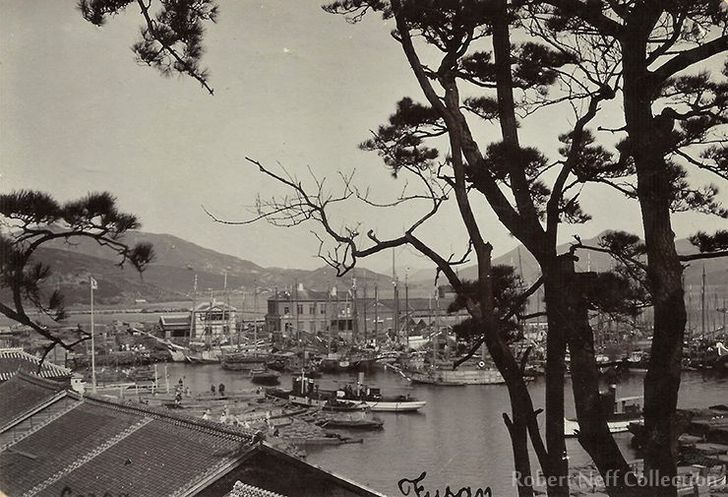
The port of Fusan, circa 1904. Robert Neff Collection
By Robert Neff
On September 5, 1905, the Russo-Japanese War ended. Celebrations were held at the Japanese consulate in Fusan (Busan) and cheerful crowds perambulated the streets.
Everywhere there was joy, except at Paolo dall' Aquila's home. With the ending of the war and the realization that Korea would become a Japanese protectorate, Aquila's position with the Korean Customs department would soon end.
He was torn. Should he marry Ofujisan (his nickname for her was Fujisan) and take her back to Italy? This would deprive her of the company of her mother and sister and would thrust her into a foreign culture. If they married and stayed in Japan, he knew that after a few years he would grow tired of the culture and want to return to Europe ― again depriving her of her family. Should he just abandon her?
Fujisan realized the anguish he was going through and made it easy for him. She declared that her mother's health was poor and that the Korean climate did not suit her. She also argued that it would be better for her younger sister to return to Kobe so that she could attend school. She could not let them go alone and would accompany them.
They both knew it was her way of providing him with time to think. The days flew by quickly ― each was spent doing a “final”: a final boat ride, a final feast, a final walk along the beach and a final night of sleeping in one another's arms. All too soon it was time for them to part.
Pusan Customs, circa 1910-1920s. Robert Neff Collection
At the dock Aquila recalled: “Ofujisan, paler than he had ever seen her, was still smiling, but the parting, more than any other he had ever experienced, was like death itself.”
Fujisan and her family returned to Japan ― with the promise that he would soon visit her ― and they continued to correspond but, “little by little, her letters became rarer.” On October 16, the anniversary of their meeting, he received a letter from her. In it she wrote:
“[Even] if fate should take me far from you, I want you to live your life without thinking too much about me. When my heart was thirsting for love you appeared ― the incarnation of everything I had imaged as ideal and splendid. You took me with you and I followed because I felt it was the will of the gods that our souls should meet in the sweet ardor of love and that I was destined to be your love, what else could interest me?”
Aquilla and Fujisan, circa 1905. Courtesy of Giorgio Olivotto
She went on to tell him that she sang his favorite songs the previous night as she thought about him and wanted him to know that she wanted to be his forever. She then ended the letter declaring she bowed three times in his direction and asked for his pardon.
Unknown to Aquila, she had returned to the place where they had first met and, overwhelmed with the sadness of being separated from him, wrote the letter and then committed suicide.
When he discovered she was dead, he had her tomb located in a small cemetery near her hometown on the shores of Biwa Lake ― not far from Kobe. Under a large maple tree, a simple stone with the engraving “O-Fuji-san dead for love” marked her final resting place.
He also ensured that every year, on the anniversary of her death, the priests in the nearby temple would recite in her memory (in Japanese):
“More nimble than the flight of the maple leaf carried by the wind is that thing called life.”
With her death, Aquilla ceased to exist but Fujisan continued to live, at least in memory, as we shall see in the final part of this story.