John J. Metzler (jjmcolumn@earthlink.net) is a United Nations correspondent covering diplomatic and defense issues.
Trump's tale of India
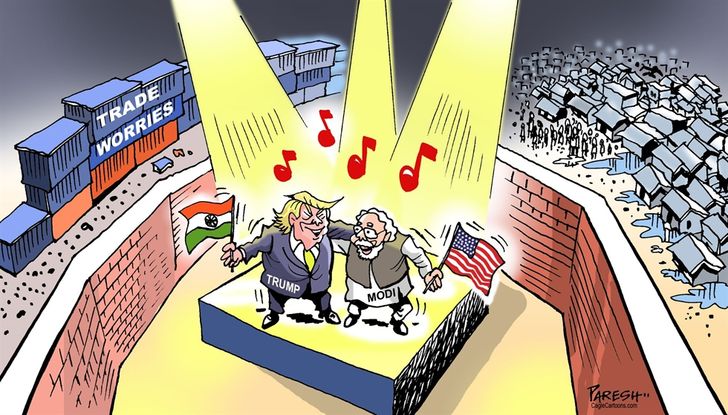
By John J. Metzler
UNITED NATIONS ― The imagery and optics presented a publicist's dream; an American president being feted by a cast of millions on foreign soil with exotic backdrops ranging from the enchanting Taj Mahal and the rousing “Namaste, Trump” rally at the Motera Cricket stadium with 110,000 cheering onlookers amid a program of song, dance and passionate rhetoric.
For those of a certain age this extravaganza was a spectacle of Cecile B. De Mille proportions.
As President Donald Trump extolled, “America loves India, America respects India, and America will always be faithful and loyal friends to the Indian people.”
Though many pundits smirkingly dismissed Trump's whirlwind trip to India as simply style over substance, the clear message was that the United States was reaffirming its close commitment to political and commercial ties to India, the world's largest democracy.
But beyond the pomp and pageantry between the two populist presidents, the themes of engagement and enterprise were the underlying mantras. So was a less than subtle appeal to the well-educated and prosperous Indian-American community who largely support the president.
Months ago India's Prime Minister Narendra Modi was greeted in Houston, Texas, by a rollicking “Howdy, Modi” rally!
Since the end of the Cold War, India has exhibited a dramatic sea change in foreign policy and a tectonic shift in economic policy. The moribund democratic socialist economic policies of the Nehru-Gandhi dynasty have been gradually replaced by free enterprise.
This has not happened overnight; India's statist system was smugly content to support the Hindu rate of growth, a lackluster economic expansion metric which simply did not support a country of now over a billion people. Growth rates are now 6.7 percent.
For the last 20 years, and increasingly so now under Modi, India's government has tried to unleash entrepreneurial genius to create a middle class. It's happening.
President Trump stated, “India's rise as a prosperous and independent nation is an example to every nation in the world and one of the most outstanding achievements of our century … It's all the more inspiring because you have done it as a democratic country.”
India remains a largely Hindu country with large religious minorities, mostly Muslim, Sikhs and Christians. Though Modi and his ruling BJP political party remain hardline Hindu nationalists, the traditional vision of India as a secular state has been blurred in recent years.
Trump was not the first American president to visit India, Dwight Eisenhower visited back in 1959 to be followed by Bill Clinton, George W. Bush, and Barack Obama. Indeed there has been clear bipartisan support in the U.S. especially since the Clinton administration to tilt toward India.
Modi stated warmly that current American ties are “no longer just another partnership, it is a far greater and closer relationship.”
Two major events presaged this: the fall of the former Soviet Union, long the political ally and weapons supplier of “non-aligned” India in the 1970s and 1980s, and then the Sept. 11, 2001, terrorist attacks on America.
In the first instance India lost its principal ally in Moscow. In the second, both India and the U.S. faced the common enemy of Islamic jihadi terrorism, some of which was rooted in neighboring Pakistan and nearby Afghanistan.
During the Trump visit the U.S. sold India $3 billion in new military helicopters; U.S. arms sales to India since 2007 have reached $17 billion.
Clearly the U.S.-India relationship poses a clear counter to China's growing military might.
Yet the Pentagon's desire for some sort of military alliance with India remains unlikely given India's strong non-aligned traditions. Nonetheless the U.S., Australia and Japan view India as a counterweight to China, and thus part of a free and open Indo-Pacific region.
Though Trump laid the groundwork for a much anticipated trade deal with India, the formalities have yet to pass. Currently U.S. two-way trade with India stands at $92 billion in 2019; just a decade ago that commerce was $37 billion. India ranked No. 9 among the top U.S. top trade partners.
Another overlooked issue has been Washington's quiet support for India's quest for permanent membership on the U.N. Security Council.
India along with Brazil, Japan, Germany and African contenders have long pressed for Council expansion from the current 15 members. Currently India is hoping to win a two-year seat in June when the U.N. elects five new non-permanent members.
As India's Hindustan Times editorialized, “The India-U.S. relationship has proved resilient amid the immense changes underway in international politics.” May I add, that's what friends are for.
John J. Metzler (jjmcolumn@earthlink.net) is a United Nations correspondent covering diplomatic and defense issues. He is the author of “Divided Dynamism ― The Diplomacy of Separated Nations: Germany, Korea, China.”