Trump is right to hold the line in NK talks
By Ted Gover
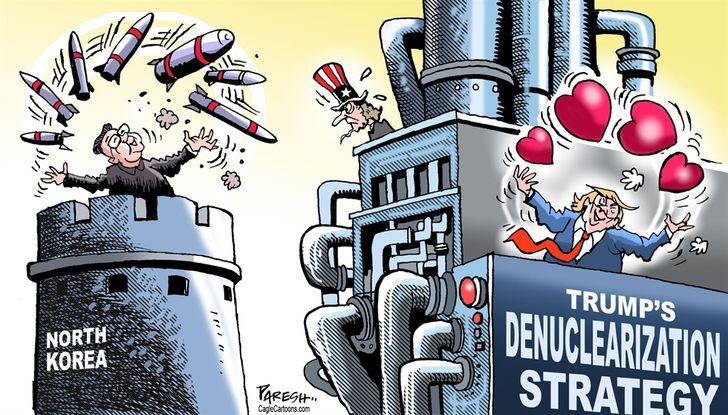
The Nov. 28 test firing of a “super-large multiple rocket launcher” likely indicates frustration by the Kim Jong-un regime that relief from international sanctions has not been forthcoming. It also shows that the Trump administration is pursuing a measured and deliberate approach that protects both U.S. and allied interests amid North Korean provocations.
Well known is Pyongyang's disappointment with Trump's views on the needed scope of denuclearization and its link to possible sanctions relief. Statements by North Korean officials have derided Washington's “Cold War mentality” while threatening a return to 2017 when Pyongyang conducted a series of intercontinental ballistic missile launches.
These developments point to Kim's dashed expectations from his prior meetings with Trump, indicating surprise and disappointment from a failure to exact concessions from Washington as his father did masterfully with past U.S. administrations.
Kim might be betting that the current 2020 campaign could be an opportune time to create a crisis for Trump. His calculus may be that launching an intercontinental ballistic missile or conducting a nuclear test may force the Trump administration to engage in partial sanctions relief in order to defuse tensions during the campaign, making him look weak as he runs for re-election.
Such a gambit on the part of Kim may backfire if Trump uses the crisis as justification to ramp up pressure on North Korea, rally American public opinion behind him and work to project an image of a strong commander-in-chief.
An outcome of this nature may make it difficult for Trump's Democratic challenger to criticize his actions without coming across as unpatriotic.
It may be that the best Washington will achieve is a nuclear North Korea that is on speaking terms with the White House after an arrangement of partial sanctions relief for partial disarmament of the North.
While such an outcome is far from optimal, it could serve as a starting point for a relationship in which Pyongyang and Washington can work together in select areas. Such an arrangement, possibly, could begin a process of lessening Beijing's heavy influence and control over Pyongyang.
Ultimately, if the North and the U.S. are unable to come to agreeable terms in their negotiations, President Trump must be willing to settle for a sustained policy of sanctions, containment and deterrence with overwhelming military capabilities, all while leaving the door open for talks.
President Trump appears cognizant of this reality. Signs indicate that his administration is on guard for the strategic deception commonly engaged by the Kim dynasty during negotiations.
Trump's saying no to Kim's excessive demands and maintaining the “maximum pressure” campaign clearly frustrates Kim and leaves him with limited options. This approach of the president puts him in the driver's seat of the talks for now, allowing him to negotiate denuclearization from a position of strength.
Ted Gover (amberjack_shoal@yahoo.com), Ph.D., writes on U.S.-Asian relations and foreign policy, and he is the Director of the Tribal Administration Program at Claremont Graduate University.