Terror reigns as moon disappears and French warships sail into Seoul
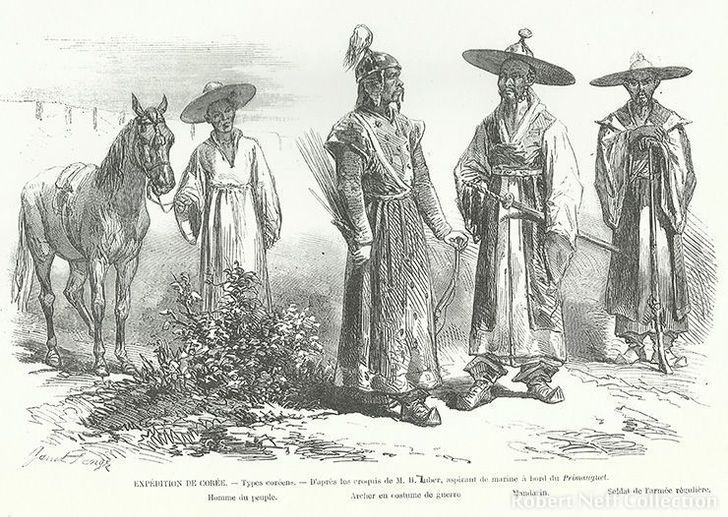
Korean soldiers and officials in 1866. Robert Neff Collection
By Robert Neff
On the night of September 24, 1866, the moon disappeared. Some of the superstitious believed the bulgae, or fire dogs, had devoured the moon but the educated ― especially those in the Korean court ― knew that it was merely a total lunar eclipse.
When the moon reappeared, the superstitious were relieved but terror still reigned in the Korean court ― not from portents of doom associated with eclipses but because French warships were sailing down the Han River toward Seoul.
Late in the afternoon on the following day, the villagers of Yanghwajin (near Hapjeong in Seoul) were surprised when they looked west and saw in the distance plumes of dark smoke along the river.
As time passed, the smoke drew closer and a horrible thundering racket grew louder. Finally, the source of the strange phenomenon was revealed ― the unmistakable silhouettes of two Western warships. Foreigners had managed to sail up the river and penetrate the heart of the kingdom.
Aboard one of the warships, Felix-Clair Ridel, a 36-year-old French priest, recalled that it was “in the evening [when] we arrived opposite the capital, to the amazement of an immense crowd that covered the banks of the river and the surrounding hills, to feast their eyes on this unprecedented spectacle: vessels moved by fire.”
But their passage was blocked by several Korean junks “tightly bound one to the other.”
Accounts of what followed differ according to the sources.
The Korean court warned military officials to avoid provoking the French in hopes the “little wretches” would eventually leave peacefully. Apparently, not everyone got the message.
The French fleet off Ganghwa Island in 1866. Robert Neff Collection
One French sailor (who heard it secondhand) stated that the blockade of junks was encountered several kilometers west of Yanghwajin. The French ordered the Korean vessels to be moved but when the demand was not complied with, the French warships fired several shots, causing the Korean vessels to flee.
Ridel, however, claimed the Korean junks fired on the French. In response, the French sank two of the Korean vessels and forced the rest to flee.
Both men claim Korean soldiers on both sides of the river fired on the French gunboats without causing any damage. The French responded with “a hail of bullets and shells which soon dispersed the Koreans or reduced [them] to silence.”
With the cessation of firing, a Korean official made his way in a small Korean junk to the warships and beseeched the French to leave the country in peace. The French commander assured the official that he was not there to punish the Koreans for the death of the French missionaries but had come as a friend. Perhaps sensing his Korean guest was unconvinced, he further added “the French were well known for their generosity and impartiality.”
The Korean official wasn't the only one skeptical of the French officer's claim of friendship. Fear and uncertainty reigned in the streets of Seoul and many fled the city fearing it would be attacked. Guards were increased at the palace and the police were encouraged to be more vigilant in maintaining order in the city and its surrounding area. There were also calls to “patriotic and loyal men.”
In the meantime, Ridel, accompanied by a small party of French soldiers, went ashore seeking information as to the fate of the French missionaries and Korean Christians but, unsurprisingly, his efforts failed ― no one would approach him and speak.
Throughout the night, the French warships surveyed the river near Yanghwajin ― always vigilant for the possibility of an attack but none came. The following morning, the two French warships completed their surveys and then sailed back down the river to the coast. They were fired on a couple of times but their aggressors were quickly silenced by well-placed shells.
For several days the French continued to survey the coast around Ganghwa Island and then ― much to the relief of the Korean government ― left.
The relief was short-lived. The French had merely returned to China to gather more men and weapons in a bid to seize Ganghwa Island and blockade the Han River, thus depriving Seoul of provisions and forcing it to surrender through starvation.
It was a bold plan but one that would be costly to both sides. There would be no winners, only losers.