Rumors, orgies and voyeurism: Seoul's foreign community of 1889 (Part 1)
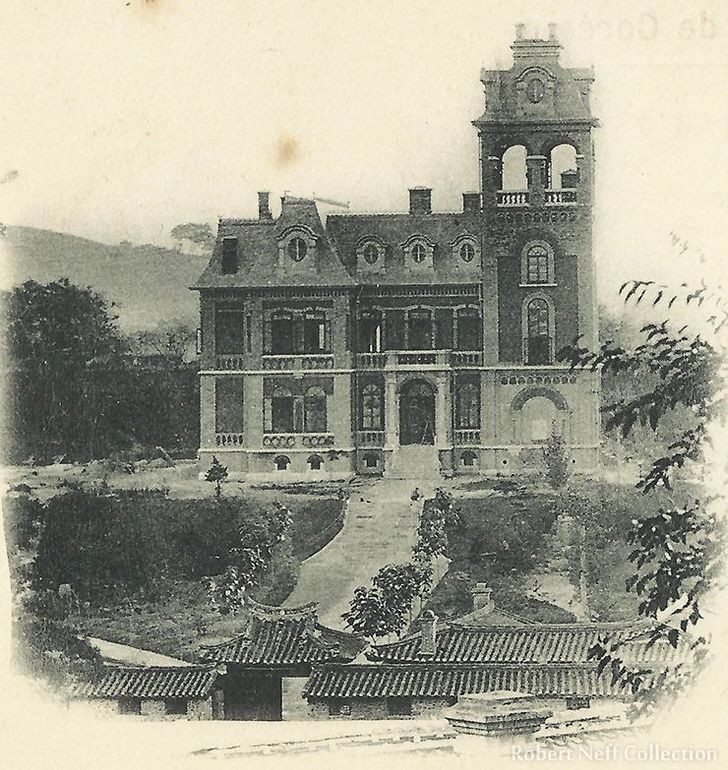
The French legation, circa 1900.
By Robert Neff
In 1889, Korea was anything but “The Land of the Morning Calm,” especially among members of the small Western community.
Vicious rumors were spread among the American missionary women that the German consul-general, Ferdinand Krien, had been engaged in wild orgies in the German consulate.
He became a pariah of the community and, out of desperation and anger, lodged a complaint of slander with the American legation.
A subsequent investigation revealed the origin of the rumor was not the American missionary women but Eugenie Waeber, the wife of the Russian representative to Korea, Carl von Waeber, who apparently did not like Krien.
There were other problems. In June, a Korean employee of the French legation was caught peeking over the wall into the women's chambers of a nobleman's estate.
It was a serious mistake, for the nobleman was a Mr. So, whom the American Minister to Korea, Hugh A. Dinsmore, described as being “highly connected, belonging to one of the most influential families in Korea.”
This act of voyeurism was strictly forbidden and So promptly had the offender arrested and severely beaten.
When Collin de Plancy, the French Commissaire, learned of his employee's situation, he immediately dispatched the legation's Korean soldiers to So's residence, where they released the employee and arrested the nobleman.
So was then conveyed to the French legation where Plancy chastised and berated him for his arrogance before releasing him ― undoubtedly shaken, outraged and embarrassed.
The Korean government was furious at the actions of the French representative and demanded that the servant be turned over so he could be further punished. Plancy steadfastly refused.
He stressed the inviolability of the legation's grounds and its staff. It was, he argued, his prerogative as to whether the servant was punished and to what degree. Plancy wrote up a note of protest to the Korean President of Foreign Affairs and asked his fellow foreign representatives to sign the note, thus presenting a unified front.
Dinsmore, a devoted Christian and “cool-headed lawyer,” refused to sign as the nature of the crime was a very serious offense in Korea. He further chastised Plancy for using the Korean soldiers in the manner he had. Dinsmore claimed that the soldiers were there as a courtesy to protect the legation and the consuls, not to be used as Plancy's personal police force.
Plancy's fury then turned on Dinsmore and he accused him of meddling in French-Korean affairs. Dinsmore denied he had interfered but admitted he had provided the Korean government with passages from a tome of international law in hopes that the incident could be concluded in an amicably way.
The incident was resolved by the end of the month, with Plancy retaining jurisdiction of his servant, the President of Korean Foreign Affairs stepping down and Dinsmore gaining Plancy's long-lasting resentment.
The American legation had its own problems. There were accusations of mail being stolen and access to the confidential archives being granted to unauthorized individuals who ― allegedly ― used the information to write unflattering articles in the English-language newspapers in China and Japan. The most serious, however, involved Dinsmore and his staff, which we will examine tomorrow.