Foreign sailors cut up rough in Jemulpo in 1897
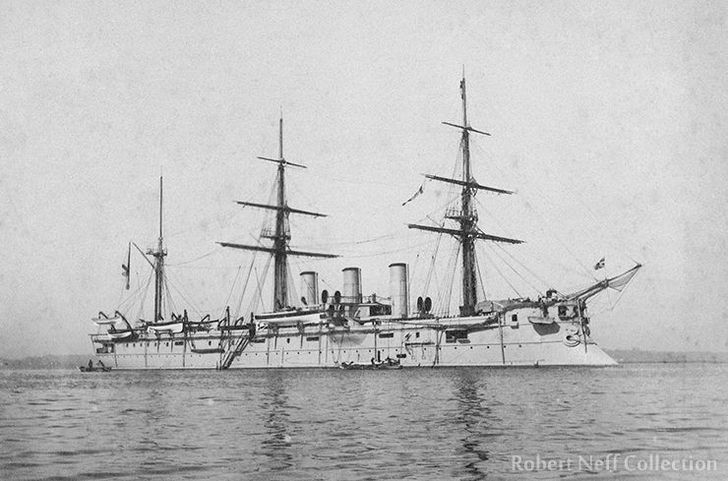
The Pamiat Azova, a Russian warship in Japan, circa 1895.
By Robert Neff
In the 1890s, Russian sailors were a tough, hard-drinking lot but, surprisingly in Korea, there weren't that many violent encounters between native Russian sailors and the residents of the ports. But the same couldn't be said for the non-native Russian sailors. Like many of the Western countries, Russia's navy was made up of several different nationalities.
Koreans aboard a Russian ship, circa 1900 (Diana Nars Collection).
On April 17, 1897, the French steward of the Russian gunboat Otvajni and his companion (another French sailor) went into Jemulpo to buy fish. It isn't clear what happened but the men soon were embroiled in a brawl with a Korean fishmonger and his friends.
Badly outnumbered by an ever-increasing crowd of angry Koreans armed with sticks, the two men tried to escape but were soon surrounded by the mob. They were, perhaps, fortunate when a Korean policeman arrived but, much to the Frenchmen's unwarranted surprise, he sided with the Koreans and attempted to arrest the steward.
The steward refused to be arrested and managed to seize the policeman's saber and proceeded to hack the Koreans nearest to him. A couple of men were severely wounded and were not expected to live.
The two Frenchmen separated and fled the scene. The steward ran through the General Foreign Settlement and sought the aid of a Japanese policeman who promptly escorted him to the Japanese consulate where he was detained. The other Frenchman sought refuge in a Japanese home ― like his friend, he was later escorted to the Japanese consulate and detained.
The commander of the gunboat was notified by the Japanese consulate but he declined to be involved as the men were not Russians. It was only after the Japanese consulate insisted that he do something that he sent an armed escort ashore and escorted the two Frenchmen back to the ship.
The commander refused to take action against the men and left the matter with the French authorities in Seoul. Unfortunately, what punishment ― if any ― the men received is unknown.
French were not the only foreign crew members aboard Russian warships to get in trouble while in Korea. Pak Keun-ho, a resident of Jemulpo, found employment as a fireman aboard one of the Russian vessels.
In late October 1897, a warrant was issued for his arrest for allegedly defrauding a Korean living in Seoul of a sum of money. A Korean judge demanded that Pak appear before the court but the quick-thinking Pak quickly returned to the warship where he sought refuge. The Jemulpo magistrate requested that the Russian commander turn Pak over to the Korean police but the commander refused.
The Jemulpo magistrate then drafted a letter of request to the Russian Minister in Seoul but the request was denied. The Russian Minister explained that the magistrate had no business contacting him and should direct such requests to the Russian consulate in Jemulpo.
As in the previous case, whether or not Pak was prosecuted and what his punishment was ― if any ― is unknown. The newspaper never followed up the story.
Robert Neff has authored and co-authored several books including, Letters from Joseon, Korea Through Western Eyes and Brief Encounters.