Hardship, loneliness: Jennie Shaw Lovatt first American woman to live in Busan
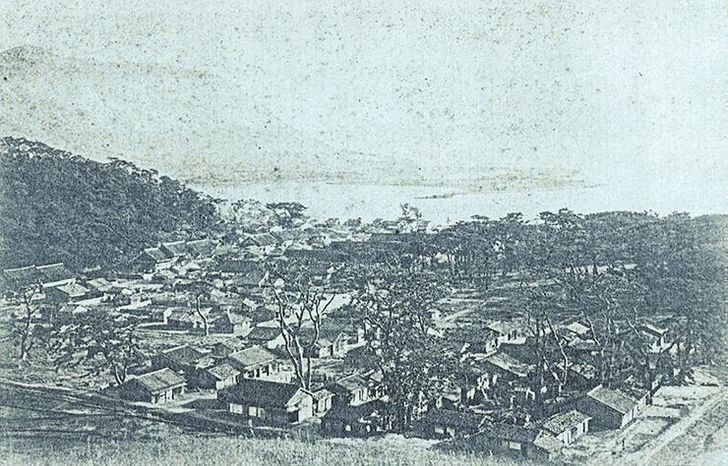
Fusan in 1886-87. Courtesy of Wayne Patterson.
By Robert Neff
While the Lamberts, in January 1882, may have been the first Western women to visit Fusan (modern Busan), they were not the first permanently to dwell in that city. That honor belongs to Jenny Shaw Lovatt.
Jennie and her four-year-old daughter Mabel arrived in Fusan in mid-November 1883 to join her husband, William Nelson Lovatt, the commissioner of customs at that port. It had been a difficult trip for Jennie, the voyage from San Francisco to Japan aboard the City of Tokio was extremely rough and many of the passengers, including Jennie, were so seasick for the first nine days that they were unable to lift their heads without becoming violently ill. Promenading on the deck was out of the question.
Their house was a small two-story Japanese-style building near the beach and the customs house. Their furniture was old and sparse and their diet was pretty much what could be hunted in the vicinity ― mainly fowl and deer ― or what they purchased in the five-day market ― mainly vegetables, chickens and eggs. And, of course, fish.
Apparently, Jennie became tired of their constant diet of fish and complained in a letter home: “[It] is a mistake about fish being able to increase brain power. [We have been dining on fish most all of summer and yet I really think we are not so bright as when we came here.”
Jennie Shaw Lovatt, circa 1870s. Courtesy of Dorothy Shaw Gillette
Of course, they also ― on occasions ― dined out in one of the local Japanese restaurants. It is surprising to note that there were at least two establishments that served Western-style meals and a couple of Japanese stores sold some Western products.
Their home may have been comfortable during the warmer seasons but in the winter it was miserable. They described it as “gloomy in the winter” and completely uninsulated, allowing icy breezes to permeate throughout the house, making even simple tasks ― such as sewing and writing letters ― miserable. Keeping it warm was difficult and expensive as their coal had to be imported from Nagasaki. The flimsiness of the house also caused them to worry that it would collapse when the wind was strong.
Life for Jenny was especially difficult mainly due to her loneliness. Her husband was able to interact with the handful of Westerners living in the port ― all of them single and employees of the Korean Customs Department. Jenny's only companions were some of the Japanese women she occasionally met but the language barrier was too much for her to overcome. She taught English to a couple of Japanese and one Korean boy.
The Lovatts, circa early 1900s. Courtesy of Dorothy Shaw Gillette
Mabel seemed to do better than her mother. She was able to pick up Japanese very quickly, as well as Korean. She had Japanese friends that she could play with and also learned the different cultures. In addition, the family had pets, including two dogs, two ducks and two pet turkeys.
The greatest diversion to their monotonous lives was the arrival of a naval vessel or, even more importantly, the steamships from Russia, China and Japan. These steamships brought mail, newspapers, gossip, packages and, even more precious, guests. Often the guests were there for just a day but sometimes they stayed for a bit longer. They were invariably invited for a meal.
“In the Service of His Korean Majesty,” by Wayne Patterson.
There also were dangers. There were frequent clashes between the Koreans and Japanese. Occasionally there were burglaries. When caught, the burglars were severely punished and when they were not caught, the police were punished.
“This morning justice was administered by the Magistrate from Fusan. With a large and liberal hand he flogged the local official and our ten Corean policemen. Four bags of rice were stolen from the Chinese Consul, who reported it to the Superintendent of Trade, and this official ordered the Magistrate to wale the Bobbies, and great was the lamentations and wailing in the little compound. The uproar was awful, the ceremony was great, but the amount of men hurt was trifling.”
There was also the threat of disease, especially cholera, which decimated Seoul's population as well as the rest of the peninsula. But, as Prof. Andrei Lankov is so fond of saying, that is a story for another time.
For a great book about the Lovatts, see Wayne Patterson's “In the Service of His Korean Majesty.” I would also like to thank Dorothy Shaw Gillette for providing me with pictures of the Lovatts and of some of Jennie's correspondence.