Robert Neff has authored and co-authored several books, including Letters from Joseon, Korea Through Western Eyes and Brief Encounters.
The pain of education in Joseon Korea
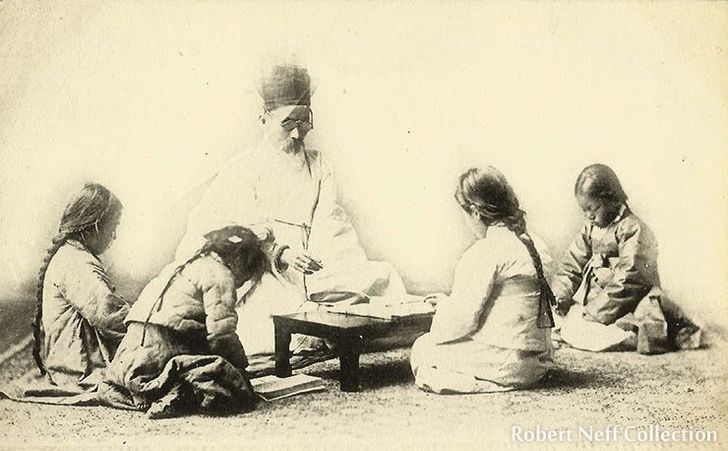
Teacher and students circa 1895
By Robert Neff
An education comes with great cost ― not only financially but also mentally, spiritually and, in the past, physically.
Frank G. Carpenter, an American journalist who traveled to Korea in the late 1880s and mid-1890s, wrote about his encounter with the youngest of Korean scholars.
While walking through one of Seoul's main streets he heard loud sing-song chanting. Intrigued, he followed it to a tiny hut where he found a small Korean traditional school.
Sitting on a mat before a small desk, a very imposing-looking teacher wearing a bright rose-pink gown, a cap of black horsehair on his head and glasses with lenses the size of Mexican silver dollars presided over his small class of four young boys. The sternness of his demeanor and the short stout switch in his hand commanded respect from his students.
Carpenter wrote:
“[The] scholars squat about on straw mats studying their lessons out loud. They sway themselves back and forth as they sing out again and again the words they are trying to learn, all shouting at once. If one stops, the teacher thinks he is not studying, and calls him up for a whipping.”
Apparently the young students were quite obedient during Carpenter's visit and no one was whipped until he asked for a demonstration. Of course, the teacher promptly complied.
“A little fellow, well knowing that he has done nothing wrong and will not be hurt, stretches himself on his stomach flat on the floor, while the teacher takes a rod and taps him a few blows on the thighs. We laugh. The little Korean laughs too, and when we have given him some coins worth about a cent of our money, he runs back to his seat, the happiest, as well as the richest, boy in school.”
The students' chief subject was to learn “by heart the sayings of the great Chinese scholars.” Carpenter explained that Koreans had “great respect for good scholarship” and that Korean officials were chosen, through public examinations, for their knowledge.
Education is still highly valued in modern Korea and very expensive ― financially, spiritually and mentally but fortunately corporal punishment has been abolished.
Good luck to the university students on their finals this week!