Trumpian brave new world
By Oh Young-jin
Will Donald Trump destroy the world?
It is a two-tiered loaded question.
The first is whether the incoming 45th U.S. president will emulate Herbert Hoover, his predecessor of a century ago to throw the world into the chaos of the Great Depression.
The second is how to deal with the dissatisfaction of the masses that are increasingly left behind and made irrelevant.
Trump owes his surprise election to those disaffected and is trying to respond to their demand.
His constituents in the U.S. and, by extension, sympathizers from all over the world, couldn’t care less, whether the world economy grew 3 percent or more as it did in the past 60 years or so. They want their fair share.
Oligarchs who reap the fruit of the growth ― corporations and elites ― are opposed to the change of the status quo.
At the center of this “class” struggle is globalization, the erstwhile engine of the world’s economy.
This disaffected class is so indignant with the status quo that they elected Trump, a Republican who was disowned by much of its leadership.
Before it, a majority of Britons voted for Brexit to get out of the European Union. They, too, were marginalized and angry. Next in line are France and maybe Germany. If either of the two is out of the EU, it means the end of the EU, the globalization project.
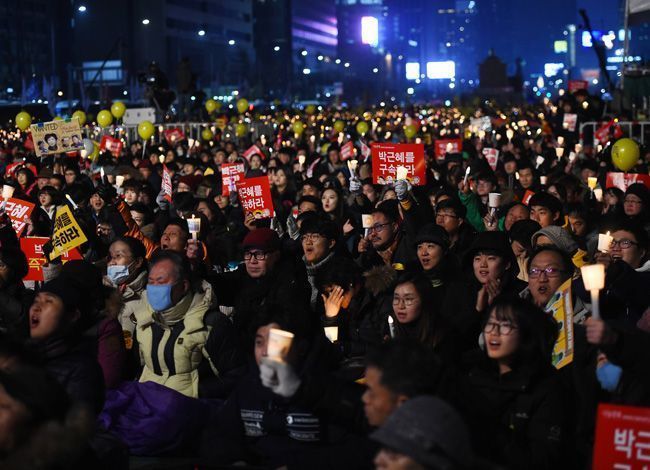
Outside, Korea’s impeachment saga on President Park Geun-hye is about a corrupt leader but, it is fueled by the discontent of people who have been made powerless. Young people living on paltry salaries with no better outlook call their country “Hell Joseon” from which they only wish to escape.
What aspects of globalization anger them? Globalization is about connecting diverse markets and turning them into one big market.
Globalization is a victim of its own success. It multiplied the size of global wealth and enriched a vast number of people. But then it spun out of control and acted as if it had its own mind ― becoming so ruthlessly efficient that people were kicked out of jobs and lost their dignity.
The 2008 Great Recession was a turning point. The distribution of wealth has failed to function and inequality has become out of proportion. The “Occupy Wall Street” movement forced the elites to confront the problem and correct it, but they turned away from it. The result was a strife pitting the top 1 percent against the remaining 99 percent. Remember it all started with the U.S. subprime mortgage crisis ― a binge on what appeared to be an unlimited supply of borrowed money ― and spread to the rest of the world because of its interconnected economy on the fast track of globalization.
Making the case worse is the onslaught of the fourth industrial revolution with artificial intelligence (AI) and automation, the cutting edge of globalization.
Robots with AI will be able to replace 70 percent of human workers in less than 10 years. The speed of development is so fast that it appears impossible to find new roles for humans. Most of them are destined to be “surpluses” with no purposes by the existing standard.
Trump’s answer is to reverse the path by calling for protectionism and isolationism.
He has called in American multinational companies to come back home and give Americans jobs.
An example is air conditioner maker Carrier, whose plan to move its operations to Mexico was scrapped by a combination of Trump’s threats and state subsidies. Ford and GM, big firms, are nixing plans to go abroad as well. Apple is also under pressure.
Trump has also vowed to “kill” international trade pacts ― the North American Free Trade Agreement (NAFTA), the 22-year-old trading block encompassing the U.S., Canada and Mexico; the Trans-Pacific Partnership (TPP), a trade agreement of 12 Pacific-rim countries; and bilateral pacts such as KORUS FTA with South Korea.
These pacts served as the superhighway of global commerce. Trump sees it as one that siphons off American jobs. He wants to shut it down. This entails repercussions of a global scale. Globalists ― most of them elitists, oppose it by all means, while erstwhile beneficiary countries balk at it.
South Korea fears a blow to its export-driven economy. China, being on par with the U.S. in the size of its economy, appears ready to go toe-to-toe, whether in a currency war or with high tariffs.
Doomsayers try to break the rank and file of Trump backers, calling them the first victims to be decimated by his policies ― his protectionism triggering a trade war with other countries, and his isolationism cutting America off from the global market. Europe can turn into a basket case, its economy still not being back in shape from its debt crisis.
Trump detractors’ predictions sound as scary as their lack of alternatives except for the status quo. As seen in previous trade wars, they claim that the world will end up in ruins if Trump continues to press his populist approach. Their prediction is that the world will revert to the era before globalization hit full stride. That is wrong because there is no past to go back to as there can only be a future.
All comes back to square one ― the masses vetoed the current system that benefits only a small demographic slice so unless they come up with an alternative that satisfies the other side, the Trumpian brave new world would be chosen by bye. At least, it has elements of destruction for the sake of construction and hopefully the end result is to reset the starting line so everybody will start with a clean slate.
Oh Young-jin is The Korea Times’ chief editorial writer. Contact foolsdie5@ktimes.com and foolsdie@gmail.com. This article is entitled “Trump Discount (II), a follow-up from last week.