We (Koreans) are thin-skinned
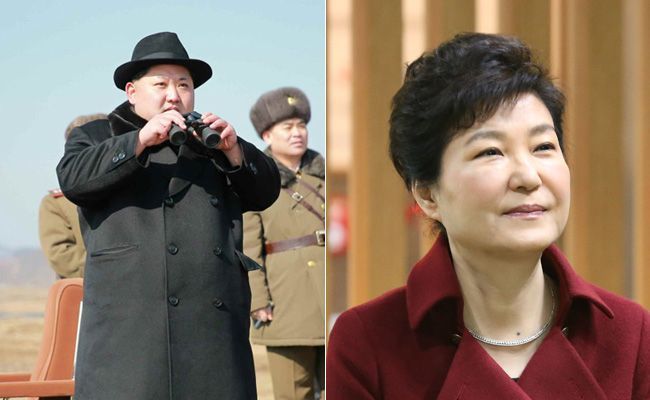
North Korean president Kim Jong-un, left, and South Korean president Park Geun-hye / Yonhap
By Oh Young-jin
The title is a political statement rather than a dermatological one.
More specifically, we are often prone to self-doubt, have quick-tempered quarrels on the basis of presumptions and learn no lessons from the failures at the risk of repeating the same mistake.
Here are three examples.
The future example: Now, China is proposing coupling the peace regime talks to replace the 1953 Korean War truce with talks for North Korea’s denuclearization. Of course, this is a stretch by any account because the peace regime talks alone will be complicated enough and throwing this together with other, equally complex denuclearization negotiations may be a recipe for disaster.
Barring the immediate implosion of the North and a second Korean War, it is still possible that the Chinese suggestion with modifications will be taken up and will proceed, if the North is squeezed by the upcoming stronger set of the United Nations sanctions.
The dilemma for Seoul is two-tiered, one about its adversary, North Korea, and the South’s ally, the United States. The South would fear it will be sidelined by the North, which will definitely insist that Seoul has no place at the negotiating table because it did not sign the truce. That has been the North’s official line, arguing that it will talk only to the U.S.
This fear is based on a doubt about itself, hardened by history. During the lead-up to the 1994 Agreed Framework, the then-Kim Young-sam government was completely left out in the cold from the U.S.-North Korea negotiations.
Korean officials relied on U.S. government handouts to know what was happening. It was by and large Kim’s misplaced conviction that his government would not talk to the North as long as it developed nuclear weapons. When Washington and Pyongyang cut the deal in Geneva, it was the South that had to foot the huge bill for the light water reactors to be provided in return for a freeze on the nuclear development. As all know, the deal fell through and, now, 20-plus years from then, we have North Korea on the verge of being a nuclear weapon state.
The collapse of the deal has triggered a lot of internal quarrels, but as things stand now, it is obvious that few lessons have been learnt.
The present example: Already, there are observations that the South has been sidelined by its ally, the U.S., which is suspected of trading away the issue of THAAD in order to acquire concessions from China in an effort to build a strong set of United Nations sanctions against the North for its latest nuclear test and rocket launch.
The Terminal High-Altitude Area Defense system is aimed at intercepting the North’s ballistic missiles and the allies have decided to bring one battery into the nation to protect Koreans and American soldiers. China is strongly opposed to it, so some people speculate that Washington and Beijing cut the deal behind Seoul’s back.
Already, some now suggest that Seoul finds itself in precisely the same old weak position, not being able to influence the course of its future. Once there are more truths out on the THAAD decision, there will be more quarrels. The same vicious cycle would be repeated.
The past example: Last September, President Park joined his Chinese counterpart Xi Jinping for Beijing’s celebration of Japan’s defeat in World War II. She was the only head of a U.S. ally to attend the ceremony and was hailed for her bold action that befits its new middle-power status. Even in the weeks before her Beijing trip, she was in the hot seat for failing to navigate the tricky diplomatic waters being chopped up by Japanese Prime Minister Shinzo Abe’s unashamed denial of responsibility for Japan’s war crimes and the U.S. endorsement of this stance.
Park’s roller-coaster ride also testifies to the vicious cycle at work.
What causes Koreans to be politically thin-skinned? One cause is an inflated view of self. South Korea should realize it is an emerging middle power located in the convergence of big powers and learn how to promote its best interests. But it acts as if it were a big power, putting itself on a collision course without preparing for Plans B, C and D.
This peculiar behavior deprives it of an imaginative diplomacy and causes a collective case of heartburn, when the gap between its view and reality clashes. One consolation is that no country, even the U.S. and China, is master of its own fate ― they are expected to play their roles according to a given set of circumstances. Understanding this order is the first step in gaining a political thick skin and strengthening our say in our future.
Oh Young-jin is The Korea Times’ chief editorial writer. Contact him at foolsdie5@ktimes.com.