A goosefoot cane for centenarians
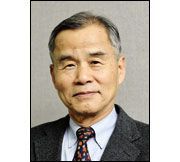
By Lee Sun-ho
On the last day of September, the Nonhyeon 2-dong Community Service Center in Gangnam-gu, Seoul, called my house and asked me to come there and take a stick for a special purpose.
The auspicious occasion was see my 100-year-old mother collect a long-life walking cane called “cheongryeo-jang” which is made of a goosefoot herb. The staff in charge of senior citizens’ affairs told me there were only two female centenarians eligible for receiving this special cane, which would be given to them by the president, in the center’s district of jurisdiction. All this was part of the commemoration into the 18th anniversary of Respect for the Elderly Day, which is held on Oct. 2 and is arranged by the Ministry of Health and Welfare.
To the best of my knowledge, few Koreans pay much attention to the meaning of “cheongryeo-jang,” the origin of the Respect for the Elderly Day, or indeed the statistics of centenarians at home and abroad.
The goosefoot is a genus of annual herbaceous flowing plants which occur almost anywhere in temperate regions around the world. The weedy, rank-smelling plant resembles the foot of a goose. The branched stems grow erect, ascending, or scrambling, while the lowermost stems do the opposite. Its root becomes bent, and thus suitable to be used for a stick handle. In history, a goosefoot cane was given to people who reached 80 years of age by kings or queens in the Unified Silla during the Joseon Kingdom period.
Since 1992, then-President Kim Young-sam started to present the traditional cane to 100-year-old citizens. The walking cane is strong, light and elegant. Its color and shape symbolize longevity, and has been used since the Chinese dynasty era.
In 1990, the 45th U.N. General Assembly in Vienna designated Oct. 1 as International Day for the Elderly. The Korean government, however, made Respect for the Elderly Day on Oct. 2 in 1997, because Oct. 1 was already promulgated by presidential decree as the Armed Forces Day in 1956.
Korea’s growth rate of its centenarian population is increasing rapidly. Centenarians here numbered 1,359 (199 males and 1,160 females) in 2014, and 1,264 (200 males and 1,064 females) last year.
The increasing trend of the centenarian population in Korea is quite noticeable in retrospect to 1,201 in 2012, 927 in 2011, 904 in 2010, and 884 in 2009. Also, it is worthy to note that male centenarians are less than one seventh of the total. My mother was born on May 22, 1914, while my former boss, who is hospitalized now, was born on March 6, 1914, two and a half months before her.
Of the 316,600 centenarians worldwide estimated by the Population Division of the U.N., Korea’s figure is 14,592 (4.6 percent). Japan has the most centenarians with 54,397 (17.2 percent), followed by the U.S. with 53,364 (16.8 percent), China with 48,921 (15.5 percent), Brazil has 22,760 (7.5 percent), France numbers 20,106 (6.4 percent) and Thailand hosts 17,883 (5.7 percent).
In honor of my mother’s centennial birthday, I consider the goosefoot cane given by the president as a most precious family treasure, even though “cheongryeo-jang” is a common and inexpensive herb stalk costing around 70,000 won. The Korean people must look after the elderly and maintain the traditions we hold dear to care for them until their time on this earth comes to an end.
After all, as the government debates the details of an “Elderly Welfare Act”we are watching our birth rate dwindle and our older people fall into poverty. Something needs to change.
The writer is an outside director of Samyang Tongsang Co., Ltd. in Seoul. Contact him at kexim2@unitel.co.kr.