‘It just makes me happy to look at it’: Korean adults go wild for ‘cuteness’
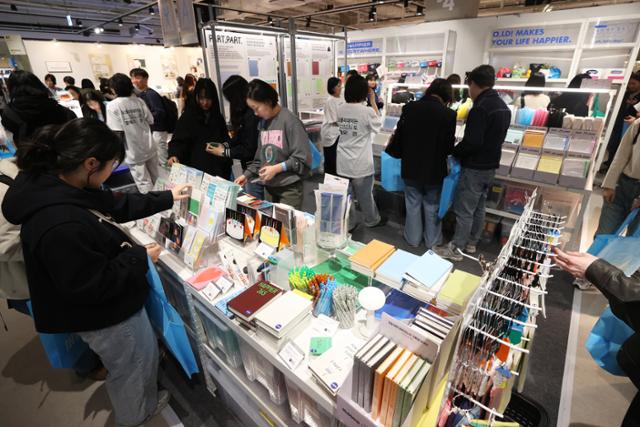
Visitors look around the exhibition at the “Inventario: 2025 Stationery Fair” at COEX in Seoul’s Gangnam District on April 2. Yonhap
A growing number of young Korean adults are spending their money on “cute” products — from plush keychains to cartoon-themed pens — as a way to lift their moods and find comfort in an increasingly uncertain society.
“I feel better every time I look at something cute,” said Oh Bo-mi, 26, an office worker who recently purchased a pen topped with a white bear doll at the “Inventario: 2025 Stationery Fair” held in Seoul’s Gangnam District on April 2. She added that she often carries cute keyrings and household items with cartoon characters. “They brighten my day, so I keep buying them.”
This trend, dubbed “cuteness consumption,” has taken hold among the MZ generation — Koreans in their 20s and 30s — with businesses actively jumping on board. Online sales for items featuring charming characters are surging, and the recent popularity of Studio Ghibli-style AI-generated portraits on social media reflects the same phenomenon.
A visitor browses keyrings and other items at the K-Illustration Fair Seoul at COEX in Seoul’s Gangnam District, Feb. 6. Yonhap
This trend, dubbed “cuteness consumption,” has taken hold among Koreans in their 20s and 30s, — with businesses actively jumping on board. Online sales for items featuring charming characters are surging, and the recent popularity of Studio Ghibli-style AI-generated portraits on social media reflects the same phenomenon.
The boom began around 2020, when Pokémon-themed snacks, Crocs shoe charms known as Jibbitz, and plush keyrings became wildly popular. That same year, a giant panda named Fu Bao, born at Everland’s Panda World, triggered a national obsession. A variety of Fu Bao merchandise — toys, books, household items — sold out repeatedly, and videos of the panda drew massive online audiences.
Stationery featuring adorable designs is also in high demand. College student Heo Yu-jin, 22, said she sticks Hello Kitty and Sanrio-themed stickers on her laptop and other belongings. “It’s really satisfying to use cute things,” she said. Kim Chae-yeon, a 29-year-old office worker, echoed the sentiment: “If I’m going to buy something anyway, I go for the cute option. It just makes me feel calm.”
According to online lifestyle retailer 29CM, sales in the stationery category from January to March this year tripled compared to the same period in 2023. A company representative said the biggest buyers were women aged 25 to 39, who are no longer purchasing stationery purely for work but instead choosing items that reflect personal taste. Over five days, more than 25,000 people visited a stationery fair co-hosted by 29CM and Point of View, a stationery boutique in Seongsu-dong, Seoul.
Pokémon bread by SPC Samlip is displayed at a large supermarket in Seoul on Feb. 13. Yonhap
Stickers featuring cute characters / Courtesy of Heo Yu-jin
The economic downturn may also be fueling the cuteness craze. By collaborating with popular character brands like Pokémon and Sanrio, companies can save on product development costs while still appealing to buyers. Choi Ji-hye, a researcher at Seoul National University’s Consumer Trend Analysis Center and co-author of “Trend Korea 2025,” said, “In tough economic times, consumers tend to opt for inexpensive but emotionally satisfying items. The ongoing wave of character-based merchandise is closely related to this shift.”
Rising social conflict is another factor. Choi said that during the pandemic, many Koreans sought comfort in harmless, adorable things to alleviate feelings of isolation. “As generational and gender-related tensions grow, more people are turning to ‘cuteness consumption’ for emotional relief,” she said. Inha University professor Lee Eun-hee agreed, noting that “young people today, who have enjoyed a richer cultural environment than previous generations, are more in touch with their inner child. They often find solace in toys, dolls, or nostalgic stationery.”
Kang Seung-hye, author of the book whose Korean title translates to “I Buy It Because It’s Cute,” wrote that the feeling of cuteness plays a vital role in helping people live together as a community. “In an age where dopamine-fueled pleasures dominate,” Kang said, “the popularity of cuteness may be a way to restore a sense of balance and stability in life.”
This article from the Hankook Ilbo, the sister publication of The Korea Times, is translated by a generative AI system and edited by The Korea Times.