How Dubai-style dessert Dujjonku became Korea’s hottest café-to-hotel craze
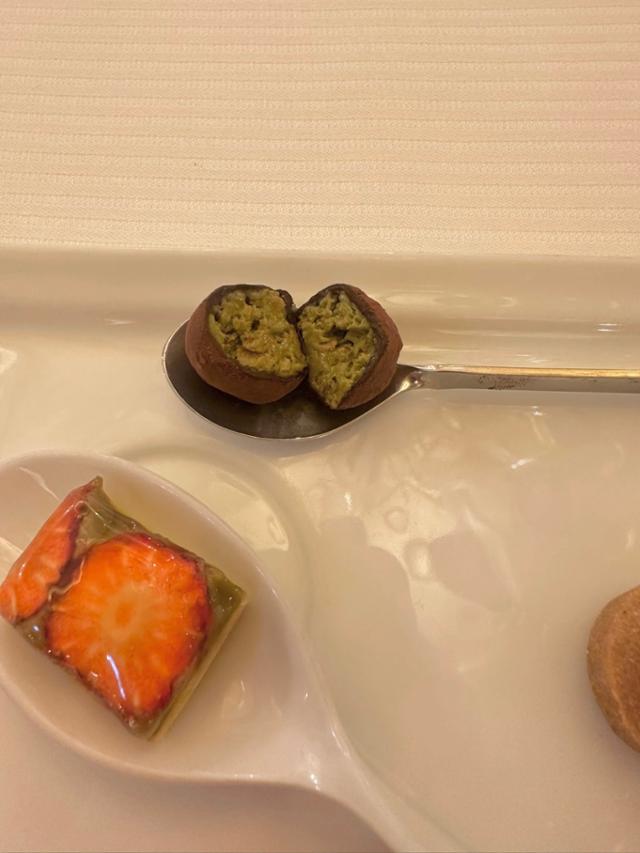
A dujjonku-inspired served as the dessert for all course menus through February at Pierre Gagnaire à Séoul, the French restaurant at Lotte Hotel Seoul / Courtesy of Lotte Hotel & Resorts
A dessert trend that began behind cafe counters is now breaking out — and reshaping Korea’s retail market.
Known as "Dujjonku" — short for “Dubai chewy cookie” — the treat has become an instant sell-out at convenience stores and has even begun appearing on the dessert menus at luxury hotels.
At Pierre Gagnaire à Séoul, a French restaurant at Lotte Hotel Seoul in central Seoul, dujjonku-inspired petit four are being offered as the dessert for all course menus through February, according to the hotel industry on Tuesday.
The dish substitutes kataifi — thin Middle Eastern pastry strands that have become difficult to source amid the trend — with Pailleté Feuilletine, a crispy crepe flake offering a similar texture. Pistachio is added, before the dessert is wrapped in a thin marshmallow layer and finished with cocoa powder.
“For hotel restaurants, which are typically slow to reflect trends, to release something this quickly shows how strong the dujjonku craze has become,” a hotel industry official said.
Dujjonku is a Korean reinterpretation of the Dubai chocolate trend that gained popularity in 2024. It blends crispness with sweetness and nuttiness, and despite being labeled a cookie, its chewy texture is closer to that of rice cake.
Its rise was accelerated by celebrity social media posts, spawning online “dujjonku maps” that track cafes selling the dessert and their remaining stock. With supplies disappearing shortly after opening, early-morning visits quickly became the norm.
Convenience stores rush to capture demand
CU private-brand desserts inspired by dujjonku (Dubai chewy cookie), including the Kataifi Chocolate Chewy Rice Cake / Courtesy of BGF Retail
Convenience store chains were quick to capitalize on the trend, finding notable success with private-brand products based on dujjonku. CU, which introduced items like Kataifi Chocolate Chewy Rice Cake, Dubai Chocolate Brownie and Kataifi Chewy Macaron in late October last year, sold more than 1.8 million units of the rice cake alone over three months. Cumulative sales of Dubai-themed products surpassed over 8.3 million units.
The company also plans to roll out the Dubai Style Towel Cake starting Wednesday. First released last December, the product’s initial batch of 40,000 units sold out quickly, followed by another sell-out of 21,000 units through preorder this month. CU is also preparing to introduce two new Dubai themed items in the near future.
GS25 also joined the trend, releasing a series of Dubai chocolate desserts since last October, including chocolate bars and chocolate balls. The products have sold more than 1 million units, with sell-through rates reaching 97 percent, quickly turning them into instant sell-outs.
Average monthly sales of the products are now more than 4.3 times higher than in the first month. As more consumers try making dujjonku at home, sales of marshmallows — a key ingredient — have also surged nearly fiftyfold.
Visual appeal fuels social media demand
GS25’s Dubai Chewy Chocolate Ball, left, and 7-Eleven’s Kataifi Chewy Ball, both inspired by dujjonku / Courtesy of GS Retail and 7-Eleven
Earlier this month, 7-Eleven also followed suit by introducing the Kadayif Ball. Within just 11 days, dessert-category sales jumped 250 percent. Encouraged by the response, 7-Eleven plans to release new desserts using kataifi.
Emart24 has also benefited from the craze. After releasing two Dubai-inspired desserts last month — Chocolate Kataifi Mochi and Chocolate Castella Kataifi Mochi — both products recorded second-week sales increases of 81 percent compared with their first week. The momentum helped push monthly cumulative sales past 180,000 units, placing the two items first and second in the dessert category.
The surge in demand was also reflected online, where related search terms ranked first and second on Emart24’s mobile app, suggesting strong conversion from consumer interest to purchase.
“Its appeal goes beyond taste,” a retail industry official said. “The visuals make it highly shareable on Instagram and other social media. In a challenging business environment, dujjonku is likely to remain a reliable revenue driver for some time.”
Emart24’s Chocolate Castella Kataifi Mochi and Chocolate Kataifi Mochi, released last month / Courtesy of Emart24
This article from the Hankook Ilbo, the sister publication of The Korea Times, is translated by a generative AI system and edited by The Korea Times.