The Korean flavor winning over New York
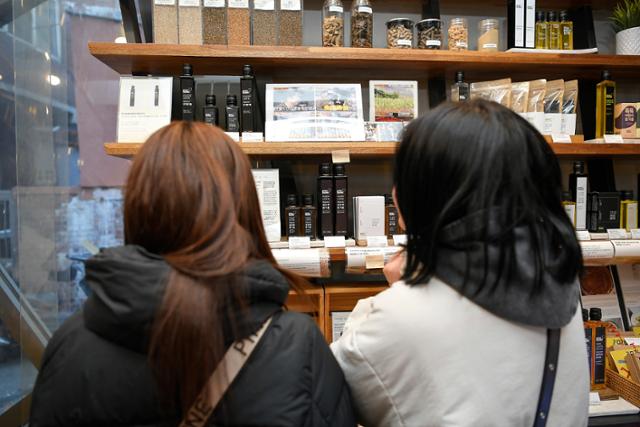
Japanese tourists browse Queensbucket in central Seoul, Jan. 2. Korea Times photo by Lim Ji-hoon
“I became interested after seeing actor Lee Kwang-soo on a variety show. In Japan it is even introduced as a must-try course,” Haru, a 26-year-old visitor from Okayama, said as she picked out two palm-sized glass bottles from a narrow alley shop in central Seoul on Jan. 2.
The store was not selling K-pop merchandise or cosmetics. Instead, its neatly arranged shelves were filled with premium sesame oil, with staff explaining in Japanese that it tastes good mixed with shoyu, or soy sauce.
Once sold in squat cans or soju bottles and long overshadowed by olive oil, sesame oil is now being reimagined as a wellness-driven premium product. Riding the global popularity of Korean cuisine, it has also become a sought-after ingredient among chefs worldwide.
The shift began in the late 2000s, when consumers learned that the traditional high-temperature pressing method — roasting sesame seeds at about 270 degrees Celsius — could destroy nutrients and even produce carcinogens such as benzopyrene. While shoppers wanted healthier options, mass-produced oils fell short in flavor and raised concerns because of chemical solvents used in large-scale production.
Kim Jong-ho arranges bottles of oil for sale at Jubu Sanghoe in Nowon, Seoul, Monday. Korea Times photo by Kang Ye-jin
An alternative emerged in low-temperature pressing, which uses roasting temperatures below 160 degrees to preserve beneficial compounds linked to anti-cancer, anti-diabetic and cholesterol-lowering effects. The resulting oil has a lighter, cleaner taste and a more delicate aroma, making it suitable even for Western dishes.
“It was not easy at first. People even accused us of mixing in soybean oil,” Jeong Jae-seo, the 70-year-old owner of Jubu Sanghoe in northern Seoul, said, recalling how the shop began using low-temperature methods in 1992.
Lower yields and higher costs have also been obstacles. Park Jung-yong, CEO of Queensbucket, a startup that has become a leader in the premium sesame oil market, said, “The lower the temperature, the higher the pressure required, so machines break down more often.”
Demand surged after the coronavirus pandemic as consumers paid more attention to health. The Ministry of Agriculture, Food and Rural Affairs said in a 2022 report that even unroasted raw sesame oil is seeing rising demand, signaling growth in the premium segment. Aging demographics have also helped, with more people seeking high-quality ingredients for healthier later years.
Park Jung-yong, CEO of Queensbucket, checks a sesame oil production machine at the company’s factory in central Seoul, Jan. 2. Korea Times photo by Lim Ji-hoon
As interest grows, consumers are now paying attention to the origin and variety of sesame seeds. Different cultivars offer distinct flavors and nutritional profiles. The Miryang-74 variety developed in 2022 contains four times more lignans — compounds linked to antioxidant and cognitive benefits — than the Geonbaek variety released in 2013.
“High-temperature pressing makes domestic and imported seeds taste almost the same, but in reality each region and variety has its own character,” Park said, adding that roasting temperatures must even be adjusted depending on how ripe the seeds are.
Small-size packaging is another trend. Inspired by the olive oil market, some consumers now buy bottles of 10 milliliters or less to prevent oxidation and for easy carrying. “It’s expensive, but stick-type sesame oil is convenient when I go camping,” Kim Seo-young said.
Jubu Sanghoe has also expanded its lineup, with Kim Jong-ho saying, “As nuclear families become the norm, even people in their 40s and older prefer smaller bottles, so we are preparing products as small as 2 milliliters.” Queensbucket sells six different sizes ranging from 5 milliliters to 500 milliliters.
Upcycled food products including "Veggie Powder" made from sesame residue are on display at Cuenz Bucket in central Seoul, Jan. 2. Korea Times photo by Lim Ji-hoon
Even the leftover sesame cake, once used only as fertilizer or feed, is now being studied for upcycled foods such as protein bars and cereal, according to the Rural Development Administration, which introduced related methods in 2023.
The buzz has reached overseas kitchens. Michelin three-star restaurant Eleven Madison Park and two-star Daniel in New York both source sesame oil from Queensbucket. BBC Food lists 376 recipes that use sesame oil.
Trade data reflects the trend. The Korea Customs Service said the trade balance for sesame oil and its fractions grew from $1.98 million in 2016 to $10.38 million last year, a 5.2-fold increase over a decade, driven by exports that nearly quadrupled to $14.53 million.
Still, experts say more promotion is needed, as K-food abroad remains focused on processed items rather than ingredients. “Hands-on Korean cooking experiences and the popularity of cooking shows can help expand the premium sesame oil market,” said Choi Hyung-min, a professor of food economics at Yeungnam University.
Eleven Madison Park in New York, which uses sesame oil supplied by Queensbucket / Captured from the restaurant’s website
This article from the Hankook Ilbo, the sister publication of The Korea Times, is translated by a generative AI system and edited by The Korea Times.