Let the wind take you this spring — soar over Yangpyeong with paragliding
A paraglider takes flight from a launch site on Mount Yumyeong in Yangpyeong, Gyeonggi Province. Hankook Ilbo
A paraglider descends toward the landing zone at the Mount Yumyeong paragliding site in Yangpyeong. Hankook Ilbo
“It might feel like flying is nothing at all,” said a guide, smiling as if to calm the nerves of first-timers.
The journey to my first paragliding experience began not in the sky, but on a rough, narrow mountain trail snaking up the side of Mount Yumyeong (863.9 meters) in Yangpyeong County, Gyeonggi Province — dubbed a “paragliding sanctuary.” On the morning of May 4, six of us boarded a 1-ton truck en route to the launch site, bumping along the unpaved road. Tension was already thick in the air. Perhaps the bumpy ride was meant to take our minds off the flight ahead.
Yangpyeong: A haven for flight
Yangpyeong, located just 30 minutes from Seoul by train, is a popular weekend retreat for city dwellers. From Dumulmeori — the scenic meeting point of the Bukhan and Namhan rivers — to Mount Yongmun, the area is known for lush landscapes and cozy eateries. But unlike other tourist towns, its skies are often dotted with colorful parachutes.
The region’s high elevation and ideal weather conditions — stable wind and temperature — make it perfect for paragliding. Because the sport depends on thermals and wind to gain altitude, Yangpyeong offers both long flight times and easy accessibility.
Two paragliders land at the Mount Yumyeong landing zone. Hankook Ilbo
Paragliding always starts with a weather check. No rain and, preferably, no strong winds. Safety-first policies mean local companies cancel flights based on forecasts, sometimes at the last minute. My own flight was delayed four days due to weather. Even on the scheduled day, morning fog threatened cancellation until it finally cleared.
Once you’ve booked a session and arrived at Yangpyeong Station, a pickup truck takes you to the landing zone at the foot of Mount Yumyeong. Three companies operate there, using shared takeoff and landing sites with identical pricing. First-timers fly tandem with certified pilots, and optional add-ons include solo steering trials, altitude matching with friends or even flying with a pet.
After selecting your flight course, you gear up. I received a green pilot-style jumpsuit, while another guest opted for a red windproof suit. In autumn and winter, thick windproof gear is used; in spring and summer, lightweight fabric suits are typical.
Our flight group was diverse — not limited to thrill-seeking twenty-somethings. A mother and daughter, a young couple on a flying date and even an enthusiastic elementary schooler were among the flyers, each quietly bracing for takeoff.
Theory, technique — and adrenaline
Before takeoff comes theory and safety instruction. Pilots handle all flight control for beginners, but takeoff and landing are critical. The rules are simple: When the parachute opens on the ground, it may pull you backward — lean back and maintain balance. Don’t stop running until fully airborne. During landing, lift your legs skyward to soften impact.
The mountain road leading to the summit of Mount Yumyeong is narrow and rugged. Hankook Ilbo
A scenic view unfolds along the trail to the summit of Mount Yongmun. Hankook Ilbo
Then came the final journey up to the launch site — another 20-minute ride up steep, rugged trails. The vehicle tossed us around like rag dolls. Laughing, our guide joked, “You get two adventures for the price of one: off-roading and flying.”
Mount Yumyeong has three takeoff zones, selected based on the day’s wind. That day, the lowest launch point had optimal conditions.
At the launch site, a flyer wears a helmet and harness, ready to connect to the parachute. Hankook Ilbo
Paragliding participants prepare for takeoff. Hankook Ilbo
At the top, I donned a helmet, gloves, knee pads and a harness. While it looked like a slack backpack on the ground, the harness transformed midair into a seat with an air-cushion that absorbs impact during landing.
Once the pilot completed final checks, it was time. The parachute pulled forcefully from behind. I struggled for balance — training suddenly felt theoretical. “Run!” shouted the pilot, and I sprinted forward with all my strength.
My feet briefly lifted, then dropped again. “Keep going!” he urged. I kicked through underbrush until, like a balloon, I was suddenly weightless. I knew I’d truly taken off.
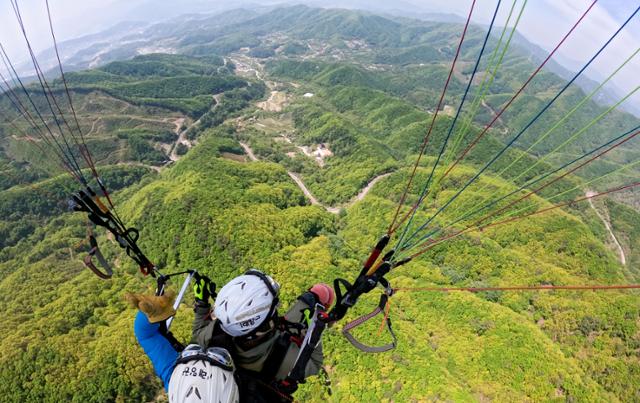
A wide-open view stretches out beneath a paraglider's feet during flight. Hankook Ilbo
A paraglider glides at a near-vertical angle above Mount Yongmun. Hankook Ilbo
Suspended in the inflated harness seat, I looked around — everything was below me. It was pure freedom. Nothing on solid ground had ever felt like this. From above, spring’s budding trees looked like mossy patches. Trails and rivers curled like capillaries across the earth. What was once invisible from the ground unfolded in full view.
Any fear or nausea I’d worried about vanished the moment I left the ground.
The thrill of descent — and the pulse of Yangpyeong
After about 10 minutes, it was time to land. “Would you like a gentle landing? Or something dynamic?” the pilot asked. I paused, then chose the latter.
The parachute tilted hard, then soared back upward. For a moment, I felt like I was riding an airborne Viking ship at an amusement park. It became clear why parachutes (used for falling) and paragliders (used for gliding) are named differently.
The inflated airbag beneath the harness absorbs impact during landing. Hankook Ilbo
As we descended toward the landing zone, we climbed and dipped to hit the target precisely. That’s when motion sickness crept in — like being rocked by ocean waves. But the landing itself was unexpectedly smooth. With legs lifted, the ground met my seat before I even realized. My first flight had ended — safely and spectacularly.
Paragliding is a year-round activity. Fall, with its stable winds, offers the most flying days. Summer flights provide refreshing breezes at altitude. Winter is cold but offers stunning views of snow-covered peaks. Spring is unpredictable — flights are often canceled — but pilots love its mild winds and fresh green landscape.
Yongmun Millennium Market stands in front of Yongmun Station in Yangpyeong, Gyeonggi Province. Hankook Ilbo
Many stalls at Yongmun Millennium Market sell wild greens. Hankook Ilbo
Markets, wild herbs and river walks
Yangpyeong also boasts vibrant local markets. If your timing is right, visit one of five traditional markets along the train line: Yangsu Market (1st and 6th), Yangpyeong Mulmalgeun Market (3rd and 8th), Yongmun Millennium Market (5th and 10th), Jipyeong Market (1st and 6th) or Yangdong Ssanghak Market (4th and 9th). The largest are Yangpyeong and Yongmun, each with over 100 vendors.
True to its mountainous roots, Yangpyeong’s markets are known for wild greens and mushrooms, often sold in woven baskets. Locally grown mushrooms are large and meaty, and Yongmun hosts an annual wild greens festival each late April. Market snacks and local food stalls make it easy to refuel after a flight.
A view of Dumulmeori and the Semiwon lotus garden in Yangpyeong / Hankook Ilbo
The Mului Garden in Namyangju, next to Dumulmeori / Hankook Ilbo
Round out your trip with a gentle riverside stroll. With the Han River splitting into two branches, Yangpyeong is full of scenic water views. Must-visit spots include Dumulmeori, the Semiwon lotus garden and Namyangju’s Mului Garden just across the county line. Come summer, lotus blossoms will be in full bloom.
This article from the Hankook Ilbo, the sister publication of The Korea Times, is translated by a generative AI system and edited by The Korea Times.