Curious about Korea's hanbok promoted by RM? Easy ways to add it to daily life
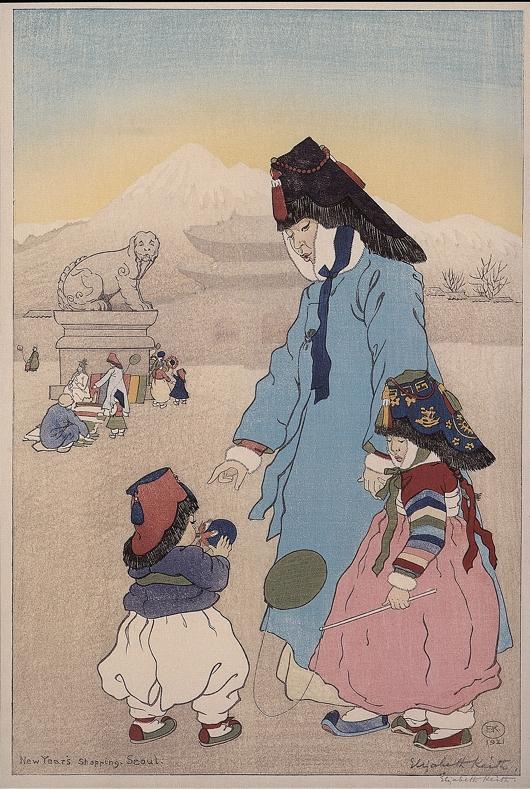
Elizabeth Keith’s painting “New Year’s shopping” / Courtesy of the National Museum of Modern and Contemporary Art, Korea
On the morning of Lunar New Year’s Day in 1921, a young woman believed to be a mother took two children on an outing to Gwanghwamun under the rosy winter sun above snow-covered Bugaksan. The girl wore a rainbow-striped jeogori and a gold-patterned headdress, while the younger boy donned colorful silk shoes and a snug winter cap.
This was how British painter Elizabeth Keith captured the holiday in colonial-era Korea. Struck by the sight of people traditionally known as the “white-clad folk” dressed in vibrant colors, she wrote in her book "Eastern Windows" that Seollal is Korea’s greatest festival and that everyone, young and old, dresses in their finest clothes and goes out.
A century later in 2026, households in the birthplace of hanbok rarely prepare the traditional five-colored New Year attire. Yet around the world, hanbok has become an object of admiration — no longer an unfamiliar costume from a distant land but a symbol of K-culture. To examine the present state of hanbok studies and ways to incorporate it into modern life during the holiday, The Hankook Ilbo met Choi Jeong, professor of fashion design at Wonkwang University and president of the Korean Society of Hanbok Culture.
New Year attire once made with care and meaning
A kkachi durumagi (colorful striped overcoat) for girls / Courtesy of the Academy of Korean Studies
It is unclear exactly when the custom of making new clothes for Lunar New Year began. Scholars assume people dressed in clean garments at the turn of the year as early as the Three Kingdoms period, but detailed records appear only in late-Joseon seasonal texts such as “Gyeongdo Japji” (late 18th century) and “Yeolyang Sesigi” (1819).
Most descriptions of historical New Year attire also date to the late Joseon period. Choi said a royal costume manual written by Lady Gyeongbin Kim (1832–1907), a concubine of King Heonjong, notes that “on special days such as the first day of the first lunar month or birthdays, women wore a green dangui, a red skirt, and a navy underskirt, along with a three-piece norigae ornament.”
Choi Jeong, professor of fashion design at Wonkwang University and president of the Korean Society of Hanbok Culture, speaks with The Hankook Ilbo during an interview in her office in Jongno District, Seoul, Feb. 2. Korea Times photo by Lim Ji-hoon
Common households also devoted care to holiday dress. Records show housewives sewing New Year garments themselves until New Year’s Eve using winter fabrics. Children were often dressed in colorful striped overcoats known as kkachi durumagi, and given fine shoes. Such attention reflected the belief that New Year attire served as ritual clothing to ward off misfortune and invite good fortune. Even if families could not afford a full new outfit, presenting elders with newly made socks for New Year bows was customary.
Fewer chances to wear hanbok today
Today, few people commission new hanbok for the holiday. Outside of renting “fusion hanbok” near historic palaces, opportunities to wear the attire are scarce. The recent popularity of AI filters that convert everyday clothing into “digital hanbok” images reflects what Choi described as a bittersweet reality for the tradition.
Visitors browse the Hanbok Expo held at COEX in Seoul from Aug. 7 to 10 in 2025. Courtesy of the Korea Craft and Design Foundation
She cited high prices and a lack of occasions as key reasons hanbok has faded from daily life. “The fact that ‘Hanbok Expo,’ the country’s only government-hosted hanbok fair, has recorded record sales for several years shows that interest is high but there are few venues beyond the expo,” she said.
Institutional support also lags behind that for other cultural assets such as traditional architecture and cuisine. While laws promoting hanok and Korean food were enacted in 2014 and 2019, respectively, the Hanbok Culture Industry Promotion Act only entered parliamentary review this month. National surveys of the hanbok industry are conducted just once every five years.
Research on historical hanbok authentication and restoration has also stagnated since the 2000s. The Korean Society of Hanbok Culture, founded in 1997 to pursue in-depth scholarship on traditional hanbok, has found it increasingly difficult to secure government funding for small-scale academic projects, Choi said.
Claims over hanbok origins rejected
Amid these circumstances, repeated attempts by China to register hanbok-related heritage — including listing hanbok as intangible cultural heritage in 2008 — have sparked criticism that Korea’s complacent response enabled such disputes. Recently, controversy also arose after Chinese traditional clothing was marketed as “hanbok” on Amazon.
A Goryeo-style formal daywear outfit for upper-class women presented by Choi Jeong at her exhibition in June 2023 / Courtesy of Choi Jung
Choi firmly rejected claims that hanbok originated in China, saying they are “not true.” While Joseon adopted some Ming dynasty dress codes for official garments, she said earlier history shows Goryeo customs spreading to the Yuan dynasty through court attendants and influencing early Ming fashion.
Regarding deeper roots, she said hanbok likely reflects practical attire favored by nomadic peoples such as Scythian groups before the Common Era. “In early Three Kingdoms times, long trailing robes like those of Chinese elites were rare, but as social stratification developed, longer garments became common,” she said. As a specialist in Goryeo costume, Choi has also curated exhibitions to counter misrepresentations of hanbok.
She expressed concern that historically inaccurate hanbok designs continue to circulate in media. “Incorporating new designs in line with modern trends should be encouraged,” she said, “but when I watch historical dramas, I sometimes worry I may have misunderstood what is authentic.”
Everyday interest and small steps encouraged
In this context, Choi said donations by RM, leader of K-pop group BTS, were highly encouraging. In 2021–2022, he donated 200 million won (about $150,000) to preserve Korean cultural artifacts overseas. Part of the funds supported conservation of a Joseon-era bridal robe held by the Los Angeles County Museum of Art, leading to an exhibition in Korea in 2023.
The Netflix animation “KPop Demon Hunters” has also been welcomed by hanbok scholars. Choi said it helped popularize the fact that the traditional gat hat — another subject of Chinese cultural claims — is Korean, and turned traditional accessories into fashionable items, inspiring hanbok-themed online challenges.
A hwarot bridal robe from the early 20th-century Joseon held by the Los Angeles County Museum of Art / Captured from the National Palace Museum of Korea
For the holiday, Choi recommended incorporating hanbok elements into daily life through accessories such as “daenggi scarves” or “norigae key rings.” “Reducing resistance to modernized hanbok that can be worn in everyday life is important,” she said. “Even wrapping a single sejodae belt should be recognized as wearing modern hanbok.”
This article from the Hankook Ilbo, the sister publication of The Korea Times, is translated by a generative AI system and edited by The Korea Times.