Birgit Nilsson Prize recognizes festival celebrating past and future of opera
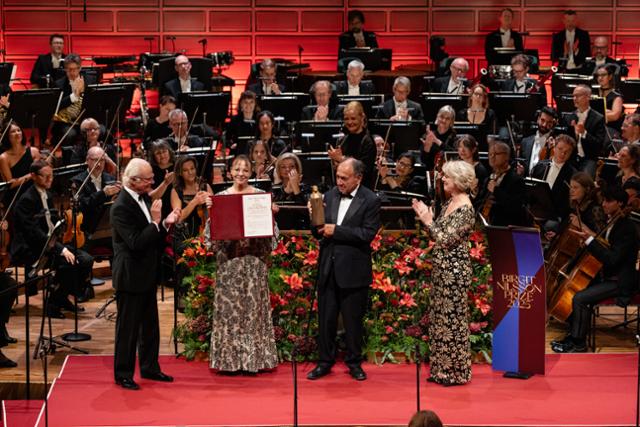
Sophie Joissains, mayor of Aix-en-Provence, and Paul Hermelin, chair of the Aix-en-Provence Festival board, hold up the Birgit Nilsson Prize after receiving it from King Carl XVI Gustaf of Sweden at the Stockholm Concert Hall on Oct. 21. Susanne Rydén, head of the Birgit Nilsson Foundation, applauds in celebration. Courtesy of Yanan Li
Award dubbed ‘the Nobel Prize of classical music’ held every three years
STOCKHOLM — “Today’s stage is a music celebration that honors both the legacy of Birgit Nilsson and this year’s laureate, France’s Aix-en-Provence Festival,” said Susanne Rydén, head of the Birgit Nilsson Foundation, opening the 2025 Birgit Nilsson Prize ceremony at Stockholm Concert Hall on Oct. 21.
Just 10 months after Korean author Han Kang received the Nobel Prize in literature on the same stage, King Carl XVI Gustaf of Sweden once again took the podium, this time to present the world’s most prestigious classical music award.
Established by legendary Swedish soprano Birgit Nilsson (1918-2005), who donated her personal fortune to create the award, the Birgit Nilsson Prize is presented every three years to recognize outstanding contributions to classical music. Valued at 1 million dollars, it is the largest monetary award in the classical field.
This year, the honor went to the Aix-en-Provence Festival, the first time a festival has received the prize rather than an individual artist. When announcing the laureate in May, the foundation said the festival “set a significant milestone in modern opera and added an important chapter to the history of the art form.”
A tribute to opera’s past and future
Paul Hermelin, left, chair of the Aix-en-Provence Festival board, delivers his acceptance speech onstage with Sophie Joissains, mayor of Aix-en-Provence, during the Birgit Nilsson Prize ceremony at Stockholm Concert Hall on Oct. 21. Courtesy of Yanan Li
The ceremony opened with a video of Nilsson performing “Dich, teure Halle” from Wagner’s “Tannhauser,” a nod to her legendary career as a Wagnerian soprano.
The event included tributes to Nilsson’s legacy, as well as to director Pierre Audi (1957-2025), who had led the Aix-en-Provence Festival since 2019 and Finnish composer Kaija Saariaho (1952-2023).
Under Audi’s leadership, the festival — founded in 1948 with a repertoire centered on Mozart — expanded its scope to modern opera, earning international acclaim. Saariaho’s opera “Innocence,” which debuted at the 2021 festival with a libretto by Finnish novelist Sofi Oksanen, tackled the theme of a school shooting, showing how opera can explore contemporary social issues. The production has since traveled to Helsinki and Amsterdam, and will reach the Metropolitan Opera in New York next spring.
The musical performances were led by conductor Susanna Malkki, who also conducted the “Innocence” premiere alongside the Royal Stockholm Philharmonic Orchestra, the Royal Swedish Opera Chorus and leading Swedish soloists such as baritone Peter Mattei, tenor Daniel Johansson and soprano Matilda Sterby. The program featured works by Wagner, Mozart and excerpts from “Innocence,” reflecting both Nilsson’s and the festival’s legacies.
A scene from the opera "Innocence," which premiered at France’s Aix-en-Provence Festival in 2021. Courtesy of Jean-Louis Fernandez
Tributes to Audi, who passed away in May shortly before the award announcement, continued throughout the evening. Paul Hermelin, chair of the festival board, said, “The person who should be standing here is Pierre Audi. When he learned of the award, he was deeply moved and said, ‘This is not only an honor but also an inspiration for a better future.’”
British composer George Benjamin added, “Even in these uncertain and dark times, Audi and the Aix-en-Provence Festival kept the flame of opera and art alive.”
At a press conference held earlier at the Royal College of Music in Stockholm, Finnish conductor Klaus Makela said, “The Aix-en-Provence Festival is a place where artists are trusted.”
The novelist Oksanen added, “For a writer working in fear of ruining a festival, the words ‘I believe in you’ can make all the difference.”
From left, conductor Klaus Makela, music critic and moderator Manuel Brug, writer Sofi Oksanen and composer George Benjamin share their experiences with the Aix-en-Provence Festival during a discussion held at the Royal College of Music in Stockholm on Oct. 21, as part of the Birgit Nilsson Prize celebrations. Courtesy of Maja Brandt
Through prizes such as the Birgit Nilsson Prize, the Nobel Prize in literature and the Polar Music Prize, Sweden has consistently upheld a national philosophy that values artistic sustainability and innovation.
“Although small in size, Sweden has achieved international recognition in both classical and popular music — often called the ‘Swedish Music Wonder,’” said Birgit Nilsson Foundation head Rydén. “Many of our prizes began as private initiatives, yet they have played a vital role in reminding society of the importance of music, culture and science.”
She added, “The Birgit Nilsson Prize ceremony is not just an award presentation — it is a festival celebrating Nilsson’s legacy and the present vitality of classical music.”
Nilsson’s legacy continues through scholarships for young Swedish vocalists and the Birgit Nilsson Festival, launched in 2018. Next August, the festival will stage Wagner’s “The Flying Dutchman” as an outdoor opera at a tennis stadium in Bastad, southern Sweden.
Soprano Birgit Nilsson / Courtesy of Wikimedia Commons
This article from the Hankook Ilbo, the sister publication of The Korea Times, is translated by a generative AI system and edited by The Korea Times.