Joseon royal parade reconstructed in 3D
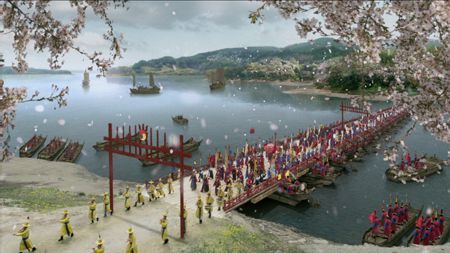
“Eight Days: The Two Faces of Feast” is a stereoscopic recreation of King Jeongjo’s famous eight-day parade from his palace to Suwon’s Hwaseong Fortress in 1759. / Courtesy of KBS Media
By Yun Suh-young
Three-dimensional (3D) filming techniques have been extensively used for action blockbusters and children’s animation, but rarely for historical documentaries.
"Eight Days: The Two Faces of Feast,’’ a stereoscopic recreation of a Joseon Kingdom (1392-1910) royal parade, is an intelligent and visually stunning work that justifies the technology in use.
The movie, which opens in Korean theaters on Thursday, is a remake of KBS television’s three-part series on King Jeongjo (1752-1800) and his famous eight-day parade from his palace to Suwon’s Hwaseong Fortress in 1759, which aired in October.
Choi Pil-gon, who directed both the TV program and movie, said he faced a dual challenge with the cinematic version ― compressing the content into 70 minutes, but leaving enough room for the modern audience to emotionally connect with an 18th-century king. He feels that he accomplished both with the rich expressions enabled through 3D technology.
"The three-part TV series combined for 150 minutes and was heavy with interviews from experts to provide an academically accurate description of a famous historical event,’’ Choi told reporters in a news conference in Seoul on Monday.
"The focus was slightly different with the film. We wanted to create a convincing idea of Jeongjo as a person and help moviegoers empathize with him. To achieve this, we had to imagine King Jeongjo’s emotions through the event and convey them effectively. This is where I believe 3D elements helped.’’
The film follows Jeongjo on his eight-day trip from Deoksu Palace to Hwaseong Fortress. The purpose of the journey was to visit the tomb of Crown Prince Sado, Jeongjo’s father, who was not given the opportunity to reign and was executed by starvation by King Yeongjo, Jeongjo’s grandfather.
Historians believe that Jeongjo’s trip to Hwaseong Fortress ― involving some 6,000 soldiers and royal servants and 1,400 horses ― was the largest and longest royal parade in Joseon history.
Choi said he first began preparing the TV series in 2011 when France agreed to return to Korea 297 Joseon-era royal books, called ``uigwe,’’ after 145 years. Jeongjo’s parade to Hwaseong Fortress is documented in one of the retrieved books, ``Wonhaeng Eulmyo Jeongri Uigwe.’’ It took two years for Choi’s team to complete the documentary.
The movie does an impressive job of reconstructing the parade described in old texts, capturing the grandeur of the event, but also details such as garments and food. The movie also explores how royal books were made during the Joseon era, which shaped how wood-block printing evolved.
The story where Jeongjo crosses the Han River to reach Suwon was recreated on land due to obstacles the production crew faced in reproducing the “ship bridge” on water. The ship bridge is a bridge consisting of 36 ships placed side by side to hold up plywood boards on which Jeongjo would use to cross the river. The production crew reproduced the bridge on land and then added special effects and 3D technology to recreate the setting for the story.
“It’s amazing and deeply moving to see the parade re-enacted on screen. As a person who majored in and teaches about Jeongjo, I feel like I have nothing more to explain in class,” said Kim Moon-sik, professor of history at Dankook University, who helped in the film production.
Actor Yeo Jin-goo, who narrated the story in the film, said he decided to participate in the production because the film would help students understand history better.
“I never thought a historical documentary could be fun, but the TV version I saw was really captivating. There was drama in the story, and I was so engaged in it that I thought other students would benefit from seeing the film,” he said.