Wine on the Web?
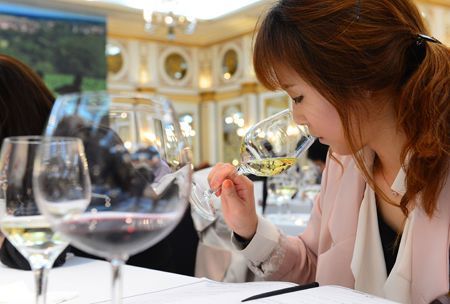
A contestant examines a white wine at the 12th annual Concours National du Meilleur Sommelier en Vins de France, a domestic contest of wine stewards sponsored by the French government, at the Imperial Palace Hotel in Seoul in March of last year. / Korea Times
Drinkers whine about prices, but online sales will not make bottles much cheaper
By Kim Tong-hyung
The government is revisiting a debate on whether to allow consumers to buy wine on the Internet as people continue to complain about high prices set by high street retailers.
The Fair Trade Commission (FTC), which backs the changes, says allowing online sales would trigger a price war between wine importers and ease the grumblings of the wine-drinking community.
However, the National Tax Service (NTS) is strongly opposed to the idea, raising concerns about the possibility, some say likelihood, of traders exploiting Internet transactions to evade taxes.
Health experts also claim that giving the green light for online sales is a dangerous path to go down when the country is already struggling to combat alcohol-related problems.
Once wine is sold online, it will become difficult to convince local beer brewers and manufacturers of ``soju,’’ Korea’s traditional distilled beverage, why they are being left out.
Including wine as part of electronic commerce is one of several options that the Park Geun-hye government is considering as it moves to reduce regulations in the alcoholic beverages market to boost consumption.
Starting this month, travelers have been able to order alcoholic beverages from the websites of airlines and receive such items on board aircraft.
``There is no doubt that disallowing wine to be sold online is an unnecessary regulation. The regulations should be eased,’’ FTC Chairman Noh Dae-lae told reporters last week.
Korea has long banned the Internet retail of alcoholic drinks. However, traditional products such as ``makgeolli’’ (rice wine) have been granted an exemption since 2010 in order to provide new income sources for struggling farming communities.
The FTC first pushed to extend the exemption to wine under the Lee Myung-bak government, which extensively used the anti-trust watchdog as a tool for combating inflation. But the NTS thwarted these efforts by arguing that online sales would foster unauthorized trade that is difficult to track and tax.
In renewing its calls, the FTC claims that the concerns raised by the NTS could be negated by strictly controlling the companies that are allowed to move wine online and requiring purchases to be made with credit cards.
Price not right?
While Korea’s presence as a wine producer is close to non-existent, the country is beginning to earn its stripes as a wine drinking nation. According to data from the Korea Customs Service, Korea’s wine imports increased for the third straight year in 2013 with 24,828 tons, about 3,000 tons more than 2012.
Korean wine drinkers have long complained they are paying too much for wine. The customs agency says the average consumer price of French wine is nearly five times higher per bottle than what importers paid. The price of Chilean wine was about six times higher than the import cost.
While the FTC and NTS seem destined for another round of circular debate, it is worth considering whether online sales of wine would have a noticeable influence on prices.
Many industry insiders believe it would not, pointing out that Korea’s high level of wine prices has more to do with heavy taxes than its retail structure.
Unlike Japan, which taxes alcoholic beverages according to volume consumed, Korea taxes drinks by price. Wine conventionally is significantly more expensive than beer and soju, so the 30 percent alcohol tax really widens the price differential. Then there is the 10 percent education tax and 10 percent value added tax, all before the middlemen and retailers add their margins.
Heavy taxes prevented the country's free trade agreements (FTAs) with major wine-making regions such as the Europe Union, the United States and Chile from making a meaningful difference on consumer prices. There is not much reason to think Internet sales would have more impact.
Another reason to be skeptical about the price impact of Internet sales is that importers will likely continue to rely on large discount chains and department stores for their main business.
Internet purchases only account for around 10 percent of wine sales in the United States. Industry people believe the proportion would be lower in Korea as wine has yet to reach national acceptance.
Thus, it is hard to imagine importers selling wine more cheaply online than the prices they provide to major retailers, who make up most of their business. They are likely to use their online stores to move less-popular wines or for special promotions, while continuing to provide their best-sellers to e-Marts and Lotte department stores.
``I think the NTS is over-stating the tax-related worries. Importers need licenses to operate and we are not at a point where we should be concerned about non-documented trading in the wine market,’’ said a wine import official from a major retailer, who did not want to be named.
``There is value in debating whether we should be allowing alcoholic drinks on electronic commerce, but I find the tax-related arguments to be ungrounded. This looks more like a power struggle between two government departments.’’
Even if the government eventually decides to allow wine sales, bargain hunters should not keep their hopes too high, he said.
``While they import a variety of wines, importers actually rely on one or two popular brands to maintain their business. Every company has what they consider as their work-horse brands, their own Montes Alpha. But they are also held back by large inventories of unsold bottles they scramble to move through discount sales. Online stores will provide them another way to reduce their inventory of unpopular products,’’ he said.