Director to speak at Oxford forum on 'music diplomacy'
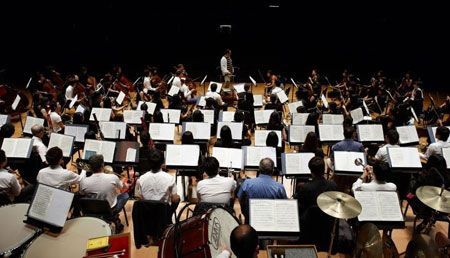
Young Korean musicians rehearse with internationally renowned musicians during the 2010 Lindenbaum Music Festival. / Courtesy of Lindenbaum Music Festival
Won Hyung-joon
By Kwon Mee-yoo
Won Hyung-joon, executive director of the Lindenbaum Music Festival, is spending restless nights preparing for his first ever speech at the Oxford Forum coming up in just a week.
"I haven't set up the time of my speech yet because I want both South Korean and North Korean ambassadors to attend the forum," Won said at an interview with The Korea Times.
The date was already postponed once from early February, but Won is still waiting for the response from the North Koreans. He thinks bringing ambassadors of both countries to the forum will take him a step closer to realizing his ambition to help ease political tension through music.
The Oxford Union is a debating society at Oxford University, known for its high-quality discussions covering wide topics. The list of notable speakers includes the Dalai Lama, Mother Theresa, former U.S. president Richard Nixon and Michael Jackson. Only two Koreans stood at the podium before Won, former Samsung Electronics President Hwang Chang-gyu and "Gangnam Style’’ rapper Psy.
“I am not a celebrity or a great person, but I am honored to be invited and will share my ideas of harmonizing through music,” he said.
The Oxford Union invited him with the goal of highlighting the contentious relationship between the two Koreas and the potential of diplomacy through music.
Won will speak on Feb. 27 at a forum titled "Communion between South & North Korean Young Musicians through Lindenbaum Orchestra Diplomacy." He is preparing for an orchestra featuring young musicians from both South and North Korea. The Lindenbaum Music Festival was established in 2009, driven by Won's ambition to promote harmony through music.
"It could be harmony between a maestro and a rookie or Asian and European. Then I thought why not the harmony of South and North Korea, since it is something only a private orchestra in Korea can do," Won said.
Won was once an aspiring violinist who studied at the Juilliard School, but was unable to continue his education after the foreign currency crisis swept Korea in the late 1990s and put his family in financial difficulty. A shoulder injury suffered while serving his compulsory military service added to his urgency to find a different path as a musician.
"My teacher David Kim, current concertmaster of The Philadelphia Orchestra, advised me to visit the Pacific Music Festival (PMF) established by Leonard Bernstein. The PMF aims to connect young musicians with world renowned masters and it inspired me to start Lindenbaum in Korea," he said.
Lindenbaum brought Swiss conductor Charles Dutoit and 13 concertmasters from notable orchestras to play with young Korean musicians in its successful performances in 2009 and 2010.
Won started drawing up a plan for a united orchestra of South and North musicians soon after the first Lindenbaum Music Festival in 2009. He studied previous examples of "orchestra diplomacy,’’ such as the Boston Symphony Orchestra’s tour of the Soviet Union in 1956, the Philadelphia Orchestra's visit to China in 1973 and most recently the New York Philharmonic's concert in Pyongyang in 2008.
Won’s interest in North Korea is partially rooted in family ties.
“My great grandfather came to South Korea after my great grandmother died in Gaesong, North Hwanghae Province. My grandfather always served an extra glass for his mother buried in Gaesong during ancestral rites and it was natural for me to long for peace between South and North Korea,’’ he said.
Won and his colleagues used every available means to get approval from both governments for the concert and Dutoit finally coaxed a "yes’’ out of the North Korean culture minister in 2011. However, it was postponed due to scheduling problems. The inter-Korean relations got worse after that time, but Lindenbaum continued efforts to host the orchestra at a third country Switzerland in 2012, but it was never realized. Despite the difficulties, Won is preparing for the South-North orchestra again this year, hopefully at Panmunjeom.
“There is no political intention behind this orchestra. I am a musician and this is my way of sparking communication and reconciliation between the two Koreas,” Won said.
Won’s dream of the shared orchestra between South and North Korea, conducted by Swiss master Dutoit, is quite detailed.
“One South Korean player will sit next to a North Korean player and they will share a music stand and sheets and play the same music. I think the orchestra will go smoothly as both South and North Korea have a respect for classical music,” he said. “When the young musicians from Seoul and Pyongyang listen to each other’s music and create a harmony based on consideration, I hope it could initiate the same for the two Koreas ultimately.”