From Buldak noodles to photo booths: North Korea copies South Korean trends
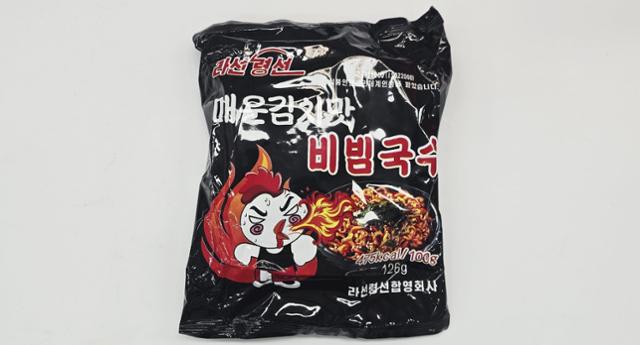
The packaging of North Korea’s Spicy Kimchi Bibim Noodles / Courtesy of Kang Dong-wan
Even as North Korea spent 2025 pushing a political strategy centered on ignoring South Korea, the country simultaneously copied South Korean products, designs and cultural content — from food packaging to football fan zones — revealing what analysts describe as a contradictory yet calculated pattern of imitation.
While Pyongyang continues to warn against the inflow of South Korean culture, it has selectively adopted popular elements and repurposed them as its own through what observers call “subjective adaptation.”
According to Kang Dong-wan, a professor at Dong-A University and head of the Busan Hana Center, North Korea’s tendency to “follow the South” became more blatant over the past year. One example is a noodle product whose packaging closely resembles Samyang Foods’ Buldak Ramen, complete with a similar black background and fiery chicken mascot. North Korea reportedly produced the imitation product, labeled “Spicy Kimchi Bibim Noodles,” and exported it to China in an apparent attempt to benefit from the global K-food boom.
An instant photo booth installed in Pyongyang / Courtesy of Kang Dong-wan
Photos provided by Kang also show a range of copycat goods produced by the Rason Yongson Joint Venture Company, including an instant noodle product made to look nearly identical to Samyang’s beef-flavored ramen and a soft drink called "Coca-Cola Carbonated Drink.” In Pyongyang, an instant photo booth modeled after the South Korean Life Four Cuts street photo booth has appeared under the name “Stylish Photographer,” reflecting the adoption of South Korean-inspired leisure trends.
North Koreans watch the FIFA U-17 Women’s World Cup final on large outdoor screens and televisions in Pyongyang as Korean Central Television airs the match. Captured from Korean Central Television
Similar scenes have appeared in photos carried by the Rodong Sinmun, the official newspaper of the ruling Workers’ Party of Korea. In June, images from the Wonsan-Kalma District showed a water park featuring slides resembling those commonly found in South Korea. In November, when North Korea won the FIFA Under-17 Women’s World Cup, authorities set up fan zone events in Pyongyang by broadcasting a recorded match and encouraging choreographed celebrations in public squares, including in front of Pyongyang Station. The practice mirrors South Korea’s fan zone culture, which became widespread following the 2002 Korea-Japan World Cup.
North Koreans watch the FIFA U-17 Women’s World Cup final on large outdoor screens and televisions in Pyongyang as Korean Central Television airs the match. Captured from Korean Central Television
Experts say North Korea’s behavior reflects an effort to ease cultural inferiority through imitation while maintaining an outwardly hostile stance toward the South. “The Kim Jong-un regime likely recognized limits in blocking outside culture, especially South Korean culture that shares the same language,” Kang said, adding that the leadership appears to be satisfying the desires of younger generations while raising the country’s cultural standards through controlled forms of adaptation.
North Korea’s Youth Education Guarantee Law, enacted in 2021, prohibits the import, production, copying, storage, distribution and viewing of “impure publications and propaganda materials.” However, as informal markets and the internet continue to expand, the law has reportedly had a limited impact in curbing exposure to outside influence.
Lim Eul-chul, a professor at the Institute for Far Eastern Studies at Kyungnam University, said North Korean authorities appear to feel a sense of weakness in the face of South Korea’s cultural and economic influence. “He likely perceived the dominance of South Korea’s economic and cultural power shaped by K-pop and K-food,” Lim said. “Providing cultural outlets for North Korean youth who are increasingly adept at accessing information is part of the process of trying to catch up with South Korean culture.”
This article from the Hankook Ilbo, the sister publication of The Korea Times, is translated by a generative AI system and edited by The Korea Times.