Korean War, USFK and The Korea Times
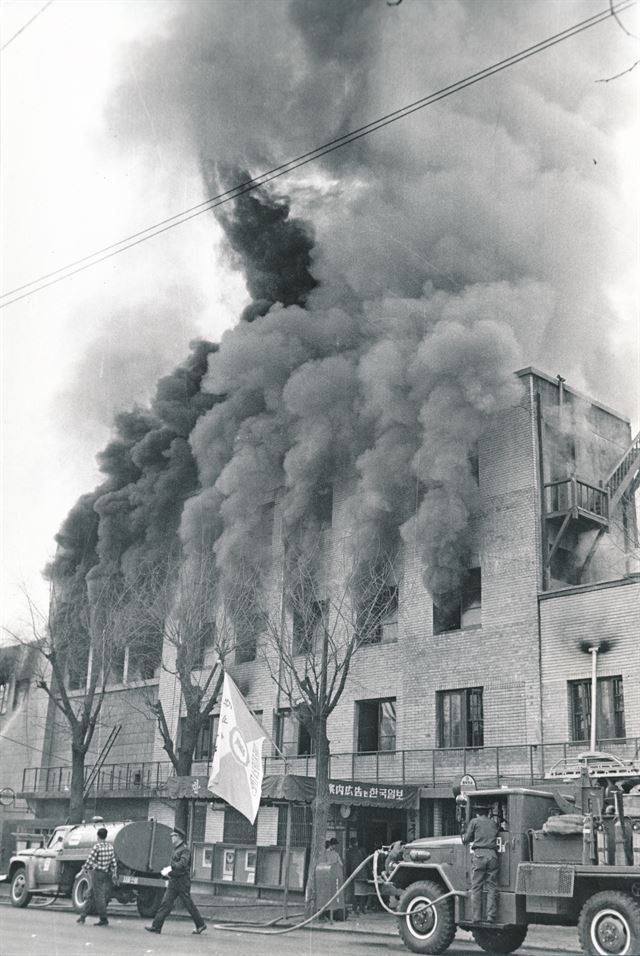
Smoke billows from the Hankook Ilbo newspaper building where The Korea Times and its sister papers were located, Feb. 27, 1968. Thousands of people sent letters of condolences to The Korea Times and its sister papers after the fire destroyed the building. Korea Times file
The following is a contribution by Kim Myong-sik, former managing editor of The Korea Times, on the relationship of the English media outlet and the United States Forces Korea, as this year marks the 70th anniversary of the alliance between South Korea and the United States. ― ED.
By Kim Myong-sik
The U.S. Army bus that carried international journalists covering the Military Armistice Commission (MAC) meeting between the U.N. Command (UNC) and North Korean officers at the Panmunjeom truce village unloaded us at Gwanghwamun intersection in the very center of Seoul, one afternoon in February 1968. Leaving the group, I walked up to The Korea Times' building a few blocks away to write a story of the day's debate in the MAC conference room exchanged by the two adversaries of the 1950-53 Korean War that had ended a decade and a half earlier.
As I approached the three-story building, shared by the five “sister papers” of the Hankook Ilbo newspaper group, I spotted smoke rising from the ground where my office had stood when I had left it early that morning. A fire that started from the underground printing shop had destroyed the whole structure, killing seven employees. There was little time to save machines or other equipment before the fire, helped by printing oil, quickly engulfed the structure. Luckily, a new office was being built at an adjoining site and the owner, Chang Key-young, decided that all five newspapers, including The Korea Times, should continue publishing despite the disaster.
My editor, as soon as he found me in the hapless crowd of reporters, told me to go immediately to the Eighth U.S. Army in Yongsan Garrison and borrow as many typewriters as possible from whoever was willing to help us. I and the driver of a 1-ton truck headed directly to the South Post, the residential area of the garrison, where I was met by a group of officers' wives who were already informed of the big fire at The Korea Times. Soon, the ladies brought nearly 30 typewriters, large and small, old and new, from their living quarters and loaded them in the truck. As I thanked them, they said they were just happy to help us and that they didn't need the machines returned.
So, we continued our work in a makeshift editorial room with the donated typewriters without missing a day's edition after the fire. We knew why the military wives were so willing: They, like their husbands, depended so much on the newspaper for their life in Korea and wanted to be able to read it the next morning. Perhaps they also were aware that the primary reason for the founding of The Korea Times during the early days of the Korean War was to help inform the U.S. military personnel of what was going on in the country they had come to defend ― on the frontline and elsewhere.
The inaugural edition of The Korea Times published on Nov. 1, 1950 when the nation was in the middle of the Korean War / Korea Times file
The inaugural edition of The Korea Times, issued on Nov. 1, 1950, barely a month after Seoul was recaptured from the North's Korean People's Army following the Inchon Landing directed by Gen. Douglas MacArthur, stated in its editorial: “Korea is not 'the Hermit Nation' anymore. She shed the coat of long dormancy, and, stepping out of her ancient shell has become a booming voice echoing all over the world … This is a really memorable new start for Korean people, and now is the opportune moment to build a free, democratic and unified Korea.”
The Korean Ministry of Information purchased thousands of copies from the company every day to distribute them among U.S. Army and Air Force personnel who were deployed here from Japan and the mainland. The Korea Times thus started as a government operation, but its reporters and editors, journalists as they were, did not always follow official instructions and occasionally carried articles critical of government policies. In 1953, the ministry turned the newspaper over to a young financier named Chang Key-young who was planning to establish a media company.
The government's free supply of the English-language newspaper was discontinued, but the U.S. Forces Korea (USFK) has been the major subscriber to the newspaper along with members of the various foreign aid agencies, diplomats, missionaries and English-learning and English-speaking Korean students. The Korea Times devoted a large portion of its space to coverage of the USFK, with much spotlight given to the activities of its commander, concurrently the UNC commander-in-chief, which had big military as well as political significance here.
The fire at my office building took place in a particularly eventful year in post-war history. On Jan. 23, 1968, the U.S. intelligence-gathering ship Pueblo with a crew of 83 was seized by the North Korean Navy off the port of Wonsan and teams of North Korean guerrillas appeared in Seoul and coastal areas throughout the year. There were many reinforcements of men and equipment from the U.S. and joint exercises were held with the South Korean forces in an effort to cope with the increased military threats from the North. The Pueblo crew were freed on Christmas Eve later that year but military tension continued on the Korean Peninsula while war was raging in Vietnam.
An employee works at the print shop of The Korea Times in 1968. Korea Times file
Once in the late 1960s, there was an episode of a copy of The Korea Times flying over the conference table during a MAC meeting. Maj. Gen. John Cicorella, a senior member of the UNC, read a Korea Times article introducing a graveyard for North Korean armed infiltrators killed in firefights south of the truce line in his harsh accusation of the communists' frequent violation of the Armistice Agreement, and handed the copy to his North Korean counterpart Maj. Gen Pak Chung Kuk across the table. Pak picked up the newspaper, tore it in half and threw it back to the UNC side. I watched the scene from outside the conference room through the window and had a weird feeling because I was the writer of the article.
As years went by, the size of the USFK has gradually been reduced to a single infantry division, a numbered Air Force command and support units with the total strength coming down to the present figure of 28,500 men and women. They consist of the Eighth U.S. Army of about 20,000 soldiers, the U.S. Naval Forces Korea headquartered in Busan with about 300 sailors, the U.S. Marine Corps Forces Korea with about 100 marines, the Special Operations Command Korea with about 100 operators and the Seventh Air Force operating with 8,000 airmen. The Yongsan headquarters of the USFK has recently completed being relocated to U.S. Army Garrison (USAG) Humphreys in Pyeongtaek, Gyeonggi Province, which is the new integrated compound housing most U.S. military forces in Korea now serving as the strategic mobile force under the U.S. Indo-Pacific Command and as a component of the Korea-U.S. Combined Forces Command (CFC).
Seven decades after the Korean War, in which 34,000 young American men were killed along with some 140,000 Korean soldiers, the military alliance between the two countries remains firm and strong while economic, diplomatic and cultural ties continue to grow across the Pacific Ocean. The Korea Times is doing its part to make closer the historical partnership that had begun in the heat of war some 70 years ago, providing those tens of thousands of men and women in uniform with as much information about their host country and its people as possible, thereby helping increase mutual understanding. While North Koreans call the USFK the tool and symbol of U.S. imperialism, most South Koreans consider it almost as an integral part of the republic with a deep appreciation for their presence. The Korea Times may attribute its birth to the war and the foreign forces' service here caused by the conflict, but the newspaper has grown over the past several decades into an indispensable medium for political, economic and cultural communication in the global community.
Kim Myong-sik is a former managing editor of The Korea Times.