Experts voice concerns over Yoon's US-centered foreign policy
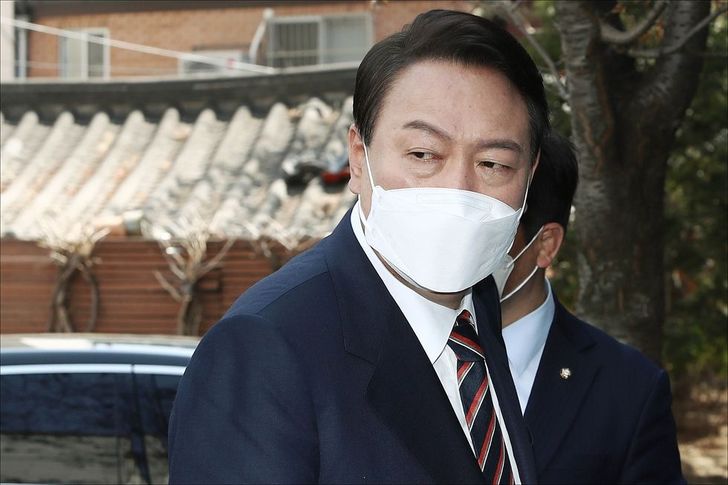
President-elect Yoon Suk-yeol enters his office in Tongui-dong, Jongno District, Seoul, Friday. Joint Press Corps
President-elect has yet to decide whether to send delegations to China, Japan
By Nam Hyun-woo
President-elect Yoon Suk-yeol has pursued a foreign policy stance of strengthening South Korea's relations with the United States, sending his delegation only to the U.S. so far, while Yoon himself visited U.S. Army Garrison Humphreys in Pyeongtaek city.
However, such a move is triggering concerns, as China is already expressing its displeasure over the strengthening of Seoul-Washington ties as the basis for South Korea's diplomatic strategy.
According to Yoon's aides, he has yet to decide whether to send delegations to China, Japan, the European Union (EU), or Russia. His predecessors, in contrast, sent diplomatic delegations to key diplomatic partners soon after being elected.
“The delegation for policy coordination to the U.S. will return home this weekend and there is no fixed schedule on sending delegations to other countries such as China, Japan, or the EU,” an aide said.
“It is true that the alliance between South Korea and the U.S. has become looser during the Moon Jae-in administration, and President-elect Yoon has been stressing the importance of the alliance throughout his campaign. That is why the delegation was sent to the U.S. first, and the rest will be determined depending on national interests.”
President Moon Jae-in, who was inaugurated without a transition period, sent his special envoys to the U.S., China, Japan, Russia and the EU months after he took the office. Moon's predecessor Park Geun-hye sent her delegations to the U.S. and China when she was president-elect, and Park's predecessor Lee Myung-bak also sent his delegations to the U.S., China, Japan and Russia.
Rep. Park Jin, the head of President-elect Yoon Suk-yeol's delegation to the U.S., left, poses with U.S. Rep. Gregory Meeks, chair of the House Foreign Affairs Committee, during their meeting in Washington, Wednesday (local time). Courtesy of presidential transition committee
On Thursday, President-elect Yoon visited U.S. Army Garrison Humphreys in Pyeongtaek city, Gyeonggi Province, and met with U.S. Forces Korea (USFK) Commander Gen. Paul LaCamera.
The event was unprecedented because the president-elect visited the USFK command center before visiting any other South Korean military base. Before Yoon, former President Kim Dae-jung was the only South Korean commander-in-chief who visited a USFK base as a president-elect, but he visited the base after inspecting a South Korean military base in Gyeonggi Province first.
Yoon's spokesperson, Rep. Bae Hyun-jin, said Friday, “The visit was to ensure the strong alliance between the two countries.” She added, “You should not find any special meaning about the order of visiting military bases.”
But the visit is widely interpreted as Yoon's intention to put the South Korea-U.S. alliance at the forefront of his diplomatic approach.
President-elect Yoon Suk-yeol gestures during his meeting with U.S. Forces Korea Commander Gen. Paul LaCamera at U.S. Army Garrison Humphreys in Pyeongtaek, Gyeonggi Province, Thursday. Courtesy of office of president-elect's spokesperson
However, experts said the move may have been “too conspicuous,” given South Korea's diplomatic environment of being intertwined in the U.S.-China rivalry and North Korea's escalating nuclear and missile threats.
“It is obvious fact that the South Korea-U.S. alliance is the main pillar of Seoul's diplomacy, national security and economic policies,” said Prof. Kim Heung-kyu, director of the U.S-China Policy Institute at Ajou University. “However, it is uncertain whether the Yoon administration is pursuing policies leaning toward the U.S. after considering the costs of such policies.”
The costs Kim is referring to are the possible strains in Seoul-Beijing relations, such as China's economic retaliation or tacit acceptance of North Korea's missile and nuclear capabilities. Seoul has suffered large-scale economic damage after it decided to deploy a U.S. Terminal High Altitude Area Defense (THAAD) battery on South Korean soil. But Yoon has pledged to deploy additional THAAD batteries as a deterrent against Pyongyang.
Regarding Yoon's promise, the Chinese Ambassador to Korea Xing Haiming said Thursday that the THAAD system “should be a taboo” in Seoul-Beijing relations, which was widely interpreted as a disapproval of Yoon's diplomatic approach of siding with the U.S. more visibly.
“It seems that Yoon is engaging with the U.S. without contingency plans for North Korea's nuclear and missile threats and the side effects of joining the U.S. bandwagon,” Kim said. “Regarding the Korean delegation to the U.S., Yoon has revealed his hand too quickly and even if he decides to send delegations to China, he needs to be more prudent about the consequences.”
Park Won-gon, a North Korea studies professor at Ewha Womans University, also said Yoon's recent moves are too conspicuous and urged the president-elect to find the right balance.
“It seems that Yoon is carrying out what he said during the presidential campaign ― rebuilding the South Korea-U.S. alliance,” Park said. “There is no doubt that we should have the alliance as the basis of our diplomacy, but it is also true that we cannot rule out China given the intertwined relationship with North Korea and other neighboring countries.”
Park said the Moon administration has faced diplomatic difficulties because it prioritized North Korea relations over all other issues and the incoming Yoon administration may find itself losing other diplomatic advantages as it is focused on improving relations with the U.S.
“The current situation forces South Korea to choose a side between the U.S. and China, but we also have to think about risks associated with uncertainty surrounding the U.S. side,” Park said.