Former Russian diplomats, Assembly speaker discuss North Korea issue
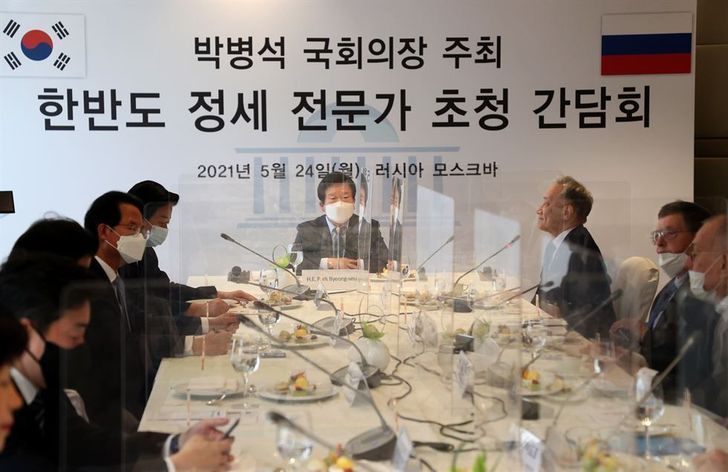
National Assembly Speaker Park Byeong-seung hosts a conference with former Russian diplomats on the security situation on the Korean Peninsula, at the Lotte Hotel Moscow, during his visit to the city to promote bilateral ties between Korea and Russia. Courtesy of office of National Assembly speaker
By Jung Da-min
Former Russian diplomats, including envoys posted to South and North Korea, anticipate the possibility of talks again taking place between Pyongyang and Washington, and advise that the issue of North Korea's denuclearization be resolved through the resumption of inter-Korean dialogue and multilateral cooperation similar to the six-party talks of the past.
Their comments were given during a meeting with National Assembly Speaker Park Byeong-seug, who is visiting Russia. Park hosted the conference with the ex-diplomats, Tuesday (local time), to discuss how to bring the North back to negotiations, and assess the results of last Friday's South Korea-U.S. summit.
Among the participants were Gleb Ivashentsov, a vice president of Moscow-based think tank the Russian International Affairs Council (RIAC); Oleg Davydov, a senior researcher at the Moscow-based Institute of World Economy and International Relations (IMEMO); Alexander Zhebin, director of the Center for Korean Studies (CKS) of the Institute of Far Eastern Studies (IFES) of the Russian Academy of Sciences in Moscow; and Evgeny Afanasiev, a former Russian ambassador to Seoul.
The Russian experts said the South Korea-U.S. summit has opened a new phase for easing tensions on the Korean Peninsula and resolving the North Korean nuclear issue. They also reaffirmed that Russia consistently supports the South Korean government's peace process and does not recognize North Korea as a nuclear power.
“The normalization of inter-Korean relations and the denuclearization of the Korean Peninsula are two wheels for the establishment of peace on the peninsula. The 2018 Panmunjeom Declaration by the Koreas showed that they can coexist peacefully without creating a war-like situation anymore,” said Ivashentsov.
Davydov said, “We can't take a step forward toward relieving tensions on the peninsula and restoring inter-Korean relations as long as the North Korean nuclear threat exists. There is no disagreement that the final goal of the South Korea-U.S. summit is the denuclearization of the Korean Peninsula. Russia is also in the same position in this regard. Russia does not recognize North Korea as a nuclear power.”
He also said, “Russia understands the peace process that South Korea is pursuing. I hope that a new chapter of cooperation will open where Russia, Korea and the United States can all participate.”
Park said he believes a comprehensive agreement and gradual developments would be a realistic solution to the issue, and now is the time for the North to respond and engage in dialogue.
“The statement on North Korea that came out from the South Korea-U.S. summit was the result of complete coordination between the two countries. ... I expect that President Biden will maintain this stance in the upcoming four years,” Park noted.
“It seems that the U.S. government understands that neither the Barack Obama administration's strategic patience nor the previous Donald Trump government's top-down collective settlement were successful. The current Biden administration is expected to take a third route.”
Park is on a nine-day trip to Russia and the Czech Republic that began last Saturday to promote South Korea's bilateral ties with each country.